Who's Afraid of AI Agents? After a String of Critical Vulnerabilities in 2026, Security Sandboxes Are Now Mandatory
📖 Glossary
AI Box (also known as Agent Computer / Agent PC), is a dedicated local hardware device that runs AI Agents. Pre-installed with an AI agent management system, plug-and-play, running 24/7. Users can remotely command AI to work via Discord, Slack, Telegram, WhatsApp, and more.
Abstract: In 2026, AI Agents were hit by a wave of critical vulnerabilities — including a CVSS 10.0 perfect score, command injection attacks, and chained privilege escalation that takes attackers from a malicious prompt all the way to a root shell on the host machine. As AI Agents transition from "playground experiments" to "production infrastructure," security sandboxes have shifted from a nice-to-have to an absolute prerequisite. This article catalogs the most severe Agent security incidents of 2026, dissects the technical trade-offs of five sandbox categories, and delivers actionable recommendations for teams deploying AI Agents in real-world environments.
Introduction: The Year the Sandbox Broke
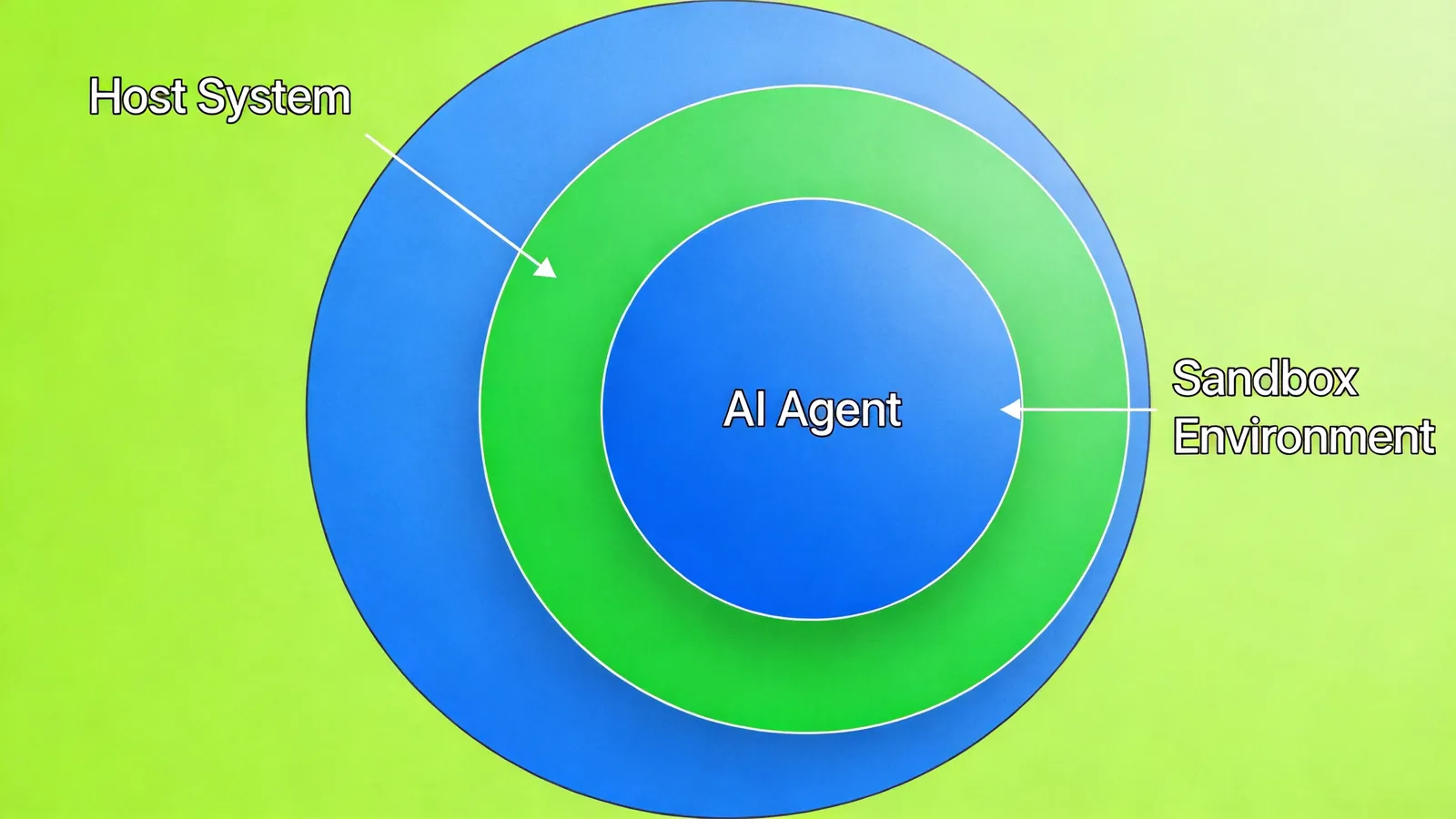
For years, the security model for AI Agents followed a simple premise: run untrusted code in a sandbox, and nothing bad can escape. The sandbox — whether implemented as a process boundary, a container, or a lightweight VM — was the conceptual wall between "what the Agent does" and "what the attacker can reach."
That premise cracked in 2026.
Between January and May, three major vulnerability disclosures and one coordinated attack campaign fundamentally challenged how the industry thinks about AI Agent isolation. A perfect-score vulnerability shattered the assumption that a well-designed sandbox equals a safe Agent. A command injection flaw demonstrated that even "benign-looking" prompts could weaponize an Agent's legitimate capabilities. And a multi-stage attack chain proved that compromising an Agent is not the end of an attack — it's the beginning.
The implications are serious: if your organization has deployed AI Agents for code generation, task automation, or system administration, you are running a security boundary that may be thinner than you think.
This article examines what happened, why it happened, and what the industry is building in response.
Section 1: CVE-2026-22686 — The Perfect Score
The most significant disclosure of 2026 — and arguably one of the most significant in the history of AI security — was CVE-2026-22686, affecting the enclave-vm JavaScript sandbox library.
What is enclave-vm?
enclave-vm is a JavaScript sandbox library built specifically for the Node.js ecosystem, targeting AI Agent use cases. Its primary purpose is to create a controlled execution environment for code generated by AI Agents. When a large language model writes a script to accomplish a task, enclave-vm is meant to run that script in isolation — preventing it from reading the host filesystem, making outbound network connections, or accessing environment variables that contain secrets.
The library achieved significant adoption throughout 2025 and early 2026, powering Agent runtimes in several commercial platforms. Its appeal was understandable: it provided strong-looking isolation with relatively low overhead, and it integrated naturally into the Node.js development ecosystem that many AI Agent frameworks were already built on.
The vulnerability: sandbox escape via prototype chain pollution
CVE-2026-22686 received a CVSS score of 10.0 — the maximum possible rating on the severity scale. This score reflects both the trivially low complexity of the attack and the catastrophic impact of a successful exploit.
The vulnerability resided in versions of enclave-vm prior to 2.7.0. Through a prototype chain pollution attack, a malicious Agent script could escape the sandbox boundary and execute arbitrary code on the host system with the same privileges as the sandbox process itself.
Prototype chain pollution is a well-understood class of JavaScript vulnerability, but its application to sandbox escaping in an AI Agent context had novel implications. Unlike a traditional web application where the attacker controls their own input, in an AI Agent scenario the "input" is code generated by a large language model — code that may have been influenced by a carefully crafted prompt injection attack.
The attack sequence, as demonstrated in the public proof-of-concept, unfolds as follows:
- An attacker embeds a malicious prompt injection in data processed by the AI Agent
- The LLM generates code that, when executed by the Agent, contains prototype pollution payloads
- The enclave-vm sandbox fails to sanitize these payloads before code execution
- The polluted prototype chain allows the code to access the sandbox's global scope — and from there, the host system
- The attacker achieves arbitrary code execution on the host
Once arbitrary code execution is achieved on the host, the attacker's capabilities expand dramatically:
Credential harvesting: Environment variables, .env files, SSH keys, API tokens stored in configuration files, and cloud service credentials become accessible. In containerized environments, the process typically runs with the container's service account, which often has significant permissions to internal services.
Reverse shell establishment: The attacker establishes an outbound connection from the compromised host to an attacker-controlled server, bypassing inbound firewall rules that typically protect servers. This reverse shell grants the attacker an interactive command-line session on the host from anywhere on the internet.
Lateral movement: With credentials in hand, the attacker can pivot to other systems within the network — databases, internal APIs, code repositories, and build systems. The compromised Agent host often has network connectivity to these systems as part of its legitimate function, making it an ideal launchpad for further attacks.
The critical insight: A sandbox that is designed to protect against untrusted code is fundamentally different from a sandbox that must also protect against a compromised LLM — one where the "source" of the code is itself influenced by adversarial inputs. CVE-2026-22686 exposed this gap with devastating clarity.
Industry response and patches
The enclave-vm maintainers released version 2.7.0 within 72 hours of the vulnerability being responsibly disclosed, patching the prototype chain pollution vectors with deep property freezing and context isolation techniques. However, the disclosure forced many organizations to reassess their dependency on the library and to consider alternative isolation architectures that don't rely on JavaScript runtime security guarantees.
Section 2: CVE-2026-2256 — Command Injection Through the Front Door
The second major vulnerability of 2026, CVE-2026-2256, affected ModelScope's MS-Agent framework and received a CVSS score of 9.8 — just shy of critical but severity-ranked as critical in most organizational risk frameworks.
The attack surface: AI Agents executing system commands
MS-Agent is designed to help users accomplish complex tasks by decomposing requests into a sequence of operations — some of which involve executing shell commands on the host system. This is a legitimate and powerful capability: an Agent that can write, test, and run code is far more useful than one limited to generating text.
The challenge, of course, is that executing shell commands means executing shell commands — and shell commands are the ultimate attack surface. Every shell command that an Agent is authorized to run is a potential vector for command injection.
How the vulnerability works
The MS-Agent framework included a function called check_safe() whose job was to inspect generated commands before execution and reject those that appeared dangerous. The function operated as a denylist — maintaining a list of known dangerous patterns and refusing to execute any command containing those patterns.
This denylist approach is fundamentally fragile, for reasons that security practitioners have understood for decades:
Incomplete coverage: A denylist can only block patterns that are already known. New bypass techniques — encoding tricks, character substitutions, indirect command invocation, environment variable expansion — are discovered continuously. The attacker needs to find one unblocked path; the defender must block every possible path.
Bypass complexity explosion: As more bypass techniques are discovered and added to the denylist, the list grows, becomes harder to maintain, and inevitably accumulates gaps. The public proof-of-concept for CVE-2026-2256 demonstrated that a carefully constructed prompt injection could bypass the denylist using a technique that combined command substitution through environment variables with base64 encoding — a combination that was not anticipated in the original filter logic.
Wrong security model: The denylist model assumes that "known bad" is a finite and manageable set. In the context of adversarial prompt injection — where an attacker can craft inputs specifically designed to manipulate the LLM's generation behavior — this assumption collapses. The attacker is not constrained by the denylist because they control the generation process itself, not just the final command.
The attack path, in simplified form:
- Attacker embeds a crafted prompt injection in user input, a document, or a webpage
- The LLM, influenced by the injection, generates a command string that includes malicious elements
check_safe()inspects the command, but the malicious elements slip past the denylist- The command executes with the Agent's system privileges
- The attacker achieves arbitrary command execution — often establishing a reverse shell or downloading additional payloads
The lesson: In the context of AI Agents that execute system commands, a denylist-based filter is security theater. The only robust approach is an allowlist model — where the Agent is explicitly permitted to execute only pre-approved commands, and no injection can introduce commands outside that set.
Section 3: ClawHavoc — Chained Exploitation in the Real World
If CVE-2026-22686 and CVE-2026-2256 demonstrated individual vulnerability classes, the ClawHavoc campaign — disclosed by Israeli cybersecurity firm Cyera on May 15, 2026 — demonstrated how these vulnerability classes combine into a real-world attack chain.
ClawHavoc involved four distinct vulnerabilities in the OpenClaw Agent platform, each of which was significant on its own. When chained together, they enabled an attacker to progress from initial compromise to persistent, undetected control over the affected system.
Vulnerability 1: Initial code execution through malicious plugin
The first stage of the attack exploited a vulnerability in OpenClaw's plugin loading mechanism. The platform supported dynamic plugin loading to extend Agent capabilities, but the signature verification for plugins was insufficiently rigorous. An attacker could craft a plugin that passed the signature check while containing malicious code that would execute once loaded.
This initial code execution ran within the Agent's sandboxed environment, but — as we learned from CVE-2026-22686 — sandboxed environments in AI Agent contexts cannot be fully trusted.
Vulnerability 2: Data exfiltration from the Agent workspace
Once code execution was achieved within the Agent environment, the attacker exploited a second vulnerability: the Agent workspace was not adequately isolated from the Agent's own execution context. The malicious code could read files that the Agent had legitimate access to — including cached API credentials, session tokens, and workspace data containing potentially sensitive information.
This stage demonstrated the cascading nature of Agent security failures: the Agent's legitimate access to files and services — access it needs to perform its job — becomes an attacker's toolkit once the Agent's execution environment is compromised.
Vulnerability 3: Privilege escalation through kernel interaction
The third vulnerability involved a flaw in the kernel-level interaction between the Agent sandbox and the host system. Through a TOCTOU (time-of-check to time-of-use) race condition in the sandbox's system call interception layer, the attacker could escalate from the sandboxed process to host-level privileges.
This was not a traditional kernel exploit — it was a logic flaw in the sandbox implementation itself. The security boundary that was supposed to protect the host from the Agent was also the mechanism through which the attacker achieved host-level control.
Vulnerability 4: Persistent control outside the sandbox
The final stage established persistent access that survived sandbox restarts and Agent process termination. The attacker modified system startup scripts, installed a lightweight backdoor, and established a command-and-control (C2) channel that would periodically beacon out to an attacker-controlled server.
At this point, the attack had achieved its goal: persistent, undetected access to the host system, disguised as legitimate Agent infrastructure.
Why ClawHavoc matters: Each individual vulnerability in the ClawHavoc chain might have been addressed through standard security practices — plugin signing, workspace isolation, sandbox hardening, startup script integrity monitoring. But the chain demonstrated that Agent security must be treated as a system, not a collection of independent controls. The interactions between components create attack paths that no single control addresses in isolation.
Section 4: The 2026 Sandbox Toolkit — What's New and What Works
The vulnerability wave of 2026 catalyzed a significant acceleration in AI Agent sandbox development. Several new tools and platforms emerged, alongside substantial improvements to existing solutions.
Agentjail: Open-source isolation for AI Agents
Agentjail is an open-source sandbox framework purpose-built for AI Agent runtime isolation. Its design philosophy is rooted in the principle of zero-trust execution: no code generated by an AI Agent is trusted by default, regardless of its apparent origin or the reputation of the LLM that generated it.
Key features include:
- Process-level isolation: Each Agent task runs in a dedicated process with minimal privileges
- Filesystem allowlisting: Only explicitly whitelisted paths and files are accessible to the Agent
- Network policy enforcement: Outbound connections are controlled through a configurable policy engine
- Capability dropping: Even the process's own capabilities are minimized — no ability to fork privileged processes, mount filesystems, or load kernel modules
Agentjail is notable for its transparency — the source code is publicly auditable, and its policy language is declarative and human-readable, making it accessible to organizations that want to understand exactly what their isolation guarantees are.
Armorer: Docker Agent control plane
Armorer takes a different approach, building on Docker as the underlying isolation substrate and focusing on the control plane — the policies, lifecycle management, and audit trails around Agent containers.
Rather than replacing Docker's isolation model, Armorer augments it with:
- Per-task container instantiation: Every Agent task launches in a fresh container, isolated from all other tasks. When a task completes, the container is destroyed.
- Fine-grained permission policies: Container capabilities, filesystem mounts, and network access are configured per-task, following the principle of least privilege at the task level, not just the environment level.
- Audit logging: Every operation performed by an Agent — file access, network connection, command execution — is logged in a tamper-evident audit trail.
- Policy version control: Security policies are stored in version-controlled repositories, enabling rollback and change management for security configurations.
Armorer is particularly well-suited for organizations that are already invested in Docker-based infrastructure and want to add Agent-specific security controls without migrating to a different isolation technology.
Tencent Cloud Cube Sandbox: Hardware-level isolation with ultra-low latency
One of the most significant releases of 2026 was Tencent Cloud's open-sourcing of the Cube Sandbox. Cube represents a novel approach to the isolation-versus-performance tradeoff: it delivers hardware-level isolation using micro-VM technology while achieving sub-100-millisecond startup times — a latency profile that is acceptable for interactive Agent use cases.
Traditional hardware virtualization (full VMs) provides the strongest isolation guarantees — each VM runs its own kernel, completely independent of the host and other VMs. However, VM startup times of several seconds make them impractical for Agent workloads that may involve many short-lived tasks.
Cube addresses this by using a lightweight micro-VM architecture inspired by the Firecracker project, optimized for cold-start latency. The result is a system where:
- Isolation is kernel-level: Each Agent task runs in a VM with its own kernel and device model. Container-escape vulnerabilities that rely on shared kernel state are not applicable.
- Startup time is under 100ms: Fast enough for interactive use cases, opening the door to per-task VM isolation rather than per-session or per-environment isolation.
- Resource efficiency is high: The micro-VM overhead is significantly lower than a full VM, making it economically viable for high-volume Agent deployments.
Cube's open-sourcing is significant because it makes hardware-level isolation accessible to organizations that cannot afford to run full VMs for every Agent task — while maintaining isolation guarantees that are meaningfully stronger than container-based approaches.
Claude Code's /sandbox command: Developer-friendly isolation
Anthropic's Claude Code introduced a /sandbox command that wraps sandboxing with a developer-friendly interface. Under the hood, it uses established OS-level sandboxing technologies:
- bubblewrap on Linux: A Linux namespace sandboxing tool that provides filesystem, network, and process isolation without requiring root privileges. bubblewrap is the technology behind Flatpak's sandboxing model.
- seatbelt on macOS: A macOS-specific sandboxing framework that enforces App Store-level sandboxing policies on arbitrary processes.
The /sandbox command allows developers to invoke sandboxed Agent execution with a simple flag, abstracting away the complexity of configuring bubblewrap or seatbelt policies directly. This democratization of sandboxing — making it accessible without deep system security expertise — is an important step toward wider adoption.
Section 5: Sandbox Architecture — Five Approaches Compared
The current landscape of AI Agent sandboxing can be organized into five architectural categories, each with distinct isolation characteristics, performance profiles, and operational requirements.
Category 1: Micro-Virtual Machines
Representative technologies: Firecracker, Cube, Kata Containers
Micro-VMs represent the strongest isolation tier. Each Agent task or session runs inside a lightweight virtual machine with its own kernel, completely independent of the host system's kernel and of other VMs. This eliminates entire classes of container-escape vulnerabilities — specifically those that rely on shared kernel state or kernel exploits.
Firecracker, developed by AWS and open-sourced in 2018, has become a foundational technology for serverless computing platforms. Its VMM (virtual machine monitor) is deliberately minimal — only the components required to run a Linux or Firecracker-void kernel. This minimization reduces the attack surface of the hypervisor itself.
Kata Containers takes a different approach, maintaining VM-level isolation while integrating with the container ecosystem. Kata Containers workloads are compatible with the OCI (Open Container Initiative) runtime specification, meaning they can be managed with standard container tools (Docker, Kubernetes) while running inside VMs. This makes Kata an attractive option for organizations that want VM-level security but cannot abandon their container management workflows.
Strengths: Strongest isolation guarantees. Complete kernel independence. Immune to container-escape vulnerabilities.
Weaknesses: Higher overhead than containers. Cold-start latency, though significantly improved in micro-VM variants. More complex operational footprint.
Best for: High-value Agent tasks where the cost of a compromise is severe. Compliance-sensitive environments. Scenarios where container-escape is a realistic threat model.
Category 2: WebAssembly Sandboxes
Representative technologies: Wasmtime, Wasmer, WasmEdge
WebAssembly (WASM) provides a sandbox at the module level — code runs in a virtualized execution environment with no direct access to system resources unless explicitly granted through a host API. Memory is bounds-checked, syscalls are mediated by the runtime, and the module cannot escape its sandbox without an explicit host-gated capability.
For AI Agent use cases, WASM sandboxes are particularly compelling for function-level isolation — running a single computation, a snippet of generated code, or a data transformation step in a fully controlled environment.
Wasmtime, the most mature WASM runtime, has seen growing adoption as a sandboxing layer for untrusted code. Its compilation pipeline (from WASM to native code) includes security-focused optimizations, and its capability-based security model means that even if the compiled code contains a memory safety vulnerability, the damage is contained within the WASM module's sandbox.
Strengths: Near-zero startup overhead (sub-millisecond). Fine-grained capability control. Language-agnostic — any language that compiles to WASM can run in the sandbox. Memory-safe by design.
Weaknesses: WASM's capability system requires explicit host API design — the sandbox is only as secure as the host interface. Not suitable for workloads that require full OS access (shell commands, filesystem traversal, etc.) without significant host-side engineering.
Best for: Compute-intensive but isolated subtasks. Function-level code execution. Environments where startup latency is the primary constraint.
Category 3: System Call Filtering (gVisor)
Representative technologies: gVisor (Google), Sysbox
gVisor implements a user-space kernel — a reimplementation of the Linux kernel surface that intercepts and validates system calls before forwarding them to the host kernel. This creates a kernel-independent security boundary without the overhead of hardware virtualization.
The gVisor approach significantly reduces the kernel attack surface available to a compromised process. Rather than exposing the full Linux kernel syscall interface (over 400 syscalls), gVisor implements a curated subset of approximately 200 syscalls, validated and sanitized before use.
Strengths: Strong isolation without VM overhead. Lower latency than micro-VMs. Compatible with standard container tooling. Active development by Google.
Weaknesses: Not as strong as micro-VM isolation — the host kernel is still involved, and gVisor's Sentry process is a potential attack surface. Some workloads require syscalls that gVisor doesn't support, limiting compatibility.
Best for: General-purpose Agent workloads in Linux environments where VM overhead is unacceptable but container-level isolation is insufficient.
Category 4: Docker Hardening with Seccomp and AppArmor
Representative technologies: Docker + seccomp profiles, Armorer
Container-based isolation with OS-level security加固 — seccomp profiles restrict the syscalls available to a container, AppArmor or SELinux profiles enforce Mandatory Access Control on filesystem and network access, and capabilities are dropped to minimize privilege.
This approach is the most operationally mature and widely deployed, particularly in Kubernetes environments where containers are the standard deployment unit. Armorer builds on this foundation, adding per-task container instantiation, fine-grained policy management, and audit trails.
Strengths: Broad ecosystem support. Low overhead. Familiar operational model for teams already running containerized workloads. Excellent tooling and observability.
Weaknesses: Shares the host kernel, making kernel-level exploits a theoretical concern. The attack surface is larger than micro-VM or WASM approaches. Requires careful policy configuration to achieve meaningful isolation — defaults are often too permissive.
Best for: Rapid prototyping and lower-stakes Agent deployments. Organizations with existing container infrastructure. Scenarios where operational familiarity outweighs maximum isolation.
Category 5: Language-Level Sandboxing
Representative technologies: enclave-vm, Deno security model, Web Workers
Language-level sandboxing operates within a single process or runtime, using the language's own security features to restrict what untrusted code can do. Examples include JavaScript's proposed ArrayBuffer transfer semantics, Python's multiprocessing with restricted environments, and Node.js's experimental permission model.
This approach offers the lowest overhead and the tightest integration with the language runtime, but its isolation guarantees are bounded by the language's own security model — which, as CVE-2026-22686 demonstrated, may contain vulnerabilities.
Strengths: Minimal overhead. Tight integration with the language runtime. Good developer experience.
Weaknesses: Isolation guarantees depend entirely on the language runtime's correctness. Vulnerabilities in the runtime (as seen in CVE-2026-22686) can compromise the entire sandbox. Not suitable for high-security environments.
Best for: Low-risk Agent tasks where isolation is a convenience rather than a security requirement. Development and testing environments.
Section 6: The Non-Negotiable Baseline — Filesystem + Network Isolation
Across all sandbox categories, one principle stands out as non-negotiable: filesystem isolation and network isolation must be deployed together.
This is not an opinion — it is derived from the attack chains observed in 2026.
Consider: if a sandbox provides filesystem isolation but no network isolation, an attacker who escapes the sandbox (or compromises the Agent inside it) can exfiltrate data over the network. API keys, database credentials, user data — none of it is protected by filesystem restrictions if the attacker can simply send it to an external server.
Conversely: if a sandbox provides network isolation but no filesystem isolation, an attacker can read sensitive files from the host filesystem — configuration files containing credentials, SSH keys, TLS certificates, internal data — even if they cannot send that data anywhere.
Both controls are necessary. Neither is sufficient alone. This is the baseline.
Filesystem isolation: Beyond simple chroot
Effective filesystem isolation goes beyond restricting which directories a process can access. It requires:
- Allowlisting, not denylisting: Explicitly enumerate which paths and files are accessible. A denylist approach will always have gaps — particularly against adversarial inputs that generate creative file access patterns.
- Read-only mounts by default: Grant write access only to explicitly designated temporary directories. Never allow write access to system paths, configuration directories, or credential stores.
- Tmpfs for temporary data: Use in-memory filesystems for Agent-generated temporary files. This prevents the accumulation of potentially malicious files on persistent storage and ensures that no artifact of Agent execution survives after the sandbox is destroyed.
- Separate mount namespaces: Each Agent task should have its own mount namespace, preventing any visibility into or interference with other tasks' filesystems.
Network isolation: The egress problem
Network isolation for AI Agents is a nuanced problem. Many Agent tasks legitimately need network access — to fetch data, call APIs, or interact with external services. The goal is not to block all network access, but to enforce the principle of least privilege on network egress.
Key controls:
- Egress allowlisting: Specify which destinations an Agent task is permitted to connect to. Whitelist domains, IP ranges, and ports. Block everything else by default.
- DNS filtering: Prevent resolution of unauthorized domains. A common bypass technique is DNS rebinding — an attacker can sometimes trick a service into resolving a blocked domain through a controlled DNS response.
- Outbound connection logging: Log every outbound connection attempt, successful or blocked. This serves both as a security control (detecting unexpected data exfiltration) and as an audit trail for investigating incidents.
- No inbound listeners: The sandbox should not accept inbound connections. All communication is outbound — initiated by the Agent task to external services.
Section 7: Beyond Sandboxing — The Defense-in-Depth View
Sandboxing is a critical layer, but it is not sufficient on its own. The incidents of 2026 demonstrated that attackers can chain multiple vulnerabilities — using sandbox escapes, privilege escalation, and persistence mechanisms to defeat even well-designed isolation layers.
A mature AI Agent security posture requires defense in depth — multiple independent controls that an attacker must defeat in sequence.
Layer 1: Input sanitization and prompt filtering
The first line of defense is at the input boundary. Prompt injection attacks — where malicious instructions are embedded in data processed by the Agent — are the entry point for many of 2026's most severe incidents.
Effective input controls include:
- Structured input validation: Reject or sanitize inputs that contain patterns associated with prompt injection (unusual instruction prefixes, encoded content, unexpected formatting)
- Context separation: Maintain strict separation between untrusted external data and system prompts/instructions. Never allow external data to influence the Agent's system-level behavior without explicit sanitization.
- Rate limiting and anomaly detection: Detect and flag unusual patterns of input — an unusually high volume of requests, inputs with suspicious structural characteristics, or behavior that deviates from the Agent's typical operational patterns
Layer 2: Least-privilege execution (the sandbox itself)
This is the sandboxing layer discussed extensively above. Key principles:
- Task-level isolation: Each discrete Agent task runs in its own sandbox instance. Never share a sandbox between tasks.
- Privilege minimization: Drop all capabilities not explicitly required for the task. If the Agent doesn't need to make outbound network connections, block all network access.
- Time-boxing: Limit the duration of each sandboxed execution. Long-running Agent tasks increase the window for attack and complicate incident investigation.
- Destruction on completion: Sandboxes should be created fresh for each task and destroyed when the task completes. Persistent sandbox instances accumulate state and increase attack surface over time.
Layer 3: Runtime monitoring and anomaly detection
Even with strong isolation, monitoring is essential. Not every attack will be prevented — the goal is also to detect attacks quickly enough to limit damage.
Key monitoring capabilities:
- System call tracing: Monitor the syscalls made by sandboxed processes. Unexpected syscalls — particularly those associated with privilege escalation, credential access, or network activity — should trigger alerts.
- Filesystem activity monitoring: Detect unexpected file access patterns — particularly read access to sensitive paths or write access outside designated temporary directories.
- Network flow logging: Log all outbound connections from Agent environments. Correlate with known-good destinations to detect unexpected data exfiltration attempts.
- Behavioral baselining: Establish normal behavioral baselines for Agent tasks. Deviations — unusual resource consumption, unexpected child process spawning, anomalous timing patterns — can indicate compromise.
Layer 4: Incident response and recovery
When prevention and detection fail, the response must be fast and effective:
- Automated containment: Upon detecting an anomalous event, automatically isolate the affected Agent instance — terminate its sandbox, revoke its credentials, and block its network access.
- Forensic logging: Maintain detailed logs of Agent activity — inputs received, decisions made, actions taken, network connections established. These logs are essential for understanding the scope and impact of a breach.
- Credential rotation: If an Agent's credentials may have been compromised, rotate them immediately. This includes API keys, database passwords, tokens, and any secrets that the Agent had access to.
- Post-incident review: After any significant security event, conduct a structured review of the attack chain. Identify which controls failed, which succeeded, and what improvements are needed.
Section 8: Hardware-Level Isolation — The KaiheAiBox Advantage
For organizations seeking a foundation that makes strong isolation easier to achieve, purpose-built AI Agent hardware offers meaningful advantages. The KaiheAiBox represents this category — an Agent Computer designed specifically for 24/7 autonomous operation.
The physical isolation that a dedicated Agent Computer provides is not a substitute for sandboxing within the software stack — but it is a powerful complement. Consider the attack surface reduction:
- Separation from development workstations: The Agent runs on a dedicated device, completely isolated from the developer's primary machine. Even a successful compromise of the Agent cannot directly access the developer's code, credentials, or internal systems.
- Network segmentation: The KaiheAiBox can enforce network segmentation at the hardware level — the Agent's network traffic flows through a separate interface or VLAN, preventing lateral movement to critical infrastructure even if software-level controls fail.
- ARM architecture advantages: The ARM architecture's simplicity relative to x86 reduces the kernel attack surface and simplifies the security configuration. Without a discrete graphics card and its associated driver complexity, the attack surface is further reduced.
- Controlled updates: Firmware and system software on a dedicated Agent Computer can be managed through a controlled update pipeline, reducing the risk of supply chain compromises affecting the Agent infrastructure.
This hardware-level separation does not replace software sandboxing — it complements it. Even the most robust software sandbox operates within the context of the host system's kernel and network stack. A dedicated Agent Computer creates an additional boundary that limits the blast radius of any compromise that does occur.
Conclusion: From "Should We?" to "How Should We?"
The security incidents of 2026 have settled a debate that should never have been a debate: AI Agents need security isolation. Not because the technology is inherently unsafe, but because any system that executes code — whether that code is written by a human developer or generated by a large language model — must be contained within defined security boundaries.
The question is no longer "should we use sandboxes for AI Agents?" The question is "which sandbox architecture is appropriate for our use case, and how do we configure it correctly?"
The answer depends on your risk model, your operational constraints, and the value of what your Agents can access. But across all scenarios, the following principles are universal:
- Filesystem and network isolation are non-negotiable baselines — deploy them together, always.
- Allowlisting beats denylisting — permit only what is necessary, block everything else.
- Task-level isolation — each Agent task deserves its own sandbox, created fresh and destroyed on completion.
- Defense in depth — sandboxing is one layer, not the only layer.
- Assume compromise — design your system as if the sandbox may be breached, and limit the damage accordingly.
The vulnerabilities of 2026 were severe. But they also catalyzed a wave of innovation in Agent isolation technology that has made secure Agent deployment more achievable than ever before. The tools exist. The architectures are well-understood. The remaining challenge is execution — implementing these controls correctly, maintaining them vigilantly, and treating Agent security as the engineering priority it deserves to be.
The Agents are coming. Make sure your sandboxes are ready.
KaiheAiBox | Smart Agent Computers That Run 24/7 — For Users Who Don't Want to Be System Administrators · AI Agent Tracker