Stronger AI, Pricier Phones: The Chip Price Hike Truth You Need to Know
📖 Glossary
AI Box (also known as Agent Computer / Agent PC), is a dedicated local hardware device that runs AI Agents. Pre-installed with an AI agent management system, plug-and-play, running 24/7. Users can remotely command AI to work via Discord, Slack, Telegram, WhatsApp, and more.
Summary: The relentless march of on-device AI is driving smartphone chip prices to unprecedented levels. Qualcomm's Snapdragon 8 Gen 4 costs over 30% more than its predecessor, MediaTek's Dimensity 9400 is following suit, and the root causes — 3nm wafer cost explosion, ballooning NPU silicon area, and memory bandwidth demands — are structural, not cyclical. This article dissects the three forces behind the price surge, examines how phone makers are responding (flagship price hikes, mid-range AI feature cuts, and a pivot toward cloud AI), and proposes an alternative architecture where Agent Computers handle the scheduling and orchestration while phones stay lean.
The Price Tag That Made Headlines
In late 2024, a leak from Qualcomm's supply chain sent shockwaves through the smartphone industry: the Snapdragon 8 Gen 4 — the chip destined to power 2025's flagship Android phones — would cost significantly more than the already-expensive Snapdragon 8 Gen 3. Initial estimates put the increase at 25–30%. By early 2025, as TSMC's 3nm production lines ramped and real silicon reached phone makers, the number settled closer to 30–35%. For context, the Snapdragon 8 Gen 3 was already estimated at around $200 per unit. Add 30%, and you're staring at a $260–$270 system-on-chip — a figure that, in isolation, costs more than some entire mid-range phones.
MediaTek's Dimensity 9400, positioned as the value-conscious alternative, wasn't far behind. Industry sources indicated a 20–25% price increase over the Dimensity 9300, eroding the traditional price advantage MediaTek held over Qualcomm. The message was unmistakable: AI capability is expensive, and no chipmaker is immune.
But why? What exactly is driving these increases, and more importantly — are they temporary bumps or the new normal? To answer that, we need to look under the hood at three structural forces that are reshaping the economics of smartphone silicon.
Driver 1: The 3nm Process Cost Explosion
The Wafer Price Nobody Wants to Talk About
The single largest contributor to the chip price surge is the cost of manufacturing itself. TSMC's N3 (3-nanometer) process — the node that both the Snapdragon 8 Gen 4 and Dimensity 9400 rely on — charges roughly $20,000 per wafer, according to multiple industry reports. That's roughly double the $10,000–$12,000 per wafer that TSMC's N5 (5nm) process commanded when it was the bleeding edge.
Let that sink in. The per-wafer cost has doubled in a single process generation transition.
To understand why, consider what "3nm" actually means in practice. While the naming convention no longer reflects literal gate lengths (a 3nm transistor's gate is not actually 3 nanometers wide), it signals a generation of manufacturing technology that packs more transistors per square millimeter than ever before. TSMC's N3E node — the refined, high-yield version of 3nm that most chipmakers are using — offers roughly 280–300 million transistors per square millimeter, compared to about 170 million on N5.
Why Does Smaller Cost More?
The economics are counterintuitive to most consumers. Smaller transistors should mean more chips per wafer, which should mean lower per-chip costs, right? In theory, yes. In practice, several forces work against this:
1. EUV Complexity and Multi-Patterning
At 3nm, extreme ultraviolet (EUV) lithography is no longer optional — it's the only game in town. TSMC uses EUV for virtually every critical layer at N3, and some layers require double or even triple patterning. Each EUV exposure requires an expensive EUV scanner (ASML's machines cost upwards of $300 million each), and the photoresists, masks, and process chemicals are all significantly more expensive than their DUV (deep ultraviolet) predecessors.
2. Yield Learning Curve
Every new process node starts with terrible yields. Early N3 wafers produced usable chips at rates well below 50%. Even with N3E's improved yields (reportedly 70–80% for mature designs), the effective cost per good die remains high. A wafer with 70% yield costs 43% more per good chip than a wafer with 100% yield — and no process node ever reaches 100%.
3. Design Rule Restrictions
N3's design rules are far more restrictive than N5's. Certain routing patterns are forbidden. Standard cell heights have changed. The layout density rules are tighter. All of this means that chip designers can't simply shrink an N5 design and call it N3 — they need to redesign significant portions of the chip, adding non-recurring engineering (NRE) costs that get amortized into per-unit pricing.
4. TSMC's Pricing Power
Let's not ignore the market structure. TSMC manufactures virtually all of the world's leading-edge smartphone chips (Qualcomm, MediaTek, Apple, Google Tensor). This near-monopoly gives TSMC enormous pricing power. When Apple, Qualcomm, and MediaTek are all competing for N3 capacity, TSMC can — and does — charge premium prices. The $20,000 per wafer figure isn't just reflecting costs; it's reflecting what the market will bear.
The Ripple Effect
The wafer cost doubling doesn't translate linearly to a doubling of chip price, because wafer cost is only one component. But it's the dominant component. For a flagship SoC that sells for $200–$270, the wafer cost per good die might be $60–$80. When that figure doubles, the chip price needs to rise by $40–$60 just to maintain the same margin — and that's before accounting for the other two drivers we'll discuss next.
"The cost of a leading-edge wafer has been rising faster than Moore's Law has been shrinking transistors. At some point, the economics break." — A senior semiconductor analyst at a Tier-1 investment bank, speaking on condition of anonymity.
Driver 2: NPU Area Expansion — The AI Tax on Silicon
From "Nice-to-Have" to "Must-Have"
Two years ago, an NPU (Neural Processing Unit) on a smartphone chip was a checkbox feature — something that enabled background blur in video calls and powered a few computational photography features. The NPU on the Snapdragon 8 Gen 2 occupied roughly 5–7% of the SoC's total die area.
Today, the NPU is the star of the show. Qualcomm's Hexagon NPU on the Snapdragon 8 Gen 4 reportedly delivers 45+ TOPS (trillions of operations per second) of INT8 performance, up from about 15 TOPS on the Snapdragon 8 Gen 2. That's a 3x performance increase in two generations, and it comes with a commensurate increase in silicon real estate.
Current estimates put the NPU area on flagship 2025 SoCs at 15–20% of total die area — triple what it was just two generations ago. And the die itself is already larger because of the 3nm density enabling more functionality.
Why NPUs Keep Growing
The demand for on-device AI inference is insatiable. Here's what's driving NPU area expansion:
1. Large Language Model Inference
Running a 7B-parameter language model locally (think Llama 2 7B, Mistral 7B, or their successors) requires substantial compute. Even with 4-bit quantization, the model needs 3.5–4 GB of memory and sustained matrix multiplication throughput that would overwhelm a GPU alone. The NPU's specialized architecture — optimized for low-precision, high-throughput matrix math — is essential for running these models at interactive speeds.
But running a 7B model is just the baseline. The industry is already targeting 13B and even 30B models for on-device inference, which means NPUs need to scale further. Each doubling of model parameters roughly doubles the compute requirement, and the NPU area scales roughly linearly with compute throughput.
2. Multi-Modal Processing
It's no longer just text. Flagship phones now run on-device image generation (think Samsung's Sketch to Image, Apple's Image Playground), real-time video enhancement, and audio processing. Each modality adds compute requirements that compete for NPU cycles. Multi-modal models — which process text, images, and audio simultaneously — are even more demanding.
3. Always-On AI Features
"Hey Siri" and "OK Google" were just the beginning. Modern always-on AI features include real-time translation during phone calls, continuous health monitoring through sensor data, and predictive UI that anticipates your next action. These features require the NPU to be active for extended periods, which means it needs to be both powerful and power-efficient — a combination that requires more silicon area, not less.
The Silicon Budget Problem
Every square millimeter of NPU area is a square millimeter not available for CPU cores, GPU shaders, or ISP (Image Signal Processor) blocks. In a world where the total die size is constrained by cost and power, the NPU's expansion comes at the expense of other components — or it forces the die to grow, which increases cost proportionally.
Chip designers are caught in a bind. They can't shrink the CPU or GPU without sacrificing traditional performance benchmarks that consumers still care about (Geekbench scores, gaming frame rates). They can't ignore the NPU without falling behind in the AI race. So they grow the die, eat the cost, and pass it on.
The NPU area expansion alone accounts for an estimated 10–15% of the SoC price increase from generation to generation. It's not the biggest factor (that's the process node), but it's the most visible symbol of the AI tax on smartphone silicon.
"Every generation, we're asked to double the NPU. At some point, we're building an AI accelerator that happens to have a phone attached." — A Qualcomm engineer, speaking informally at a developer conference.
Driver 3: Memory Bandwidth Demands — The Hidden Cost Accelerator
Why AI Starves for Bandwidth
While the NPU grabs headlines, memory bandwidth is the silent killer of smartphone BOM (bill of materials) costs. AI inference, particularly for large language models, is fundamentally memory-bound. The NPU can compute matrix multiplications far faster than the memory subsystem can feed it data.
To understand why, consider the mechanics of LLM inference. When you generate text from a language model, each output token requires reading the entire model's weights from memory. For a 7B-parameter model in 4-bit precision, that's roughly 3.5 GB of data per token. At a generation speed of 20 tokens per second, you need 70 GB/s of memory bandwidth just for the model weights — before accounting for KV cache, activations, or any other data.
Now consider that a typical LPDDR5X memory subsystem in a 2024 flagship phone provides 60–70 GB/s of bandwidth. It's barely enough for a 7B model, and completely insufficient for anything larger.
LPDDR5X to LPDDR6: The Bandwidth Leap and Its Price
The industry's answer is LPDDR6, the next generation of low-power DRAM for mobile devices. Expected to debut in 2025–2026 flagship phones, LPDDR6 promises:
- Data rates up to 12.8 Gbps per pin (vs. LPDDR5X's 9.6 Gbps), a 33% increase
- Total system bandwidth of 100+ GB/s in typical flagship configurations
- Improved energy efficiency per bit transferred, though total power consumption may still rise due to higher data rates
The problem? LPDDR6 isn't just faster — it's more expensive. Early pricing estimates suggest a 20–30% premium over LPDDR5X at equivalent capacities. This comes from several factors:
1. New Signaling Technology
LPDDR6 is expected to adopt PAM3 (Pulse Amplitude Modulation 3-level) signaling, a departure from the NRZ (Non-Return-to-Zero, 2-level) signaling used in LPDDR5X. PAM3 transmits 1.5 bits per symbol instead of 1, enabling higher data rates without proportionally increasing clock frequency. But PAM3 requires more sophisticated transmitters and receivers, which increases the cost of both the memory controller (on the SoC) and the DRAM die itself.
2. Tighter Timing Margins
Higher data rates mean tighter timing margins, which means more careful PCB layout, better signal integrity, and more expensive manufacturing tolerances. The phone's motherboard doesn't get cheaper when you switch to faster memory.
3. Capacity Pressures
AI models aren't just bandwidth-hungry — they're capacity-hungry. A phone that wants to run a 7B model locally needs at least 8 GB of RAM (preferably 12–16 GB) just for the model and OS. With LPDDR6, the cost per gigabyte is higher, and the total capacity required is larger. It's a double hit.
The Memory Cost Multiplier
On a typical flagship phone BOM, memory accounts for 15–20% of total component cost. A 30% increase in memory cost translates to a 4.5–6% increase in total BOM cost — not trivial in an industry where margins are already thin.
But the real impact is in the interaction with the other two drivers. A bigger NPU needs more bandwidth. A faster process node enables more transistors, which means more NPU, which needs even more bandwidth. The three drivers form a positive feedback loop that amplifies cost increases at every level.
| Component | Gen 3 (2023) | Gen 4 (2025) | Cost Impact |
|---|---|---|---|
| Process Node | 4nm (N4) | 3nm (N3E) | ~2x wafer cost |
| NPU Performance | ~15 TOPS | ~45 TOPS | 3x compute, ~3x area |
| Memory Standard | LPDDR5X | LPDDR6 | 20–30% premium |
| Typical RAM | 8–12 GB | 12–16 GB | More capacity at higher $/GB |
How Phone Makers Are Responding
The chip price surge is not an abstract concern — it's hitting phone makers where it hurts: their margins and their product strategies. Here's how the industry is adapting.
Response 1: Flagship Price Hikes
The most visible response is the one consumers feel directly: flagship phone prices are going up.
Samsung's Galaxy S25 Ultra launched at a starting price $100 higher than its predecessor in several markets. Xiaomi's 15 Ultra followed a similar pattern. In China, where price competition is fierce, multiple brands quietly raised the prices of their Snapdragon 8 Gen 4-powered flagships by 200–400 RMB ($28–$56) compared to the previous generation.
These aren't arbitrary price increases. They reflect genuine BOM cost pressures. When the SoC alone costs $60 more per unit, memory costs $15–$20 more, and the associated power delivery and thermal management components (bigger vapor chambers, more sophisticated power ICs) add another $10–$15, the total BOM increase can easily reach $100–$120 per unit. At typical smartphone margins of 10–15%, a $100 BOM increase requires a $130–$150 price increase just to maintain the same absolute margin.
The result: the $999 flagship is becoming the $1,099 flagship, and the $1,099 flagship is becoming the $1,199 flagship. Premium phones are drifting into luxury pricing territory.
Response 2: Mid-Range AI Feature Cuts
Not every phone can be a flagship, and not every consumer will pay $1,000+ for a phone. But the chip cost surge is forcing an uncomfortable decision in the mid-range: which features to cut.
The answer, increasingly, is AI. Mid-range phones powered by chips like the Snapdragon 7 Gen 3 or MediaTek Dimensity 8300 get smaller NPUs, less memory bandwidth, and less RAM than their flagship siblings. This means:
- No on-device LLM inference — Mid-range phones must rely on cloud APIs for language model features like smart replies, summarization, and translation.
- Limited on-device image generation — The NPU simply can't handle it at usable speeds.
- Reduced computational photography — While basic AI-enhanced camera features remain, the most advanced ones (like Samsung's ProVisual Engine or Google's Magic Eraser with full on-device processing) are flagship exclusives.
This creates a two-tier AI experience: flagship users get responsive, private, always-available AI; mid-range users get cloud-dependent AI that requires internet connectivity, has higher latency, and raises privacy concerns.
The irony is that mid-range phones represent the vast majority of the market. In 2024, phones priced below $500 accounted for over 70% of global smartphone shipments. If AI features are limited to the top 30% of devices by price, the "AI phone" revolution risks becoming a premium niche rather than a mass-market transformation.
Response 3: Cloud AI Replacing Local Inference
The third response is the most consequential for the long term: a pivot back toward cloud AI for features that were originally pitched as on-device.
Google was one of the first to signal this shift. While the Pixel 9's Tensor G4 chip has a capable NPU, several of the phone's most impressive AI features — including the advanced photo editing tools and the Gemini Nano-powered on-device assistant — actually require a cloud connection for their most capable versions. The on-device model is a smaller, less capable variant.
Samsung's Galaxy AI suite similarly mixes on-device and cloud features. Basic translation and summarization run locally on the Snapdragon 8 Gen 4's NPU, but advanced features like generative photo editing and the full-featured Bixby assistant offload to Samsung's cloud.
This isn't necessarily a bad thing — cloud AI models are larger, more capable, and continuously updated. But it does undermine the privacy and offline-availability narratives that chipmakers and phone brands have been building around on-device AI. It also means that the expensive NPU on your $1,099 flagship phone is being underutilized for the most demanding tasks.
"The dirty secret of on-device AI is that the models running locally are tiny compared to what's available in the cloud. You're paying for NPU silicon to run 3B-parameter models locally while the cloud runs 100B+ parameter models that are far more capable." — A mobile industry analyst
The Structural Nature of the Problem
Here's the uncomfortable truth: none of these cost drivers are temporary.
Process nodes aren't getting cheaper. TSMC's 2nm (N2) process, expected to enter production in 2025–2026, will likely be even more expensive per wafer than N3. The industry is already discussing $25,000–$30,000 per wafer for N2. The era of cheaper-per-transistor scaling is over; what remains is more-transistors-per-area-but-more-expensive-per-chip scaling.
NPU demands will continue to grow. The industry consensus is that on-device AI models will grow from today's 3–7B parameters to 13–30B parameters over the next 2–3 years. This requires 3–5x more NPU compute, more memory, and more bandwidth. The NPU isn't getting smaller — it's going to eat an even larger share of the SoC.
Memory demands are structural. Larger models need more memory capacity and bandwidth. LPDDR6 is a stepping stone; the industry is already looking toward LPDDR6X and beyond. Each generation is more expensive than the last.
The implication is clear: the chip price surge isn't a blip — it's a structural trend. Flagship phones will continue to get more expensive, mid-range phones will continue to lag on AI features, and the gap between the AI haves and have-nots will widen.
Rethinking the Architecture: Why Your Phone Doesn't Need the Strongest Chip
The smartphone industry's current approach — cramming more AI compute into the phone itself and absorbing the cost — is one path. But it's not the only path, and it may not be the best one.
Consider a different question: What if your phone didn't need to run AI models at all?
Not because AI isn't valuable, but because the AI computation happens elsewhere — not in a distant cloud data center, but on a device that sits in your home or office, always on, always connected, and dedicated to running AI agents on your behalf.
The Agent Computer Concept
An Agent Computer is a purpose-built device optimized for running AI agents continuously. Unlike a smartphone, it doesn't need a screen, a camera, a cellular modem, or a slim form factor. It doesn't need to be carried in a pocket or survive a drop test. It just needs:
- Enough compute to run AI models — Whether locally on an NPU/GPU or by calling cloud LLM APIs (GPT-4, Claude, Gemini), the Agent Computer handles the heavy lifting.
- Always-on connectivity — It stays connected to the internet 24/7, ready to execute tasks at any time.
- Low power consumption — Designed to sip electricity, not guzzle it. A typical Agent Computer draws 10–25 watts, comparable to a smart light bulb.
- Agent orchestration software — The software layer that schedules, manages, and monitors AI agents, routing tasks to the appropriate model (local or cloud) based on requirements.
How This Changes the Phone Equation
If you have an Agent Computer handling your AI workloads, your phone's role changes dramatically:
- Your phone becomes a remote control, not the AI engine. It sends task requests to your Agent Computer and receives results — text, images, notifications — in return.
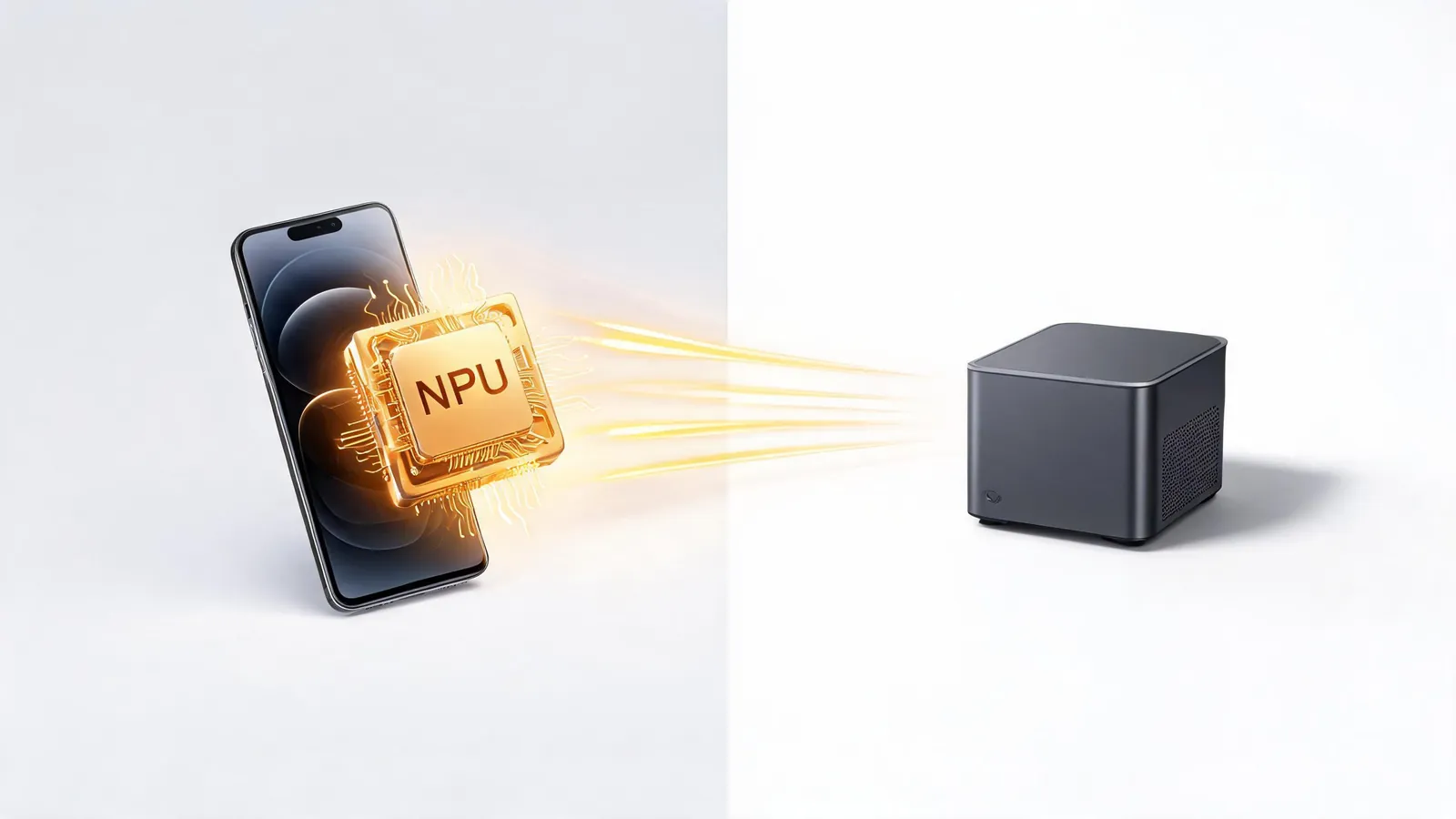
- Your phone's NPU can be smaller, because it's not running 7B+ parameter models. It handles lightweight on-device tasks (voice activation, basic translation, photo pre-processing) while the Agent Computer handles everything else.
- Your phone's memory can be smaller, because it's not holding large model weights in RAM. 8 GB is plenty when you're not running an LLM locally.
- Your phone's chip can be cheaper, because it doesn't need to be a $260 flagship SoC. A $120 mid-range chip with a modest NPU is more than sufficient when the heavy AI lifting happens elsewhere.
The math is compelling. If a flagship phone with top-tier AI costs $1,099, and an Agent Computer costs $299–$399, the total is $1,398–$1,498. But you could pair a $599 mid-range phone (with adequate but not flagship AI) with the same Agent Computer for $898–$998 — saving $100–$500 while actually getting better AI capabilities, because the Agent Computer has access to more powerful models and doesn't have battery or thermal constraints.
The KaiheAiBox A1: Agent Scheduling + Cloud Inference
The KaiheAiBox A1 is built on exactly this principle. It's an Agent Computer that combines local agent scheduling with cloud LLM inference, giving you the best of both worlds:
Local agent scheduling means the A1 runs the orchestration layer — deciding which agent handles which task, when to invoke a cloud API versus a local model, and how to chain multiple agent steps together. This doesn't require a massive NPU; it requires reliable, low-latency compute that's always available.
Cloud LLM inference means the A1 calls GPT-4, Claude, Gemini, or any other cloud API for the heavy computational tasks. This gives you access to models far more capable than anything that can run on a phone — 100B+ parameter models with state-of-the-art reasoning, coding, and creative abilities.
The result: Your phone doesn't need the strongest chip to use AI. It just needs to be connected to your Agent Computer, which handles the intelligence layer. The phone remains lean, affordable, and battery-efficient, while the A1 provides the AI horsepower that never sleeps.
This architecture also solves several problems that the "stuff more AI into the phone" approach creates:
| Problem | Phone-Only AI | Agent Computer + Phone |
|---|---|---|
| Battery drain during AI tasks | Severe (NPU + GPU active) | Minimal (phone receives results) |
| Thermal throttling | Limits sustained AI workloads | Not applicable (A1 is always-on, passively cooled) |
| 24/7 agent availability | Phone must stay on, draining battery | A1 runs agents while phone is in your pocket |
| Model capability | Limited to what fits on-device | Access to cloud-scale models |
| Cost | $1,099+ for flagship AI phone | $599 phone + $299–$399 A1 |
| Privacy | Better (on-device), but limited models | Cloud models with API privacy policies; local scheduling |
The Bigger Picture: AI Compute Distribution
The chip price surge is forcing a fundamental rethinking of where AI compute happens. The industry has been on a trajectory toward ever-more-powerful on-device AI, driven by the (reasonable) desire for privacy, low latency, and offline capability. But the economics are pushing back.
What's emerging is a more nuanced model of AI compute distribution:
-
On-device (phone): Lightweight, latency-sensitive, privacy-critical tasks. Voice activation, basic translation, face unlock, computational photography pre-processing. These require modest NPUs and can run on mid-range chips.
-
On-premise (Agent Computer): Agent orchestration, task scheduling, moderate local inference (small models for privacy-sensitive tasks), and cloud API routing. The Agent Computer sits between your phone and the cloud, providing always-available intelligence without the constraints of a mobile form factor.
-
Cloud (data center): Heavy inference for the most capable models. Complex reasoning, creative generation, multi-step planning, and any task requiring 100B+ parameter models. The cloud provides capability; the Agent Computer provides accessibility and orchestration.
This three-tier model is more economically sustainable than the current "cram everything into the phone" approach. It distributes cost appropriately: the phone stays affordable, the Agent Computer provides dedicated AI infrastructure at a moderate price, and cloud APIs charge only for what you use.
What This Means for Consumers
If you're shopping for a phone in 2025 or 2026, here's what the chip price surge means for you:
1. Don't overpay for on-device AI you won't fully use. The flagship phone you're considering at $1,099+ is priced partly to cover the cost of an NPU that will be underutilized for most tasks. Unless you specifically need offline AI capabilities (e.g., you frequently travel to areas without connectivity), you're paying for silicon you don't need.
2. Consider the Agent Computer alternative. Pairing a mid-range phone with an Agent Computer gives you better AI capabilities at a lower total cost. The Agent Computer provides 24/7 agent availability, access to more powerful models, and no battery drain on your phone.
3. Watch the mid-range carefully. As chip costs push flagships higher, mid-range phones are becoming the value sweet spot. A well-chosen mid-range phone with 8 GB of RAM and a modest NPU can handle essential on-device AI tasks, especially when paired with an Agent Computer for heavier workloads.
4. Cloud AI is not the enemy. The privacy concerns around cloud AI are real but manageable. Modern cloud APIs (especially those from major providers) offer robust data handling policies, and the capability gap between cloud and on-device models is enormous and growing. A hybrid approach — local for privacy-critical tasks, cloud for capability-intensive tasks — is pragmatic and cost-effective.
What This Means for the Industry
For chipmakers, phone brands, and the broader mobile ecosystem, the chip price surge is a wake-up call:
- Chipmakers need to offer better price-performance ratios for mid-range NPUs, not just chase TOPS benchmarks on flagships. The mid-range is where the volume is.
- Phone brands need to stop treating AI as a feature that justifies flagship pricing and start thinking about how to deliver AI value across their entire product line — potentially through ecosystem devices like Agent Computers.
- Software developers need to design AI features that work across a range of hardware capabilities, with graceful degradation on mid-range devices and cloud fallback for the most demanding tasks.
- The industry as a whole needs to move beyond the "more AI in the phone" narrative and embrace a distributed compute model that plays to the strengths of each device.
The Road Ahead
The chip price surge is real, structural, and likely to persist for the foreseeable future. The transition from 4nm to 3nm, the expansion of NPU area, and the demands of next-generation memory are not temporary phenomena — they're the new reality of smartphone silicon economics.
But this reality doesn't have to mean ever-more-expensive phones with diminishing returns. It can instead catalyze a shift toward a more intelligent distribution of AI compute — one where phones do what they're good at (portable, always-with-you interaction) and Agent Computers do what they're good at (always-on, power-unconstrained AI orchestration and inference).
The phone in your pocket doesn't need the strongest chip to be the smartest device you own. It just needs the right partner.
KaiheAiBox · AI Frontier