AI Won't Replace You, but Someone Better at AI Will: This Isn't Chicken Soup, It's Competitive Reality
In early 2026, a narrative circulates in offices: "AI will replace 50% of white-collar jobs." Two years into the ChatGPT era, the reality is more nuanced—AI isn't replacing people; people who use AI well are systematically outcompeting those who don't.
This sentence was once used to persuade people to learn programming. Then it became "learn to write prompts." Today, it has a new version: people who can build AI workflows are systematically crushing those who only use chat dialogs.
And the equipment these people use most often is quietly shifting from "a good computer" to a local AI agent computer.
The Inequality Everyone Ignores: The "Equipment Gap" in AI Usage
In 2023-2024, the threshold for using AI was "can you access it." In 2024-2025, it became "can you write good prompts." In 2026, the threshold has evolved to: can you set up an automated AI workflow that runs 24/7 for you?
Behind this threshold lies an overlooked inequality: compute gap is widening the efficiency gap between people.
A simple scenario:
Person who doesn't use AI: Spends 3 hours manually collecting industry news, organizing into a brief, takes 2 days to finish.
Person who knows prompts: Asks ChatGPT to help write the brief, finishes in 2 hours. But still needs to operate, copy-paste, and send manually.
Person with an AI workflow: A local agent automatically completes everything—every Monday at 8 AM, the agent has scraped 10 information sources, written the brief, and sent it to the inbox. No human intervention required.
Time cost for the three: 3 hours vs 2 hours vs 0 hours.
But the deeper gap is in how time is used: the first person spends 3 hours per week on mechanical information gathering;
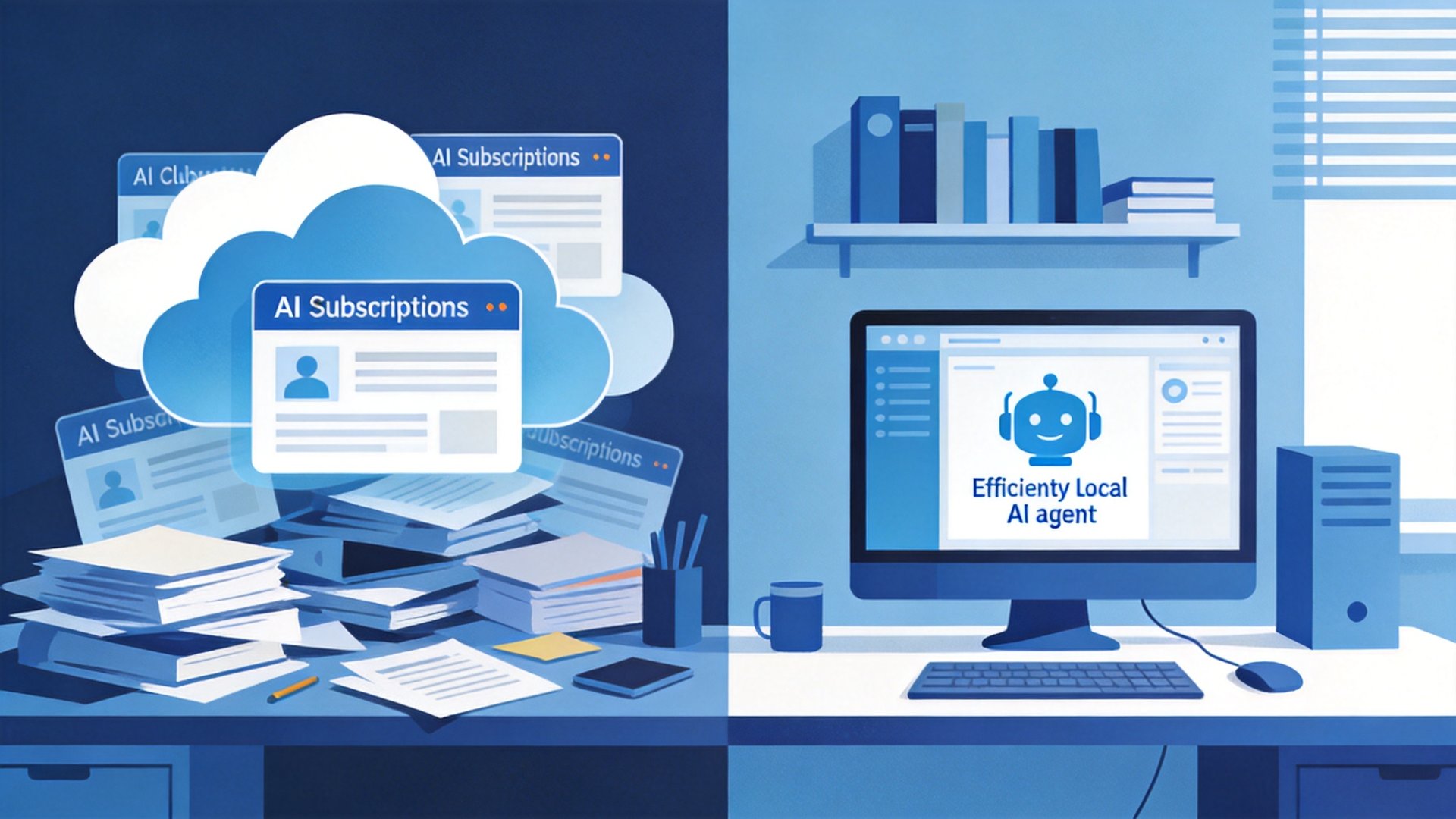
Why the Efficiency Gap Is Accelerating
Over the past two years, AI tools have exploded in number, but the "equipment" ordinary people use to access AI has barely evolved. Most people still use AI the "browser + dialog box" way—this is as inefficient as operating a computer with hand gestures.
The truly efficient way to use AI is essentially treating it as your digital employee, not a smarter search box.
Where does the difference lie?
| Usage Mode | Description | Time per Use | 24/7 Available |
|---|---|---|---|
| Pure dialog | Open ChatGPT/Claude, copy-paste questions | 5-30 min | ❌ |
| Prompt engineering | Carefully designed prompts, reusable templates | 10-30 min | ❌ |
| Local Agent workflow | Configure once, auto-loop execution, only need to review results | 0 min | ✅ |
The core of the third mode isn't "AI is smarter"—it's that you no longer need to teach it how to do things from scratch every time. One-time configuration, long-term reuse, automatic operation—this is the correct way to unlock AI's value.
And this usage mode requires not a better browser, but a local hardware designed for continuous agent operation.
Who Needs a Local Agent Computer Most?
Not everyone needs one. Knowledge workers: Researchers, analysts, consultants, lawyers, doctors—core competency is information processing and judgment, not information gathering. But in reality, they spend大量 time on information gathering. A local agent helps them automatically monitor sources, generate summaries, and organize archives, returning time to truly valuable judgment work.
Content creators: Writing drafts, researching materials, doing competitive analysis, writing social media posts, updating multiple platforms—these are what AI excels at, but also the most time-consuming. Agent workflows automate all of this; creators only need to focus on creativity and quality control.
Small businesses and independent developers: No budget for a team, no resources for cloud—but still need AI capabilities. Local agent computers provide a low-cost, high-privacy, zero-monthly-fee AI infrastructure that replaces multiple SaaS subscriptions.
Developers and technical teams: Code review, documentation generation, API testing, automated testing—these repetitive technical tasks are handed to agents; developers focus on architectural design and creative programming. Code and data are all local; intellectual property doesn't leak.
Local Agent vs Cloud AI: Here's How the Math Works
Choosing a local agent computer over cloud AI isn't just about "data security"—it's an economic calculation.
Direct cost comparison (using a small content team's AI usage as an example):
| Cost Item | Cloud AI (monthly estimate) | Local Agent Computer (Kaihe A1) |
|---|---|---|
| Tool subscription | 50-200 CNY | 0 CNY |
| API calls | 100-500 CNY | 0 CNY (local models) |
| Electricity | 0 CNY | ~5 CNY/month |
| Hardware depreciation | 0 CNY | ~2 CNY/day (5-year amortization) |
| Monthly total | 150-700 CNY | ~65 CNY |
Annual savings: 1020-7620 CNY.
But this is just direct cost. Cloud AI's token cost grows linearly—the more you use it, the higher the fee. When your agent workflow becomes complex (multi-step, multi-agent collaboration, long-context tasks), token consumption grows exponentially.
Local model inference cost is fixed cost—whether you run it 100 times or 10,000 times a day, the cost is the same. Complex agent orchestration is actually more cost-effective.
Adding the premium of data sovereignty (your competitive analysis, client data, internal data—once uploaded to the cloud, there's leakage risk), the true ROI of a local agent computer is much higher than the账面 shows.
24/7: The Undervalued Mode of AI Usage
The biggest mental blind spot in AI usage is treating it as an "on-demand tool"—ask when there's a question, leave it idle when there isn't.
But the way to truly unlock AI value is to treat it as your digital employee, operating according to a schedule and proactively reporting.
Imagine such a morning:
- 7:00 AM: Your local agent starts scraping last night's industry news
- 7:15 AM: Deduplicates content, scores, sorts
- 7:30 AM: Generates a 500-character industry brief
- 7:35 AM: Pushes to your phone or email
- 8:00 AM: When you arrive at the office, a well-organized brief is waiting for you
This agent also works at night: monitoring whether your competitors' websites have new products, whether clients have replied to emails, whether tomorrow has important meetings requiring preparation.
This isn't sci-fi; this is a scenario you can realize today for 999 CNY.
The core philosophy of Kaihe Agent Computer is to upgrade AI from an "on-demand tool" to a "digital employee." It's not a "more powerful computer"—it's a specialized device designed for continuous agent workflows—low power consumption, zero noise, 24/7 operation, all configurations revolve around agent workflows.
Written at the End: The Gap Isn't Talent, It's Equipment
In every major technological revolution in human history, new efficiency gaps emerge. During the Industrial Revolution: steam-powered weaving vs hand weaving. During the computer revolution: skilled operators vs those who rejected computers. During the AI revolution: people who can build agent workflows vs those who only use dialog boxes.
The gap has never been "talent"—it's the ability gap in accessing and using tools.
Today's tools are already sitting there: local agent computers are no longer geek toys, but practical devices any knowledge worker can configure within an hour and let them start working. The key question isn't "Will AI replace you?"—AI won't; it's just a tool. The real question is: What equipment are you using to compete with those who are better at AI than you?
📖 Glossary
AI Box (also known as Agent Computer / Agent PC), is a dedicated local hardware device that runs AI Agents. Pre-installed with an AI agent management system, plug-and-play, running 24/7. Users can remotely command AI to work via Discord, Slack, Telegram, WhatsApp, and more.
Kaihe Agent Computer — A digital employee that works 24/7 Learn more: nizwo.com