AMD AI Mini PC vs KaiheAiBox: A Complete Hardware Selection Guide for Local Agent Deployment
📖 Glossary
AI Box (also known as Agent Computer / Agent PC), is a dedicated local hardware device that runs AI Agents. Pre-installed with an AI agent management system, plug-and-play, running 24/7. Users can remotely command AI to work via Discord, Slack, Telegram, WhatsApp, and more.
When you decide to run AI agents locally, the first question is always the same: what hardware should you choose? The market is flooding with options that promise local AI capabilities, but the gap between marketing claims and real-world performance can be significant. This guide cuts through the noise by comparing two fundamentally different approaches to local AI deployment.
In 2025, AMD introduced mini PCs powered by the Ryzen AI Max+ 395 processor, priced near 30,000 RMB, targeting local AI inference capabilities with impressive on-paper specifications. Meanwhile, KaiheAiBox takes a more pragmatic approach to the same market: instead of stacking raw compute power in a single machine, it provides a ready-to-use agent runtime environment out of the box. The distinction matters more than you might think.
This article breaks down the differences between these two approaches from a hardware selection perspective, examining real-world performance, deployment complexity, and total cost of ownership to help you make a choice that truly matches your business needs.
The AMD AI Mini PC: Pros and Cons of the High-Compute Route
The AMD Ryzen AI Max+ 395 is a high-performance APU designed for mobile platforms, integrating a Radeon 8060S GPU with 128GB of unified memory and leading TOPS performance. Mini PC manufacturers package this into a compact chassis typically measuring between one and three liters, with a clear selling point: one device handles both inference and graphics processing without requiring a separate GPU.
Advantages:
- Unified Memory Architecture: The 128GB of memory shared between CPU and GPU is particularly friendly for large model inference, avoiding the capacity bottlenecks that plague traditional dedicated VRAM setups. When you need to load a model that requires 80GB or more of memory, unified architecture eliminates the painful trade-off between model size and GPU VRAM limitations.
- Compact Form Factor: Mini PCs typically measure 1-3 liters, taking up minimal desk space compared to a traditional workstation with a full-sized GPU. This makes them suitable for office environments where space is at a premium.
- Local Compute Autonomy: Run small to medium parameter models without internet connectivity, keeping data entirely on-device. For organizations with strict data governance policies, this is a significant advantage.
- Versatility: Beyond AI workloads, the hardware serves as a capable general-purpose workstation, handling everything from software development to content creation.
Real-World Constraints:
- Price Barrier: A price tag approaching 30,000 RMB is prohibitive for small-to-medium businesses and individual developers, especially when you consider that this cost covers hardware only—software deployment, model optimization, and ongoing maintenance are additional expenses.
- Thermal and Noise Issues: Under sustained high load—which is typical for AI inference workloads—mini PCs face significant thermal challenges. The compact chassis limits airflow, forcing fans to spin at high RPM. In an office environment, this can be disruptive during extended inference sessions.
- Software Ecosystem: AMD's ROCm framework still lags behind NVIDIA's CUDA in AI inference optimization depth. While the gap has narrowed considerably, some popular models and frameworks require extra adaptation work, custom compilation steps, or community-maintained forks. This adds friction to what should be a straightforward deployment process.
- Single-Point Compute Ceiling: Even with 128GB of memory capable of loading larger models, inference speed remains limited by the integrated GPU's compute power. When you're running a single agent, this might be acceptable. But complex agent orchestration scenarios—where multiple agents need to run concurrently and communicate with each other—will quickly expose this bottleneck.
- Maintenance Overhead: Keeping the inference stack updated, managing model versions, debugging compatibility issues between framework updates and hardware drivers—these tasks consume engineering hours that could be spent on business logic.
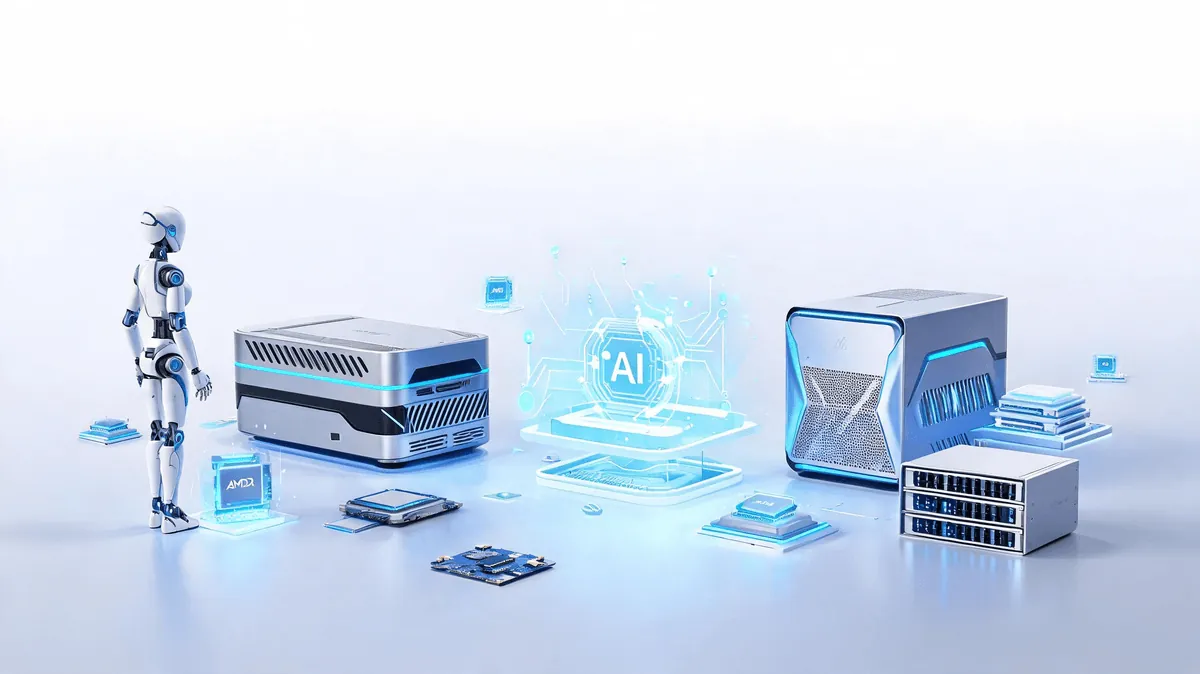
KaiheAiBox: The Ready-to-Use Agent Appliance
Kaihe takes a fundamentally different path: it doesn't sell compute power—it sells a complete agent runtime environment. This distinction is crucial. While the AMD mini PC gives you raw hardware that requires significant engineering effort to transform into a useful AI platform, KaiheAiBox delivers a turnkey solution where the hardware, software, and orchestration layer work together as an integrated system.
KaiheAiBox comes pre-installed with the OpenClaw agent framework, including built-in model scheduling, tool invocation, memory management, and other core capabilities. Users power on and start using it immediately, without manually configuring inference engines, API keys, or agent orchestration logic. The entire technology stack—from the operating system layer to the agent coordination layer—has been optimized and tested as a cohesive unit.
Core Design Philosophy:
- Agent-First Architecture: Hardware is configured around "running multiple agents simultaneously" rather than "running the largest model." This is a critical philosophical difference. The AMD approach assumes your primary need is raw inference throughput for a single model. KaiheAiBox assumes your primary need is orchestrating multiple specialized agents that work together on business tasks.
- Pre-Installed and Ready: The AI runtime is fully deployed at the system level; users only need to define business logic. There's no need to install Python environments, configure CUDA or ROCm, set up API endpoints, or debug dependency conflicts. The days or weeks typically spent on infrastructure setup are reduced to minutes.
- Elastic Scaling: Supports hybrid scheduling between local inference and cloud APIs. When local compute is insufficient, it automatically calls cloud models rather than forcing a hardware upgrade. This means you're never locked into a fixed compute ceiling—you can start with local-only workloads and seamlessly scale to hybrid deployments as your needs grow.
Real-World Experience:
Consider a typical enterprise knowledge base scenario: after a user uploads documents, the OpenClaw agent on KaiheAiBox automatically handles document chunking, vectorization, and index construction, then provides precise Q&A through a natural language interface. The entire process requires zero lines of code from the user and no understanding of underlying concepts like RAG, embedding models, or vector databases. A non-technical team member can have a fully functional knowledge base running within an hour of unboxing.
Or take an automated office scenario: one agent monitors emails, another organizes meeting minutes, a third generates weekly report drafts, and a fourth tracks action items from conversations. KaiheAiBox's agent orchestration capabilities enable these multiple agents to work collaboratively, sharing context and coordinating their outputs. A single mini PC, constrained by inference speed, would need to process these agent tasks serially, introducing unacceptable latency in a real-time workflow.
The difference becomes even more pronounced when you consider ongoing operations. On the AMD mini PC, adding a new agent capability means installing additional frameworks, configuring new model endpoints, and potentially rebalancing resource allocation. On KaiheAiBox, adding a new agent is a configuration task handled through the OpenClaw interface—no infrastructure expertise required.
Head-to-Head Comparison
| Dimension | AMD AI Mini PC | KaiheAiBox |
|---|---|---|
| Core Positioning | General-purpose AI inference hardware | Agent-specific computing appliance |
| Out-of-Box Experience | Requires self-deployment of inference framework | Pre-installed OpenClaw, ready on boot |
| Multi-Agent Support | Limited by single-machine compute, primarily serial | Native multi-agent orchestration |
| Model Strategy | Pure local inference | Local + cloud hybrid scheduling |
| Target Users | Developers with AI engineering experience | Business personnel seeking rapid deployment |
| Price Range | ~30,000 RMB (hardware only) | Lower (including software and services) |
| Data Security | Fully local | Supports pure local mode |
| Time to Value | Days to weeks | Minutes to hours |
| Ongoing Maintenance | User responsibility | Managed updates |
Which Solution for Which Scenario
Choose the AMD Mini PC when:
- You have extensive AI deployment experience and need a fully controllable inference environment where every parameter can be tuned
- Your business scenario primarily involves single-model, long-running inference (e.g., local fine-tuning, continuous training, large-scale batch processing)
- You have hard compliance requirements for data never leaving the device, and your organization has the engineering bandwidth to maintain a fully self-managed stack
- Budget is sufficient, and you're willing to invest time in system optimization and ongoing maintenance
- You need the hardware to serve double duty as a general-purpose workstation when not running AI workloads
Choose KaiheAiBox when:
- You want to order today and use AI capabilities tomorrow—speed of deployment matters more than peak theoretical performance
- Your business needs involve multi-agent collaboration (customer service + knowledge base + automated office workflows running simultaneously)
- Your team lacks dedicated AI engineers, and you need a solution that business users can manage independently
- You need flexible local + cloud hybrid deployment that can adapt as your workload patterns change
- You care about total cost of ownership—including the hidden costs of engineering time, maintenance, and opportunity cost—not just hardware specifications
- You want to future-proof your investment with a platform that can incorporate new models and capabilities without hardware replacement
Hybrid Deployment: The Pragmatic Best Practice
In reality, the two approaches are not mutually exclusive. An increasing number of enterprises are choosing hybrid deployments that leverage the strengths of both:
- KaiheAiBox as the agent orchestration hub: Runs the OpenClaw framework, orchestrating business workflows and managing agent lifecycle. This is where the "brain" of your AI operations lives.
- AMD Mini PC as an inference node: Handles latency-sensitive or locally-required large model inference tasks. This dedicated hardware ensures that compute-heavy workloads get the resources they need without competing with orchestration overhead.
- Cloud API as fallback: Automatically switches to cloud models during peak loads or for models too large for local deployment. This elasticity means you never hit a hard capacity wall.
This three-tier architecture ensures both smooth agent orchestration and meets specific scenarios' local inference requirements. It represents the most pragmatic local AI deployment strategy available today—one that balances performance, cost, and operational simplicity.
Final Thoughts
There are no standard answers in hardware selection—only fit. The AMD AI Mini PC delivers high-compute local inference capability, suitable for technical teams seeking deep customization and willing to invest in infrastructure management. KaiheAiBox provides a ready-to-use agent runtime environment, ideal for business teams seeking rapid deployment and multi-agent collaboration without the infrastructure overhead.
If you're evaluating local AI deployment solutions, the core question isn't "which machine has higher specs" but rather "is your team better at tuning hardware or defining business workflows?" Once you figure that out, the answer reveals itself. The best hardware choice is the one your team can actually use effectively—not the one with the most impressive spec sheet.
KaiheAiBox| Agentaibox that lets AI work for you 24/7· Product Center