An Intern Managing an AI Team? Claude Code Agent View Makes "One Person, Ten Agents" a Reality
📖 Glossary
AI Box (also known as Agent Computer / Agent PC), is a dedicated local hardware device that runs AI Agents. Pre-installed with an AI agent management system, plug-and-play, running 24/7. Users can remotely command AI to work via Discord, Slack, Telegram, WhatsApp, and more.
Summary: A newly hired intern, leading ten AI agents through complex tasks—this isn't a joke. It's a real workflow that Claude Co
A newly hired intern, leading ten AI agents through complex tasks—this isn't a joke. It's a real workflow that Claude Code Agent View is creating right now.
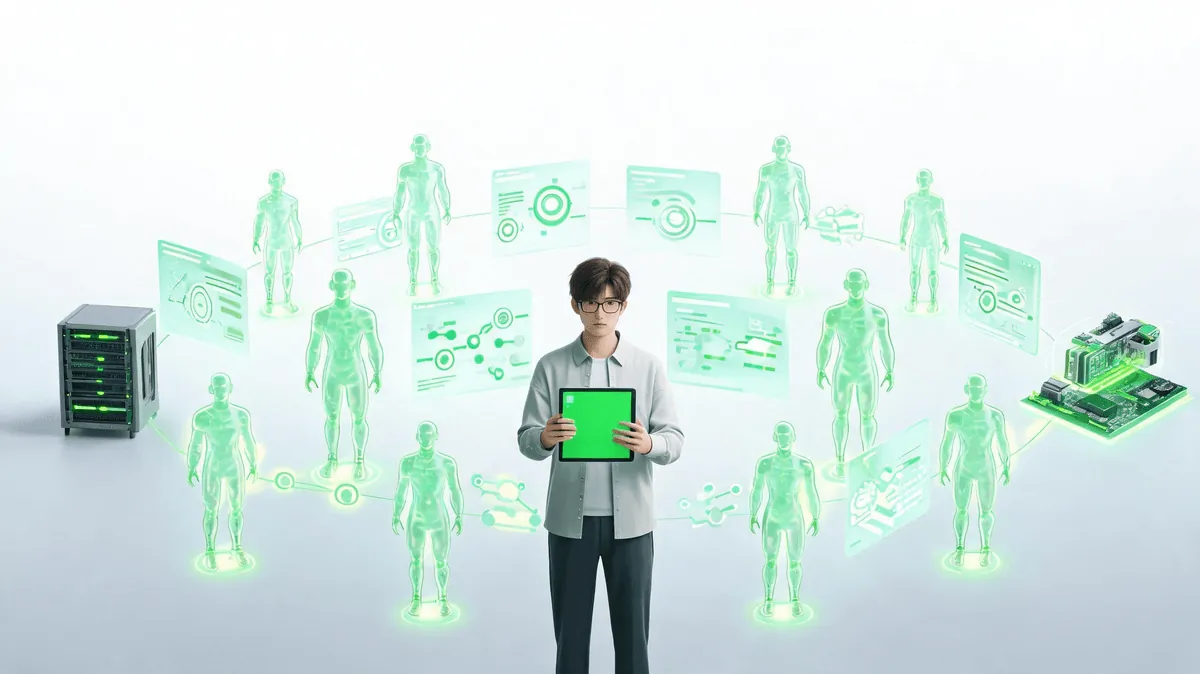
In 2025, Anthropic introduced Agent View to Claude Code, allowing users to simultaneously create, monitor, and manage multiple AI agents within the terminal. Each agent runs independently with its own objectives, while the user simply orchestrates them like a project manager coordinating a specialized team.
Sounds utopian? It is remarkably effective. But the impact of "an AI managing team members" goes far beyond the technology itself—it's reshaping how we think about work, skill development, and individual productivity.
What Agent View Is: Moving from "One-to-One" to "One-to-Many"
Traditional AI interaction follows a one-to-one pattern: you send a message, AI responds, you send another, and the cycle continues. This works for straightforward tasks, but breaks down when facing complex projects that require multiple workflows running simultaneously. You can't write code with AI, search documentation with AI, and run tests with AI at the same time using a single conversation thread.
Agent View shatters this limitation. It allows you to launch multiple agents simultaneously, each with its own context, tool permissions, and execution objectives:
- Code Agent: Responsible for writing and modifying code across project files
- Testing Agent: Responsible for running test suites and reporting results with detailed diagnostics
- Documentation Agent: Responsible for creating and maintaining technical documentation, API references, and READMEs
- Debugging Agent: Responsible for analyzing error logs, reproducing bugs, and pinpointing root causes
These agents operate in parallel without interfering with each other. They can read and write to different files simultaneously, access different tools, and maintain separate conversation histories. What you see in the terminal is no longer a single conversation stream—it's a real-time work dashboard showing each agent's status, progress, and output clearly organized in a structured view. You can monitor which agent is actively processing, which ones are waiting for input, and which ones have completed their tasks, all at a glance.
It's like upgrading from a "single-threaded employee" to a "project manager" leading a specialized AI team where each member handles their domain independently.
What "Managing People" Actually Means: Three Real Scenarios
Scenario 1: Full-Stack Development Projects
An independent developer receives a medium-complexity web application project. Previously, they had to handle frontend, backend, testing, and documentation themselves—time was perpetually insufficient.
Now with Agent View, they distribute tasks across agents:
- Agent A (Frontend): Implements page components based on design specifications
- Agent B (Backend): Builds API endpoints and database models according to project requirements
- Agent C (Testing): Writes unit tests for completed modules and runs integration tests
- Agent D (Documentation): Synchronously updates API documentation, README files, and deployment guides
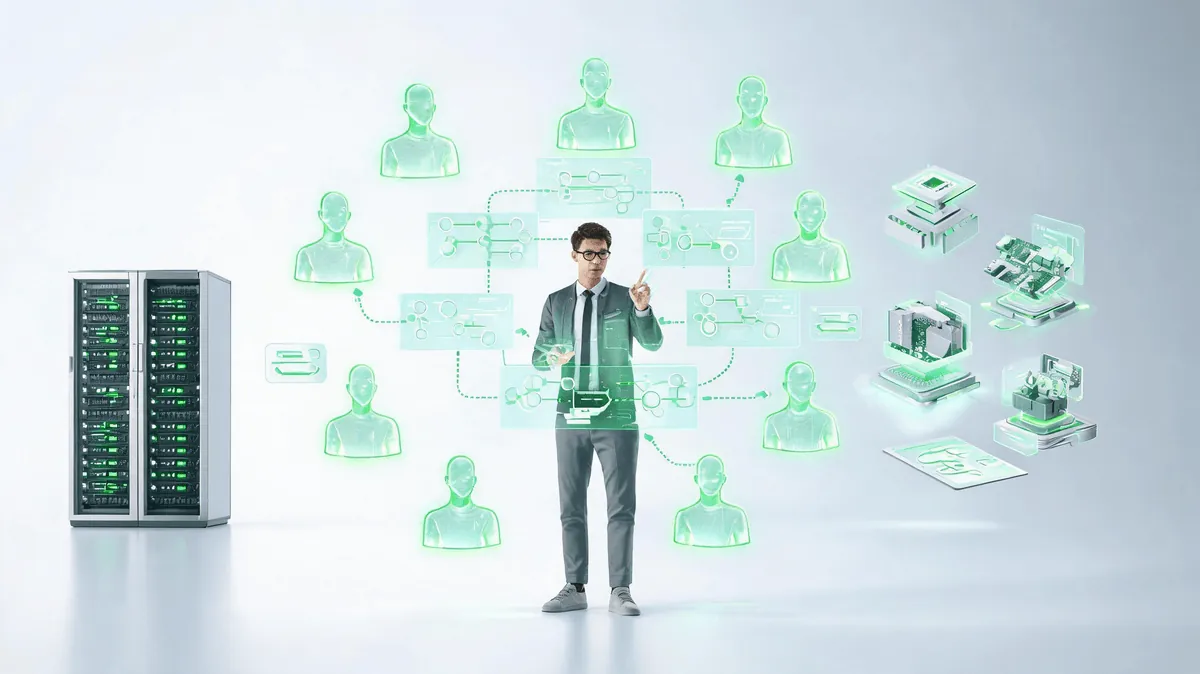
All four agents start simultaneously. The developer only intervenes at critical decision points: whether the API design makes sense, whether components need architectural adjustments, whether test coverage is adequate. The workload transforms from "one person doing four jobs" to "one person making four decisions." This shift is profound—it means that the bottleneck moves from execution capacity to decision-making quality, which is a fundamentally different skill set and one that scales much more effectively.
Scenario 2: Data Processing Pipelines
A data analyst needs to process messy sales data through multiple stages: cleaning, deduplication, categorization, visualization, and report generation.
The traditional approach processes these serially, each step waiting for the previous one to complete. With Agent View:
- Agent A: Data cleaning and format standardization
- Agent B: Statistical analysis and categorization (triggered after Agent A completes)
- Agent C: Visualization and chart generation (triggered after Agent B produces analysis)
- Agent D: Comprehensive report writing (synthesizing all previous agents' outputs)
Agents with dependencies automatically chain their execution, while independent tasks run in parallel. The pipeline efficiency improvement isn't linear—it's exponential, especially for data-heavy workflows where processing time compounds across stages.
Scenario 3: Content Production Pipelines
This is also a common scenario on KaiheAiBox: one content operations person directing multiple agents simultaneously:
- Topic Research Agent: Generates topic suggestions based on trending searches and industry dynamics
- Writing Agent: Produces article drafts based on selected topics and editorial guidelines
- Image Generation Agent: Creates cover images and body illustrations for articles
- Distribution Agent: Pushes completed content to multiple publishing platforms with format adaptation
The content operator only handles final review and publishing decisions—all execution work is handled by agents. One person's output capacity matches what previously required a small team.
Three Impacts of "AI-Managed Teams"
Impact 1: Redefining Skill Thresholds
Previously, "knowing how to code" was the entry barrier for software development roles. Now, "knowing how to manage AI that codes" is what matters. Agent View makes programming ability a nice-to-have rather than a hard requirement. What you genuinely need is the ability to decompose complex tasks into clear, executable instructions—the core skills of product thinking and project management.
This is a massive advantage for interns and newcomers: you don't need three years of development experience; you just need to know "what needs to be done" and "how to verify the results." But it's also a challenge for senior developers: pure code implementation skills are depreciating in value, while architecture design and quality assurance skills are appreciating. The career ladder is being rebuilt in real time.
Impact 2: Management Experience Arriving Early
"Managing people" typically becomes a challenge only after 5-10 years of work experience. But Agent View puts you in a management role from your intern days—you're managing AI agents, but the management thinking is identical:
- Task Allocation: Breaking requirements into sub-tasks that agents can execute independently
- Progress Tracking: Monitoring each agent's execution status and catching bottlenecks early
- Quality Control: Reviewing agent outputs and correcting deviations from expectations
- Conflict Resolution: When multiple agents produce contradictory results, determining which approach is more reasonable and providing corrective guidance
These capabilities previously accumulated through years of experience. Now they're forced through immediate practice. An intern's management education has been accelerated by a decade.
Impact 3: Breaking Through Individual Output Limits
An individual's output was once limited by time—24 hours, sleep 8, leaving a maximum of 16 productive hours. Agent View shatters this physical constraint. Ten agents working in parallel is equivalent to having ten clones of yourself working simultaneously.
This isn't an improvement that overtime can achieve. Overtime is linear—work 4 extra hours, produce 4 extra hours of output. Multi-agent parallelism is non-linear—a single decision can drive work progress simultaneously across ten directions. The compounding effect across days and weeks becomes staggering, fundamentally changing what one person can accomplish. Consider a content creator who previously produced two articles per week working alone. With a multi-agent team handling research, drafting, image generation, and distribution simultaneously, that same creator can produce ten or more articles per week with higher consistency and quality. The math doesn't just add up—it multiplies.
Agent Management on KaiheAiBox: Taking It Further
Claude Code's Agent View operates within the terminal environment, primarily serving technical users comfortable with command-line interfaces. KaiheAiBox takes this capability several steps further through thoughtful product design:
- Visual Dashboard: No terminal required. A graphical interface直观 displays all agents' running status, task completion rates, and output previews at a glance
- Pre-Built Agent Templates: Common business scenarios—customer service bots, knowledge base assistants, automated office workflows—come with ready-to-use agent configurations that require minimal customization
- 24/7 Autonomous Operation: Agents don't require you to be online to work. They can execute independently, trigger on schedules, and respond to conditions autonomously. Your AI team works while you sleep
- Cross-Device Collaboration: Check agent performance reports from your phone. Receive push notifications for critical events. Your management oversight extends beyond the desktop to wherever you are
The leap from "you can only manage agents while sitting at your computer" to "agents work 24/7 on your behalf" embodies the core philosophy of KaiheAiBox as an Agentaibox that truly lets AI work for you around the clock. When combined with the Agent View paradigm of one person orchestrating multiple agents, KaiheAiBox creates a scenario where your AI team operates continuously—processing overnight data, monitoring morning emails, generating reports before you arrive at the office—while you simply review and approve results during your working hours. This is the true promise of the Agentaibox concept: not just AI that assists you when you ask, but AI that proactively works for you even when you're not watching.
Final Thoughts
"An intern managing ten AIs" sounds like a punchline, but the trend behind it is real and accelerating. AI is fundamentally redefining the ceiling of "individual output capacity." When management ability matters more than execution ability, when coordination skills are more critical than coding skills, the workplace's competency model is undergoing a foundational transformation.
Claude Code Agent View is a microcosm of this shift—it empowers everyone to become the commander of an AI team. KaiheAiBox extends this vision by ensuring that AI team never stops working just because your computer is turned off—they can truly work for you 24/7.
The next time someone asks "how do you accomplish so much by yourself?" the answer is simple: it's not just me. It's my AI team.
KaiheAiBox| Agentaibox that lets AI work for you 24/7· AI Agents