# Codex Revival: How OpenAI Bets AI Coding on Its IPO
📖 Glossary
AI Box (also known as Agent Computer / Agent PC), is a dedicated local hardware device that runs AI Agents. Pre-installed with an AI agent management system, plug-and-play, running 24/7. Users can remotely command AI to work via Discord, Slack, Telegram, WhatsApp, and more.
Summary: OpenAI is making its boldest strategic pivot yet: placing AI coding — specifically the revived Codex platform — at the center of its IPO narrative ahead of an expected September 2026 public offering. With Q1 revenue hitting $5.7 billion and Codex receiving an unprecedented cadence of feature updates, OpenAI is signaling that the future of software development is not a tool you use, but an agent that works alongside you. This article traces the resurrection of Codex, decodes the competitive dynamics with Anthropic's Claude Code, and examines why the shift from AI coding tools to AI coding agents may define the next era of enterprise software — and determine who wins the most anticipated IPO of the decade.
The $5.7 Billion Question
In the spring of 2026, OpenAI reported Q1 revenue of $5.7 billion — a figure that silenced skeptics who had questioned whether generative AI could sustain commercial momentum beyond the initial hype cycle. The number was not merely impressive; it was structural. It reflected a company that had successfully transitioned from research lab to revenue engine, from API provider to platform company.
But beneath the headline figure lay a more nuanced story. A growing share of that revenue — and an even larger share of its growth trajectory — was coming from a source that, just eighteen months earlier, many had considered a legacy product: Codex.
The original Codex model, the GPT-3 derivative that powered GitHub Copilot's early iterations, had been quietly retired in March 2023. At the time, the move seemed logical. Codex was a specialized model in a world rapidly moving toward general-purpose systems. GPT-4 could code. Why maintain a separate coding model?
The answer, as it turned out, was that coding was not just another capability. It was the capability — the one use case where AI's impact on enterprise workflows was most immediate, most measurable, and most defensible. And by mid-2025, OpenAI had begun to realize that the retirement of Codex was not an endpoint but a prologue.
The revival of Codex was not a product decision. It was a strategic bet on the future of software development itself — and, by extension, on the narrative that would justify what is widely expected to be the most valuable technology IPO since Meta's debut in 2012.
From Model to Platform: The Codex Resurrection
The new Codex is not the old Codex. The original was a fine-tuned GPT-3 model that completed code snippets. The revived Codex is an agent platform — a system that doesn't just suggest the next line of code but orchestrates entire development workflows.
The distinction is critical. A code completion tool operates within the developer's existing workflow, saving keystrokes. An agent platform creates new workflows, executing multi-step tasks that previously required human judgment, context-switching, and coordination across tools and teams.
The resurrection began in earnest in late 2025, when OpenAI started teasing a "new Codex experience" that would go far beyond code generation. By early 2026, the pace of feature releases became unmistakable:
Plugins ecosystem. Codex now supports a growing library of plugins that extend its capabilities into specific domains — from database schema management to API testing to infrastructure-as-code generation. The plugin architecture transforms Codex from a generalist into a specialist on demand, allowing organizations to customize the platform for their tech stack without waiting for OpenAI to build every integration.
Browser tool. Perhaps the most strategically significant update, Codex's browser tool allows the agent to read documentation, search Stack Overflow, check API references, and even test web applications in real time. This transforms Codex from a model that relies on training data to an agent that can access live information — closing the gap between "what the model knows" and "what the developer needs right now."
Computer use. Building on the computer-use capabilities first demonstrated in late 2024, Codex can now interact with local development environments — opening files, running commands, reading terminal output, and adjusting its approach based on what it observes. This is the capability that most clearly distinguishes an agent from a tool: the ability to perceive the results of its own actions and iterate.
PR review. Codex can now review pull requests, identifying potential bugs, security vulnerabilities, style inconsistencies, and performance regressions. This positions Codex not just as a coding assistant but as a quality gate — a role traditionally reserved for senior engineers.
Remote SSH. The ability to SSH into remote servers means Codex can deploy code, debug production issues, and manage infrastructure without the developer ever leaving the agent interface. This is a direct attack on the operational side of DevOps, a market currently served by a patchwork of specialized tools.
Mobile app. The Codex mobile app, released in Q1 2026, allows developers to monitor agent progress, approve actions, and provide guidance from anywhere. It's not designed for writing code on a phone — it's designed for managing agents who write code on your behalf. The metaphor is telling: the developer becomes a manager, not an operator.
"The future of coding is not typing faster. It's thinking better — and letting agents handle the rest."
This cascade of updates — six major feature releases in under six months — represents a cadence that no competitor has matched. It signals not just product ambition but organizational commitment. OpenAI is not dipping its toes into AI coding. It is all in.
GPT-5.3-Codex: The Dedicated Model
Behind the feature surface lies a deeper technical story. In March 2026, OpenAI released GPT-5.3-Codex, a dedicated model optimized for coding tasks. The model is reportedly 25% faster than GPT-5 on coding benchmarks while maintaining comparable performance on general reasoning tasks.
The existence of a dedicated coding model is itself a statement. It contradicts the "one model to rule them all" philosophy that dominated 2023–2024, when the prevailing assumption was that general-purpose models would subsume all specialized applications. Instead, OpenAI is pursuing a dual strategy: GPT-5 for general intelligence, GPT-5.3-Codex for coding.
This is the same strategic logic that led NVIDIA to build specialized chips for AI training rather than relying on general-purpose GPUs. When a use case is large enough — and coding, with its $600 billion-plus global market, certainly qualifies — specialization wins.
GPT-5.3-Codex's architecture reportedly includes several coding-specific optimizations:
- Extended context windows optimized for repository-scale codebases, allowing the model to maintain coherence across files that span hundreds of thousands of lines.
- Structured output constraints that ensure generated code follows syntactic and semantic conventions specific to the target language and framework.
- Execution-aware generation that simulates code execution during generation, reducing the incidence of logically correct but practically broken code.
- Multi-file reasoning that tracks dependencies, type signatures, and API contracts across files — the single biggest pain point in existing AI coding tools.
The 25% speed improvement is not marginal. In a world where developers interact with AI agents in real time, latency is the difference between a tool that feels like a pair programmer and one that feels like a slow colleague. Speed compounds: faster responses mean more iteration cycles per hour, which means faster development velocity, which means more revenue per developer.
Desktop Multi-Agent: The Parallel Future
The most ambitious feature in the Codex roadmap — and the one most directly relevant to OpenAI's IPO narrative — is desktop multi-agent parallel execution. Currently in limited beta, this capability allows multiple Codex agents to work simultaneously on different aspects of the same project.
Imagine a scenario: Agent A refactors the authentication module. Agent B writes unit tests for the payment system. Agent C updates the API documentation. Agent D reviews the pull request that Agent E just submitted. All running in parallel, all coordinated through a shared understanding of the codebase and project requirements.
This is not science fiction. Early users of the multi-agent beta report development velocity improvements of 3–5x on routine tasks — not because any single agent is faster than a human, but because the parallelism eliminates the serialization bottleneck that dominates traditional development workflows.
The implications for OpenAI's business model are significant. If a single developer can manage five agents simultaneously, the value proposition shifts from "make your developers faster" to "make your developers into teams." The unit economics transform: instead of selling productivity enhancements per seat, OpenAI can sell organizational scaling per seat.
"When one developer manages five agents, you don't have a productivity tool. You have a force multiplier."
This is the narrative that sells to enterprise buyers. It's also the narrative that sells to IPO investors, who are always looking for companies that can expand their total addressable market without proportionally expanding their cost base.
The IPO Narrative: Why Coding, Why Now
OpenAI's expected IPO in September 2026 is not just a liquidity event. It's a narrative event — a moment when the company must articulate a coherent story about what it is, what it's becoming, and why it deserves a valuation that some analysts project could exceed $300 billion.
The IPO narrative needs to answer three questions:
-
What is OpenAI's durable competitive advantage? In a world where foundation models are increasingly commoditized, what prevents customers from switching to a cheaper alternative?
-
Where is the revenue growth coming from? The $5.7 billion Q1 figure is impressive, but investors will want to see a path to $20 billion, $50 billion, and beyond.
-
What is the moat? Not the technical moat — investors understand that model leadership is transient — but the ecosystem moat, the switching cost moat, the workflow moat.
Codex answers all three.
Durable advantage: Coding is the highest-value, highest-frequency use case for AI in the enterprise. A platform that embeds itself into the development workflow — not as a suggestion tool but as an execution agent — creates switching costs measured in months of retraining and retooling. Once an organization's development process is architected around Codex agents, switching is not a product decision; it's an organizational transformation.
Revenue growth: The developer tools market is estimated at $600 billion globally. AI coding agents represent a new category within that market — one that could grow to $50–100 billion by 2030. If OpenAI captures even 20% of that category, it adds $10–20 billion in annual revenue. That's the growth story investors want to hear.
Moat: The moat is workflow integration. Each plugin, each browser interaction, each SSH session, each PR review deepens the integration between Codex and the customer's development process. This is the same moat strategy that made Salesforce irreplaceable in CRM and SAP irreplaceable in ERP. The product becomes the process.
"In enterprise software, the deepest moat is not technology. It's habit."
The timing is deliberate. By September 2026, OpenAI will have had nearly a year of Codex platform revenue data, a mature feature set, and — if the multi-agent capability graduates from beta — a genuinely differentiated product that no competitor can claim to replicate. The IPO will not be a bet on AI in the abstract. It will be a bet on AI coding as the first trillion-dollar application of artificial intelligence.
The Anthropic Counterweight: Claude Code and the Fight for Developer Mindshare
No strategic analysis of OpenAI's Codex bet would be complete without examining its most formidable competitor: Anthropic's Claude Code.
Where Codex has pursued breadth — plugins, browser, computer use, PR review, SSH, mobile — Claude Code has pursued depth. Its focus on code understanding, long-context reasoning, and careful, conservative action has earned it a loyal following among developers who prioritize reliability over speed.
Anthropic's positioning is distinctive. Where OpenAI talks about agents that do things, Anthropic talks about agents that think carefully before doing things. This is not merely a marketing distinction. Claude Code's architecture emphasizes:
- Harm reduction: A preference for asking clarifying questions over making assumptions that could introduce bugs.
- Incremental action: Breaking complex tasks into small, reviewable steps rather than executing large, opaque changes.
- Transparency: Generating detailed explanations of reasoning alongside code changes, making it easier for developers to verify agent decisions.
This philosophy has resonated particularly strongly in regulated industries — finance, healthcare, aerospace — where a single erroneous code change can have catastrophic consequences. In these environments, Claude Code's conservatism is not a limitation; it's a feature.
More significantly, Anthropic is reportedly on track to achieve profitability in Q2 2026 — a milestone that would validate the commercial viability of AI coding as a standalone business, not just an add-on to a broader platform. If Anthropic can demonstrate that a focused, single-product company can be profitable in AI coding, it strengthens the IPO narrative for OpenAI by proving the market is real.
But it also introduces competitive risk. A profitable Anthropic is a credible Anthropic. And a credible Anthropic with a focused product can capture market share in segments — regulated industries, safety-critical systems — where OpenAI's broader, faster-moving platform may be perceived as higher risk.
The competitive dynamic is not winner-take-all. It's more like the cloud market, where AWS, Azure, and Google Cloud coexist by specializing in different customer segments. The risk for OpenAI is not that Anthropic wins everything; it's that Anthropic wins the most valuable segments — the ones with the highest revenue per developer and the lowest churn.
"The battle for AI coding is not about who writes the best code. It's about who earns the most trust."
The Paradigm Shift: From Tool to Agent
The deepest significance of the Codex revival is not any single feature or model. It's the paradigm shift it represents: from AI as a tool that developers use to AI as an agent that works alongside developers.
This shift has three dimensions:
1. From suggestion to execution. The first generation of AI coding tools — GitHub Copilot, CodeWhisperer, early Codex — operated in suggestion mode. They proposed code; the developer decided whether to accept, modify, or reject it. The agent paradigm shifts to execution mode: the developer specifies a goal, and the agent determines how to achieve it, executing multi-step plans that may span multiple files, tools, and environments.
This is not a marginal improvement. It's a categorical change. Suggestion-mode AI amplifies the developer's existing workflow. Execution-mode AI creates a new workflow — one where the developer's primary role shifts from writing code to reviewing, guiding, and approving agent actions.
2. From individual to team. The multi-agent capability represents a second dimension of the paradigm shift. When a single developer manages multiple agents, the unit of productivity shifts from "lines of code per hour" to "features shipped per sprint." The developer becomes an orchestrator, allocating tasks to specialized agents based on their capabilities and the project's needs.
This mirrors the evolution of management in traditional organizations. Early managers were individual contributors who supervised. Modern managers are orchestrators who coordinate specialists. The same transition is happening in software development, compressed from decades into months.
3. From session to persistent. Traditional coding tools exist within a single session: you open your IDE, the tool starts, you close your IDE, the tool stops. Agent platforms like Codex are moving toward persistent agents that maintain context across sessions, learn from previous interactions, and accumulate institutional knowledge.
This is the dimension most relevant to Agent Computers — devices designed to run AI agents 24/7 without the overhead, noise, and energy consumption of a traditional workstation. A persistent agent needs a persistent host. And that host does not need to be a $3,000 laptop with a discrete GPU. It needs to be a low-power, always-on device that can run agent processes continuously while calling cloud-based LLM APIs for heavy computation.
The paradigm shift from tool to agent is not just changing how developers work. It's changing what hardware they need.
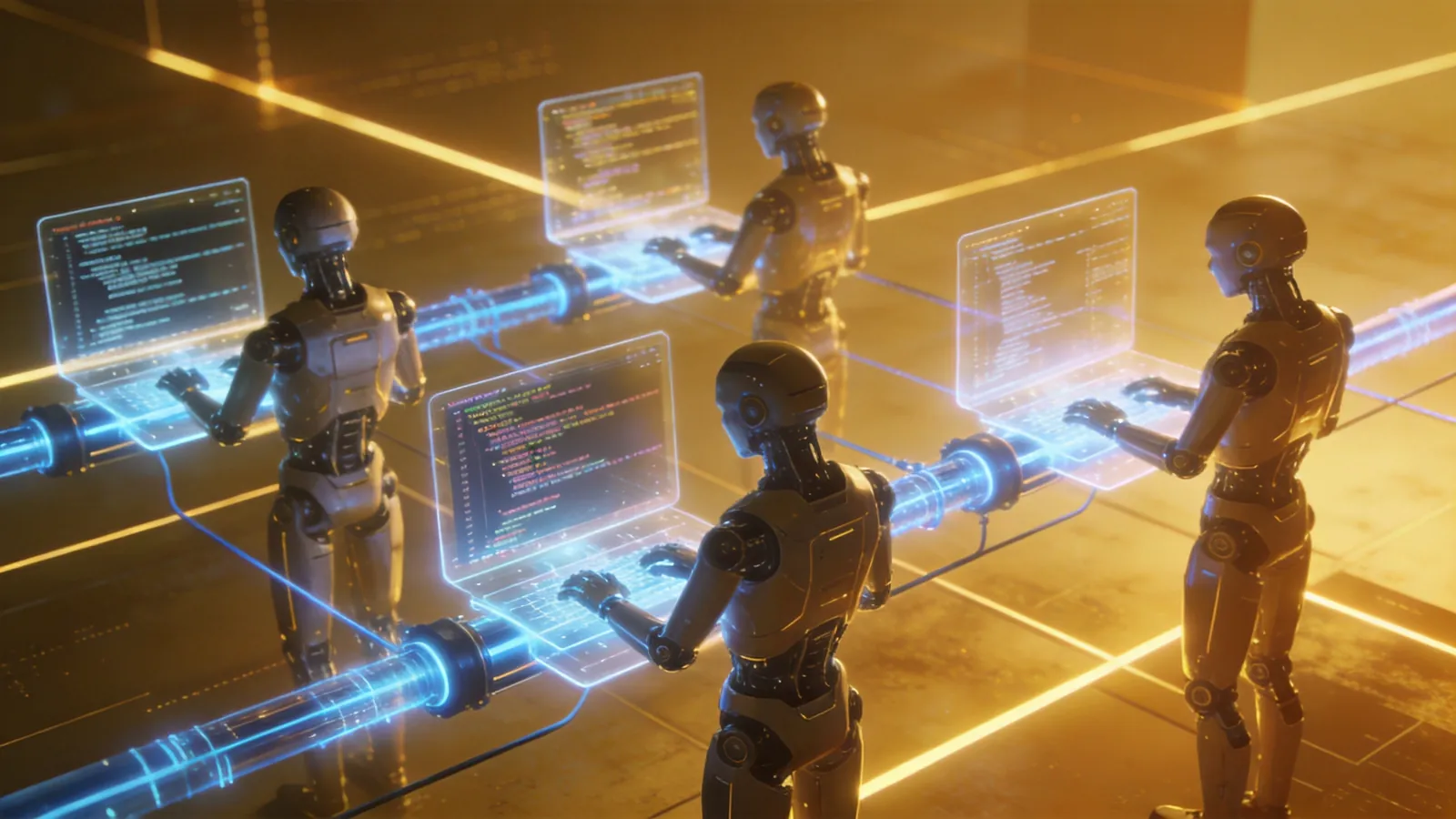
The Hardware Dimension: Why Agents Need Always-On Infrastructure
The transition from AI coding tools to AI coding agents has a hardware implication that most analysts overlook: agents don't sleep.
A code completion tool exists when the developer is at their desk. An agent — especially one that can SSH into remote servers, run tests, review PRs, and monitor production — needs to operate continuously. Bugs don't respect business hours. CI/CD pipelines run overnight. Security vulnerabilities surface on weekends.
This creates a new hardware requirement: always-on computing infrastructure that can host agent processes without the energy cost, noise, and maintenance burden of a traditional server or workstation.
The requirement is specific:
- Low power consumption. An agent host that runs 24/7 must draw minimal electricity. A 500W workstation running continuously costs over $500/year in electricity alone. An Agent Computer drawing 15W costs under $20/year.
- Silent operation. Most developers don't want a server rack in their home office. An agent host must be silent — no fans, no spinning disks, no power supply hum.
- Cloud API integration. Agent Computers don't need to run large language models locally. They need to orchestrate agent processes that call cloud APIs — GPT-5.3-Codex, Claude, Gemini — for inference. This means the compute requirement is modest (coordination, not calculation), but the network requirement is significant.
- Reliability. An agent host that crashes at 2 AM and isn't noticed until 9 AM has defeated its purpose. Agent Computers must be reliable enough for unattended operation.
This is the design philosophy behind devices like the KaiheAiBox A1: an Agent Computer that runs AI agents locally, 24/7, while calling cloud LLM APIs for inference. The A1 doesn't replace the developer's laptop. It extends the developer's reach by providing an always-on agent host that operates independently of the developer's presence.
In the context of the Codex ecosystem, an Agent Computer serves as the persistent execution environment for Codex agents — the always-on infrastructure that makes the agent paradigm practically viable. Cloud-based agent execution (which Codex also supports) is complementary but not sufficient for all use cases: latency-sensitive operations, air-gapped environments, and cost-sensitive organizations all benefit from local agent hosting.
The Competitive Landscape: More Than Two Players
While the OpenAI-Anthropic dynamic dominates headlines, the AI coding market is more complex than a two-horse race. Several other players are positioning themselves for different segments of the market:
Google (Gemini Code Assist). Google's entry leverages its deep integration with Google Cloud and its ownership of the Android ecosystem. Gemini Code Assist benefits from Google's unmatched training data (Google's internal codebase is one of the largest in the world) but has struggled with enterprise adoption outside the Google Cloud ecosystem.
GitHub (Copilot). GitHub Copilot remains the market share leader in AI coding tools, with over 1.8 million paid subscribers. However, Copilot is increasingly positioned as a suggestion tool rather than an agent platform, which limits its growth trajectory in the agent era. GitHub's challenge is that its parent company (Microsoft) also owns a significant stake in OpenAI, creating strategic tensions.
Amazon (CodeWhisperer / Q Developer). Amazon's coding AI is tightly integrated with AWS, making it the default choice for organizations that have standardized on Amazon's cloud. However, CodeWhisperer has been slow to adopt agent capabilities, and Amazon's focus on its own ecosystem limits cross-platform appeal.
Cursor / Windsurf / Other startups. A crop of AI-native coding tools — Cursor, Windsurf, Replit Agent, Devin — has emerged to challenge the incumbents. These startups are often more innovative in specific areas (Cursor's editor integration, Devin's autonomous execution) but lack the enterprise sales channels, compliance certifications, and reliability track records that large organizations require.
The market structure is converging on a pattern familiar from other enterprise software categories: two or three platform players (OpenAI, Anthropic, Google) competing on breadth and depth, with niche players (Cursor, Devin) capturing specific segments, and ecosystem incumbents (GitHub, AWS) defending their installed bases.
The IPO: What Investors Will Be Buying
If OpenAI goes public in September 2026, investors will not be buying a bet on artificial general intelligence. They will be buying a bet on AI coding as the first and largest enterprise application of AI — a category that, by 2030, could be as large as the entire SaaS market was in 2020.
The bull case is straightforward:
- Proven revenue. $5.7 billion in Q1 revenue is not a projection; it's a fact.
- Clear growth vector. AI coding is a new category growing at 40–60% annually, and OpenAI's Codex platform is the early leader.
- Defensible moat. Workflow integration creates switching costs that compound over time.
- Platform economics. The plugin ecosystem, multi-agent capability, and dedicated model create a platform with network effects.
- Margin expansion. As the Codex platform matures, the incremental cost of serving additional customers declines, while the value of the ecosystem increases.
The bear case is equally clear:
- Model commoditization. If foundation models become commodities, OpenAI's pricing power erodes.
- Anthropic's focus. A leaner, more focused competitor could win the most valuable enterprise segments.
- Regulatory risk. AI coding agents that can execute code, access servers, and deploy changes operate in a regulatory gray zone that could attract scrutiny.
- Customer concentration. If a disproportionate share of Codex revenue comes from a small number of enterprise customers, churn risk is amplified.
- Open-source competition. Open-weight models and open-source agent frameworks (like LangChain, CrewAI, AutoGen) could commoditize the agent orchestration layer.
The IPO's success will depend on which narrative prevails. If investors buy the platform story — Codex as the Salesforce of AI coding, with compounding ecosystem effects — the valuation could justify the hype. If they fixate on model commoditization, the IPO could look like a peak.
"The question is not whether AI coding is real. It's whether the platform that wins is open or closed."
What This Means for Developers
For individual developers, the Codex revival and the broader shift to agent-based coding represent both opportunity and anxiety.
Opportunity: Developers who learn to manage AI agents — setting goals, reviewing outputs, providing feedback, orchestrating parallel workflows — will be dramatically more productive than those who continue to write code manually. The skill premium shifts from "writing code" to "directing agents," and developers who make this transition early will have a significant career advantage.
Anxiety: The same transition raises uncomfortable questions about job security, skill depreciation, and the value of deep technical expertise. If an agent can refactor code, write tests, and review PRs, what exactly is the developer's unique contribution?
The honest answer is that we don't yet know. The agent paradigm is too new, and its impact on employment, skill requirements, and career paths is still unfolding. What we do know is that the transition from tool to agent is not reversible. Once developers experience the productivity gains of managing parallel agents, they will not voluntarily return to manual coding any more than they returned to manual memory management after garbage collection became standard.
The pragmatic advice for developers is simple: learn to work with agents, not against them. The developers who thrive in the agent era will be those who can articulate clear goals, evaluate agent outputs critically, and understand systems well enough to catch mistakes that agents miss. These are fundamentally different skills from "writing code faster," and they require different training, different habits, and different mental models.
The Broader Signal: AI Coding as the Canary
The Codex revival is not just a story about one company or one product. It's a signal about the trajectory of AI in the enterprise. If AI coding — the most structured, most testable, most automatable knowledge work — can sustain a $300 billion valuation, then every other knowledge work domain is next.
Legal research, financial analysis, medical diagnosis, architectural design, educational content creation — each of these domains has the same structural characteristics that make AI coding viable: structured inputs and outputs, well-defined success criteria, large training datasets, and high-value time savings.
The Codex revival is the canary in the coal mine. It proves that AI can move beyond assistance to execution in a domain where execution quality is directly measurable. The question is not whether this pattern will repeat in other domains. The question is how quickly.
For OpenAI, the answer to "how quickly" determines the IPO multiple. For the rest of us, it determines how soon our own work becomes a conversation with agents rather than a solo performance.
The Infrastructure We'll Need
If the agent paradigm takes hold — not just in coding but across knowledge work — it will create demand for a new category of computing infrastructure: always-on, low-power, agent-hosting devices that bridge the gap between cloud APIs and local execution.
Cloud-based agent execution (what Codex offers through its web platform) works well for interactive, latency-tolerant tasks. But agents that monitor systems, respond to incidents, or coordinate across services need to run continuously — and running continuously in the cloud is expensive. A single cloud VM running 24/7 costs $50–200/month, depending on configuration. An Agent Computer like the KaiheAiBox A1 costs less upfront and draws under 15W, making it economical for always-on agent hosting.
The infrastructure stack for the agent era will likely be hybrid: cloud for heavy inference, local for persistent orchestration. Developers will use their laptops for interactive work, Agent Computers for background agent processes, and cloud APIs for compute-intensive tasks. Each layer serves a different function, and the overall system is more resilient and cost-effective than any single layer alone.
This is the infrastructure thesis that underpins the Agent Computer category. It's not about replacing laptops or replacing the cloud. It's about providing the missing middle: always-on local compute that hosts agent processes, maintains persistent connections to cloud APIs, and operates independently of the developer's presence.
Conclusion: The Bet
OpenAI's IPO will be, at its core, a $300 billion bet on a single proposition: that AI coding agents will become as indispensable to software development as spreadsheets became to finance.
The evidence is accumulating. Q1 revenue of $5.7 billion. Codex's breakneck feature cadence. GPT-5.3-Codex's dedicated performance. Multi-agent parallelism. Anthropic's counter-strategy. The developer community's growing comfort with agent-based workflows.
But bets are not certainties. The path from "promising platform" to "indispensable infrastructure" is littered with the remains of companies that had the right product at the wrong time, or the right time with the wrong execution, or the right execution against a competitor who was just a little bit better.
What makes this moment different is the convergence of three forces: the maturity of large language models, the readiness of enterprise buyers, and the emergence of infrastructure — cloud APIs, agent frameworks, Agent Computers — that makes the agent paradigm practically viable.
The Codex revival is not nostalgia. It's a declaration. OpenAI is telling the world that the next era of software development will be defined not by who writes the best code, but by who builds the best agent. And it's betting $300 billion that it will be that company.
September 2026 will tell us whether the market agrees.
KaiheAiBox · AI Frontier