Codex vs Claude Code vs Cursor: The 2026 AI Programming Agent Showdown
📖 Glossary
AI Box (also known as Agent Computer / Agent PC), is a dedicated local hardware device that runs AI Agents. Pre-installed with an AI agent management system, plug-and-play, running 24/7. Users can remotely command AI to work via Discord, Slack, Telegram, WhatsApp, and more.
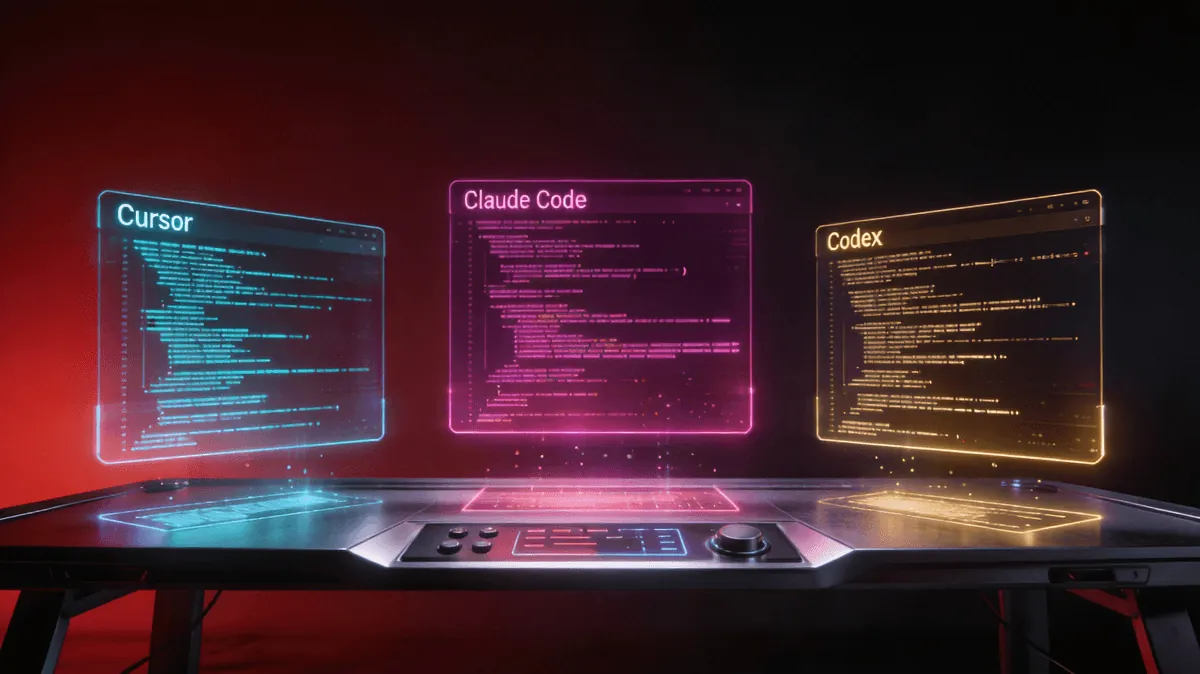
The AI coding landscape has evolved dramatically. Three tools now dominate the conversation — and the smartest developers are using all of them.
Introduction: The New Trinity of AI Coding
In 2026, the question is no longer whether AI will write your code. The question is which AI agent to use, and when. The three most powerful contenders have emerged as a distinct trinity: OpenAI Codex, Anthropic Claude Code, and Cursor — each representing a fundamentally different philosophy of how artificial intelligence should interact with human engineers.
These aren't just plugins or assistants. They're autonomous or semi-autonomous agents capable of planning, executing, and iterating on complex software tasks. But their differences in architecture, autonomy, and scale make them suited for radically different jobs.
This isn't a competition where one tool wins outright. It's a showdown that reveals the complementary strengths of each — and why the smartest engineering teams are running all three simultaneously, orchestrated by platforms like KaiheAiBox AIBOX-A1, which supports multi-agent parallel execution for 24/7 autonomous development workflows.
OpenAI Codex: The Cloud-Native Full-Stack Agent
What It Is
OpenAI Codex is the engine behind GitHub Copilot's most advanced capabilities, and it's also available as a standalone API and agentic system. Built on GPT-4o's architecture with deep code-specific fine-tuning, Codex operates primarily in the cloud, receiving high-level instructions and returning complete, production-quality code.
Architecture
Codex is a cloud-hosted agent. It doesn't run locally — every task is processed through OpenAI's infrastructure, meaning it has virtually unlimited compute backing it. It communicates via a REST API or native agentic loops, executing code through sandboxed cloud environments or integrated CI/CD pipelines.
Strengths
- End-to-end task completion: Give Codex a feature spec and watch it scaffold, implement, and test — without constant hand-holding.
- Broad language support: Trained on tens of billions of lines of code across hundreds of languages, Codex has few blind spots.
- Cloud-native integration: Seamless hook-in to GitHub Actions, Azure DevOps, and enterprise CI/CD systems.
- Multimodal reasoning: Understands not just code but architecture diagrams, documentation, and inline comments.
Limitations
- Latency: Round-trip cloud communication introduces delays that can frustrate developers who want instant feedback.
- Context windows: While OpenAI has expanded context windows significantly, Codex is still optimized for targeted tasks rather than ingesting entire enterprise codebases.
- Autonomy vs. control trade-off: High autonomy means less granular control — Codex will make architectural decisions you may need to reverse.
Best For
Codex excels at autonomous feature development, API integration tasks, and rapid prototyping. If you have a clear brief and need the AI to run with it without interruption, Codex is your cloud-native workhorse.
Claude Code: The Terminal-Class Engineering Agent
What It Is
Anthropic's Claude Code is a terminal-level programming agent that runs locally within your development environment. Built on the Claude 3.5 Sonnet and Opus models, it operates as a persistent CLI session — think of it as a senior engineer who lives in your terminal and understands your entire codebase.
Architecture
Claude Code runs as a long-lived local process. It reads files, runs shell commands, uses git, executes tests, and iterates autonomously — all within a single session. Its 200,000-token context window means it can hold an entire large-scale codebase in memory simultaneously.
Strengths
- Massive context capacity: 200K tokens allows Claude Code to truly understand large monorepos — something no other agent handles as gracefully.
- Local execution: No cloud latency, no data leaving your machine. Full privacy and instant feedback loops.
- Deep codebase awareness: Remembers file structures, variable names, and architectural patterns across sessions.
- Refactoring mastery: Particularly strong at large-scale code restructuring — it sees the whole picture before making surgical changes.
- Unix-native: Comfortable with grep, sed, awk, git, and the full Unix toolchain.
Limitations
- CLI-only interface: Not built for visual IDE workflows — developers who prefer GUI-heavy environments may find it unfamiliar.
- Steeper learning curve: Requires comfort with terminal workflows and agentic interaction patterns.
- Resource intensity: The large context window means it can be memory-hungry on very large codebases.
Best For
Claude Code is the go-to agent for large-scale refactoring, legacy system modernization, and complex multi-file architectural changes. If you're working with a 500K+ line codebase and need an AI that truly understands the whole picture, Claude Code is unmatched.
Cursor: The IDE-Native AI Pair Programmer
What It Is
Cursor is an AI-augmented code editor (built on VS Code) that integrates large language model capabilities directly into the development environment. It's not an agent in the classical sense — it's more like having an intelligent pair programmer embedded in your IDE at all times.
Architecture
Cursor runs as a desktop application with real-time AI inference via cloud API (with local options for certain models). Its architecture centers on tight IDE integration: inline completions, chat panels, predictive edits, and agentic apply modes — all within the same window where you write code.
Strengths
- Real-time code completion: Cursor's autocomplete is arguably the most fluid on the market — it predicts and applies multi-line changes as you type.
- Conversation-driven editing: You can chat with Cursor about a specific file or bug, and it will apply changes directly to the code with a single click.
- Project-wide indexing: Cursor indexes your entire project to provide contextually relevant suggestions.
- Multi-model support: Access to GPT-4o, Claude 3.5, and its own specialized coding models.
- Low barrier to entry: Developers familiar with VS Code can adopt Cursor in minutes.
Limitations
- Less autonomous: Cursor excels at assist mode — it's not designed to run off and build a feature independently.
- Context window constraints: While excellent for per-file context, its project-wide context management is less sophisticated than Claude Code's.
- Single-file focus: Its best results come from working within individual files rather than orchestrating multi-file architectural changes.
Best For
Cursor is ideal for daily coding sessions, bug fixing, and incremental feature work. It's the tool you open first thing in the morning when you need intelligent, real-time coding assistance as you work.
The Six-Dimension Comparison
| Dimension | OpenAI Codex | Claude Code | Cursor |
|---|---|---|---|
| Architecture | Cloud-native API agent | Local terminal agent | IDE-native desktop app |
| Code Quality | High — trained on massive corpus | Excellent — strong reasoning | Very good — context-aware |
| Project Scale | Medium (optimized per-task) | Excellent (200K context) | Good (project-indexed) |
| Autonomy Level | High (end-to-end capable) | High (local execution) | Medium (human-in-loop) |
| Context Window | ~128K tokens (API) | 200K tokens (native) | ~100K (project-indexed) |
| Best Scenario | Autonomous cloud tasks | Large codebase refactoring | Real-time pair programming |
They're Complementary, Not Competitive
The most important insight from this comparison: these tools are designed for different layers of the development stack, and using them together produces dramatically better outcomes than picking any single winner.
Here's the workflow we recommend:
-
Morning: Cursor — Open your project in Cursor and code with real-time AI completion. Fix bugs, write unit tests, refactor individual functions.
-
Mid-task: Claude Code — When you hit a complex refactoring challenge or need to modernize a legacy module, switch to Claude Code in your terminal. Let it analyze the full scope of changes needed and execute them.
-
Epic feature: Codex — For a new service, a major API integration, or a greenfield project, hand the spec to Codex and let it build the scaffolding end-to-end, then review and iterate.
This layered approach means you're always using the right tool for the job — not forcing a single agent to do everything.
KaiheAiBox AIBOX-A1: Multi-Agent Orchestration in One Device
This is where the 2026 AI coding story gets truly compelling. KaiheAiBox AIBOX-A1 is designed as a dedicated AI agent computer that can run multiple programming agents simultaneously — including Codex, Claude Code, and Cursor instances — without the cloud dependency that limits most tools.
Key capabilities of AIBOX-A1: - Parallel multi-agent execution: Run Codex for cloud API tasks, Claude Code for local refactoring, and Cursor for IDE sessions — all at the same time on a single device. - Local-first privacy: All code stays on-device, critical for enterprise environments with strict data governance requirements. - 24/7 autonomous development: With multi-agent orchestration, AIBOX-A1 can run continuous development pipelines that cycle through different agents as tasks demand. - Unified context management: AIBOX-A1's orchestration layer manages context across agents, preventing the silos that typically emerge when running multiple AI tools in parallel. - Agent swapping on demand: When one agent hits a capability ceiling, AIBOX-A1 can transparently hand off to another agent mid-task.
For engineering teams, AIBOX-A1 represents a shift from "which AI should I use?" to "how do I run all of them, all the time?"
Conclusion: The Era of Agentic Development
The Codex vs. Claude Code vs. Cursor showdown reveals something deeper than competitive product features. It reveals the emergence of a layered AI development stack — where cloud agents, local agents, and IDE-native assistants each own a distinct role in the software development lifecycle.
Codex handles the autonomous cloud layer. Claude Code owns the deep local analysis and refactoring layer. Cursor owns the real-time human-in-the-loop layer. Together, they cover the full spectrum of what modern software development demands.
And with KaiheAiBox AIBOX-A1, teams can finally run all three in parallel — not as a compromise, but as a deliberate architecture that harnesses the unique strengths of each tool.
The developers who understand this will build faster, better, and more reliably than those still trying to do everything with a single AI tool.
The era of agentic development is here. Are you ready?
Authored by KaiAIBox | Agentaibox that lets AI work for you 24/7 · AI Agent
#Codex #ClaudeCode #Cursor #AICoding #KaiheAiBox