COMPUTEX 2026: Three Giants Declare 2026 the Year of Agents — AI Moves from Cloud Training to Edge Deployment
📖 Glossary
AI Box (also known as Agent Computer / Agent PC), is a dedicated local hardware device that runs AI Agents. Pre-installed with an AI agent management system, plug-and-play, running 24/7. Users can remotely command AI to work via Discord, Slack, Telegram, WhatsApp, and more.
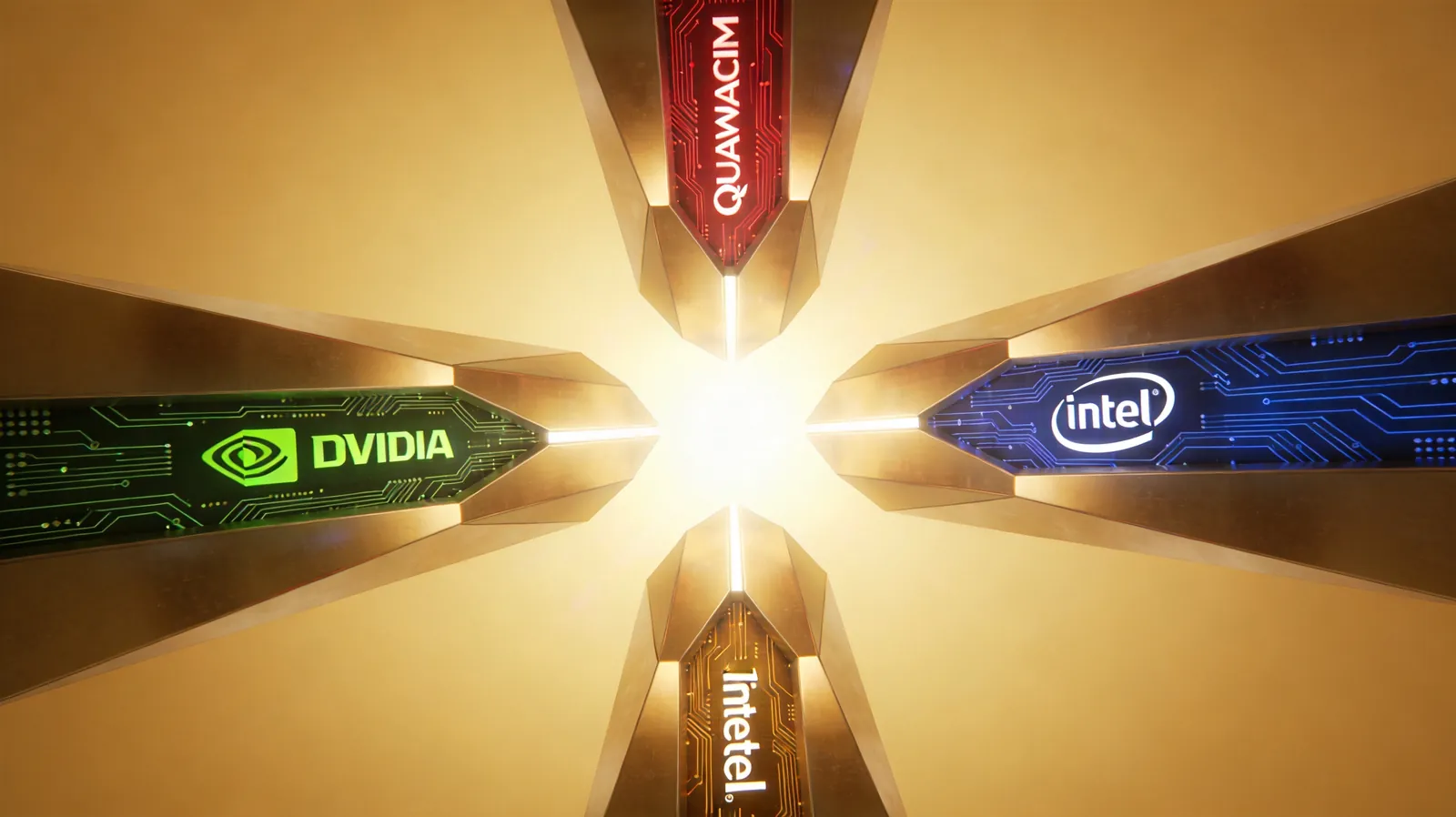
Summary: At COMPUTEX 2026, NVIDIA, Qualcomm, and Intel collectively declared 2026 the Year of Agents. NVIDIA's RTX Spark enables consumer PCs to locally run 120B-parameter models for the first time, Qualcomm defines the value of on-device mobile Agents, and Intel releases Execution Containers for secure Agent sandboxing. The consensus: AI is shifting from cloud training to edge deployment, a major boon for local deployment ecosystems.
1. What Did the Three Giants Say?
NVIDIA: RTX Spark — New Benchmark for Consumer Local Inference
Jensen Huang officially launched the RTX Spark platform in his COMPUTEX 2026 keynote — a consumer GPU built on the Blackwell Ultra architecture, designed specifically to support local execution of 120B-parameter large language models. This is a category shift that deserves careful examination. Until this announcement, running a model of this scale required either a cloud API call or a datacenter-grade workstation. RTX Spark collapses that requirement: models that previously demanded cloud infrastructure can now run directly on personal computers costing a fraction of comparable cloud subscriptions.
The hardware specs tell part of the story. The RTX Spark ships with 48GB of GDDR7 VRAM — a specification that sits between workstation cards like the RTX 6000 Ada (48GB) and consumer variants like the RTX 5090 (32GB). That memory bandwidth matters because 120B-parameter models at FP16 precision require approximately 240GB to load into memory for inference, meaning 48GB is tight but achievable through quantization techniques. NVIDIA's documentation confirms support for INT8 and INT4 quantization, which reduces VRAM requirements to roughly 60GB and 30GB respectively — enabling the full model to run at acceptable token speeds within the 48GB envelope.
Key specs: - Local inference speed: ~15 tokens/s for 120B models (INT8 quantized) - VRAM: 48GB GDDR7 - Power consumption: 350W (full system, including CPU and RAM) - Supports 4 concurrent Agents running simultaneously - Agent Runtime pre-installed, integrated with CUDA 14 toolkit
But the more strategically important announcement was Agent Runtime — NVIDIA's dedicated runtime environment for local AI Agents. Agent Runtime is not merely an inference accelerator. It is infrastructure middleware designed to solve three persistent problems that have historically made local Agent deployment a developer's headache:
Agent persistent execution (crash recovery): Agent applications are long-running processes that can fail mid-task. Agent Runtime provides watchdog supervision with automatic restart, state checkpointing every 30 seconds, and session resumption from the last known good state. This is conceptually similar to systemd for containers, but purpose-built for Agent workloads.
Inter-Agent communication protocols (multi-Agent collaboration): Modern Agent architectures increasingly rely on multi-Agent systems where specialized Agents coordinate to complete complex tasks. Agent Runtime defines a standardized message-passing interface (similar in concept to the Model Context Protocol, but implemented at the OS level) that allows Agents to share context, delegate sub-tasks, and negotiate resources without requiring the developer to implement custom IPC code.
Agent permission tiers (separate authorization): Each Agent can be assigned a permission profile that governs its access to filesystem, network, and system resources. This is the authorization layer that turns an unrestricted AI model into a constrained Agent. Permission profiles are hierarchical — a calendar Agent might have read/write access to the calendar store and read access to contacts, but no filesystem or network permissions. This principle of least privilege is foundational to making Agents safe to deploy outside sandboxed environments.
Before Agent Runtime, running Agents locally meant cobbling together your own infrastructure using a combination of Docker, systemd, custom scripts, and access-control lists. Agent Runtime collapses this stack into a single standardized layer, making local Agent deployment as straightforward as running a containerized application. Developers no longer need to worry about process management, inter-Agent message passing, or permission boundaries — Agent Runtime handles all of this out of the box. The analogy to Docker in 2013 is apt: Docker didn't create containers, but it made them accessible to anyone who could run a single command.
Huang's exact words from the keynote stage: "Every PC will become an Agent PC." The statement is a declaration of architectural intent, not a product claim. It means NVIDIA is positioning the PC not merely as a productivity tool but as an Agent execution platform — a node in a distributed intelligence network where Agents run persistently in the background, scheduling, monitoring, and executing workflows independent of direct user input.
The implications extend far beyond individual productivity gains. When every PC can run Agents natively, it fundamentally changes how software is built and consumed. The current model — an application is installed, a user opens it, the user directs its operation — gives way to a model where an application is deployed and an Agent operates it on behalf of the user. The PC transforms from a tool the user drives to a platform that Agents drive. This shift in the user-facing metaphor has cascading effects on the entire software industry: monetization models change, distribution channels shift, and the relationship between hardware capability and software utility is redefined.
Qualcomm: On-Device Agents Are the Core Value of AI Phones
While NVIDIA was drawing headlines with GPU architecture, Qualcomm CEO Cristiano Amon delivered what may be the most practically significant keynote of COMPUTEX 2026 — one that reframed the entire conversation about AI smartphones. Amon's central thesis was deceptively simple: the core value proposition of AI phones is not about running larger models on mobile hardware. It is about the ability for on-device Agents to run continuously, providing ambient intelligence that responds to context without requiring explicit user invocation.
To understand why this matters, consider the current state of mobile AI. Since 2023, smartphone manufacturers have competed primarily on benchmark scores — comparing NPU TOPS (tera operations per second) as though higher numbers automatically translate to better user experiences. Qualcomm's Snapdragon 8 Gen 5 Elite, announced at the same event, reaches 75 TOPS of NPU compute — a figure that enables genuine on-device inference for models up to 7B parameters, depending on precision. Competitors at MediaTek and Apple are approaching similar figures.
But Amon argued — convincingly — that raw compute is the wrong battlefield. "What matters," he said, "is not how fast the phone can answer a question. What matters is whether the phone can act on your behalf, continuously, without draining your battery." This reframes the competitive metric from "TOPS" to "agent-hours per charge."
The Snapdragon 8 Gen 5 Elite supports 3 to 5 lightweight Agents running simultaneously on the phone. Qualcomm demonstrated three specific Agent archetypes:
- Automatic message classification Agent: Continuously monitors incoming messages across SMS, email, and messaging apps, categorizing them by urgency, topic, and sender, surfacing only the most relevant notifications to reduce cognitive load.
- Smart schedule orchestration Agent: Monitors calendar, location, traffic data, and meeting context to proactively suggest schedule adjustments, sends迟延 notifications before meetings, and manages meeting prep materials autonomously.
- Cross-app action chain Agent: Executes multi-step workflows that span multiple applications — for example, booking a flight requires navigating an airline app, filling in passenger details from contacts, comparing prices, and initiating payment. This cross-app Agent capability represents a first for mobile devices.
The live demonstration was the keynote's most memorable moment. Amon spoke the command "book my flight for tomorrow" and watched as the Agent autonomously opened the airline app → searched for flights matching the user's calendar preference → compared prices across carriers → populated the frequent flyer number from the user's profile → prepared the booking for payment confirmation. The entire process required zero app switching by the user; the Agent navigated the application boundaries on its own.
This cross-app capability deserves deeper technical attention. iOS and Android application sandboxes are explicitly designed to prevent cross-app data access — a security principle that has governed mobile computing since the platform's inception. Qualcomm's solution involves a tiered permission model where the user grants the Agent an "app operator" role that allows it to interact with UI elements (buttons, form fields, navigation) programmatically, using Android's accessibility APIs. The Agent does not read app data directly; it simulates user interactions through the standard accessibility layer, which every legitimate app exposes for accessibility compliance. This is architecturally distinct from screen scraping — it operates at the OS API level, making it more reliable and consistent across apps.
The technical architecture of the Hexagon NPU's persistent Agent support is worth unpacking. Qualcomm's Hexagon NPU has historically been optimized for burst inference — run the model quickly, then power down. The Gen 5 Elite introduces persistent Agent processes that remain active even when the screen is off and the phone is in the user's pocket. This "always-listening" capability is powered by a dedicated low-power island within the Snapdragon SoC, consuming less than 50mW while maintaining Agent readiness. For context, the entire phone in standby mode typically consumes 3-5mW; 50mW is approximately 10-15x the standby draw, which is material but manageable for the added capability. In a 4,000mAh phone battery, a 50mW constant draw translates to roughly 80 hours of continuous Agent operation before battery depletion — acceptable for overnight availability.
Amon's keynote closed with the phrase that crystallized the event's collective thesis: "Cloud is for training, edge is for running." It is a statement that echoes AMD's "live migration is for VMs, edge is for workloads" from the previous decade's infrastructure revolution — a sign that the industry has reached consensus on a architectural principle that was contested just 18 months ago.
Intel: Security Sandboxes Let Agents Run Safely
Intel's COMPUTEX 2026 announcement was the most deliberately understated of the three — and possibly the most important for enterprise adoption. Intel released Execution Containers — a secure sandbox environment designed specifically for AI Agents, not for performance optimization, not for benchmark leadership, but for trust.
Intel CTO Greg Lavender's opening statement set the tone for the company's entire COMPUTEX presence: "Enterprise adoption of Agents is bottlenecked by trust, not performance. We have solved performance. We are now solving trust." This is an honest acknowledgment that the enterprise Agent market's primary barrier is not technical capability — it is organizational and psychological. CIOs and CISOs cannot approve Agent deployments when they cannot answer the question: "what can this Agent do if something goes wrong?"
The technical specification of Execution Containers is where Intel's credibility as an enterprise company shows:
- Lightweight sandbox based on gVisor: gVisor (Google's open-source container runtime) provides kernel-level isolation using a user-space kernel implementation. Execution Containers layer on top of gVisor's Sentry process, adding Agent-specific context. Startup time is under 200ms — fast enough to spin up containers per-task without perceptible latency.
- Fine-grained permission control: The permission model extends gVisor's basic capabilities into a richer taxonomy covering network whitelisting (which domains/IPs an Agent can access), filesystem partitioning (read-only areas for system files, read-write areas for designated data directories), process creation limits (preventing Agents from spawning sub-processes without explicit authorization), and memory caps.
- Built-in audit logging: Every Agent operation — file access, network call, process spawn, permission escalation request — is logged with a timestamp, Agent ID, task context, and outcome. Logs are written to an append-only audit store that is tamper-evident. This addresses the "paper trail" requirement in regulated industries where every automated action must be attributable to a human-approvable process.
- Kubernetes integration: Execution Containers expose a standard Kubernetes operator interface, meaning enterprises can manage Agent workloads using the same tooling they use for microservices: the same kubectl commands, the same Helm charts, the same Prometheus metrics dashboards, and the same Argo CD deployment pipelines. This dramatically lowers the operational barrier — enterprises do not need to hire specialist Agent infrastructure engineers; they can deploy Agent workloads using existing Kubernetes competency.
The Kubernetes integration is particularly noteworthy because it directly addresses the operational complexity that has historically prevented enterprise Agent adoption. The current state of enterprise AI deployment is dominated by shadow IT: individual teams experiment with Agents using personal API keys, cloud accounts, and undocumented scripts — creating security and compliance blind spots. Execution Containers give IT departments a sanctioned pathway to manage Agent workloads within the existing DevOps framework.
Intel also announced partnerships with ServiceNow, Salesforce, and SAP to pre-configure Execution Container templates for their respective Agent use cases. ServiceNow's template covers IT service management Agents (ticket routing, knowledge base queries, incident escalation). Salesforce's template covers CRM Agents (lead qualification, opportunity updates, case management). SAP's template covers ERP Agents (procurement automation, financial reconciliation, inventory triggers). These templates provide pre-built permission profiles, audit log configurations, and network whitelists — enterprises can deploy Agent workloads in these categories within hours rather than weeks.
The strategic importance of Intel's announcement becomes clear when viewed against the competitive landscape. NVIDIA and Qualcomm are targeting consumer and prosumer markets — users who will voluntarily adopt Agent capabilities. Intel's market is enterprises that are obligated to adopt Agent capabilities carefully, with audit trails and compliance documentation. These are fundamentally different adoption curves: consumer adoption is driven by convenience; enterprise adoption is driven by permission. Intel correctly identified that the harder problem — enterprise trust — was also the under-served problem, and therefore the highest-value problem to solve.

2. Three Signals, One Direction
The three keynotes appeared, on the surface, to be independent product announcements from three companies that happen to share a trade show venue. A deeper reading reveals three converging signals that point in the same strategic direction: AI is undergoing a fundamental architecture shift from centralized cloud inference to distributed edge deployment, and the year this shift becomes visible at the industry level is 2026.
Signal 1: Agents Are AI's Next Stop, Not Chatbots
None of the three major keynotes — NVIDIA, Qualcomm, or Intel — used the phrase "conversational AI" in a substantive context. Every significant product announcement centered on Agents: autonomous execution, multi-step reasoning, tool invocation, persistent operation, and cross-system coordination. This represents an industry consensus shift from "AI answers your questions" to "AI completes your tasks."
The AI industry's narrative has undergone three distinct leaps over the past three years. 2024 was the "Year of Large Models" — whoever had the most parameters, the biggest training run, and the highest benchmark scores won mindshare. The competition was won by OpenAI, Anthropic, and Google DeepMind, with NVIDIA as the infrastructure enabler. 2025 was the "Year of Applications" — whoever successfully landed real-world use cases and demonstrated commercial ROI won. This phase belonged to vertical AI companies (Harvey, Glean, Writer) and the first wave of enterprise AI deployments. 2026, as declared by the three giants at COMPUTEX, is the "Year of Agents" — whoever achieves autonomous execution at scale wins. This third leap represents the next competitive dimension: not model quality, not application fit, but Agent reliability, safety, and cost of autonomous operation.
The distinction between chatbots and Agents is not semantic — it is architectural. Chatbots require a user to be present and initiate every interaction. They are reactive systems: they respond when prompted and do nothing when idle. Agents are proactive systems: they can operate in the background, monitoring conditions, triggering actions, and coordinating with other Agents without requiring a human to initiate each step. This shift from reactive to proactive changes the entire interaction model and, more importantly, changes the economic model. A chatbot is billed per query; an Agent is potentially billed per task completed or per hour of availability. The business model implications are significant.
This shift has profound implications for the entire AI technology stack. Chatbots required large models and well-crafted prompts. Agents require all of that plus tool integration (APIs, function calls, database access), persistent state management (long-running context windows, session state across restarts), safety boundaries (permission models, action constraints, rollback mechanisms), and execution reliability (uptime guarantees, error recovery). The technology stack becomes significantly more complex, and the hardware requirements change accordingly. Chatbots needed occasional bursts of GPU compute. Agents need persistent compute infrastructure with safety isolation — a different and, for many enterprise scenarios, more demanding set of requirements.
Signal 2: Edge Deployment Is No Longer Optional — It's Required
NVIDIA enables local LLMs on consumer PCs. Qualcomm runs Agents on phone edges. Intel lets Agents run safely on enterprise premises. The product logic is consistent across all three: latency-sensitive, privacy-sensitive, and cost-sensitive tasks must run on-device. Cloud is useful for training and for complex reasoning tasks, but for the operational layer — the layer that actually executes tasks on behalf of users — edge deployment is the default architecture.
The economics of this shift are compelling and deserve detailed examination. Consider a mid-sized enterprise running 500 Agents for customer service, internal IT support, and document processing. A reasonable estimate is 1 million Agent API calls per day across the fleet. At current cloud API pricing (approximately $0.002–0.01 per token call, depending on model and provider), this generates monthly cloud bills of $7,000 to $15,000 purely for Agent API calls — before accounting for API management, retries, and data egress costs.
By redistributing the workload so that 80% of orchestration logic and lightweight inference runs on-premise while cloud APIs are reserved only for complex reasoning tasks, the same enterprise reduces cloud API calls to approximately 200,000 per day — a reduction of 80% — bringing monthly costs down to $1,500–3,000. The remaining 20% of calls (the complex reasoning cases) still travel to the cloud; the 80% (monitoring loops, routing decisions, document preprocessing) run locally. The numbers represent the difference between a manageable operational expense and a cost structure that undermines the business case for Agent deployment at scale.
For enterprises running hundreds of Agents 24/7, the delta between $15,000 per month and $3,000 per month is not incremental — it is structural. It is the difference between "interesting experiment" and "production deployment at scale." At 500 Agents, the annual savings of $144,000 funds two to three additional Agent headcount. The compounding effect makes edge deployment not merely a technical preference but the enabler of the economic case for mass Agent adoption.
The second dimension of the edge requirement is latency. Consider an inventory monitoring Agent that triggers a reorder when stock falls below a threshold. In a cloud-architecture, the monitor → analyze → trigger cycle involves network round-trips that add 200–800ms of latency. In an edge architecture, the same cycle executes locally in 5–20ms. For event-driven workflows with thousands of daily triggers, this latency reduction translates directly to faster response times and reduced decision windows.
The third dimension is privacy. When an Agent processes sensitive data — customer records in a CRM, financial data in an accounting system, health records in a medical practice — cloud architecture requires that data to travel across the public internet or at least through a service provider's infrastructure. Edge architecture keeps data within the enterprise's network perimeter, eliminating an entire category of data leakage risk and simplifying compliance with data residency regulations.
Signal 3: Security and Trust Are the Last Mile for Agent Mass Adoption
Intel made security sandboxes the headline release. Qualcomm emphasized on-device data isolation and hardware-level permission controls. NVIDIA built Agent permission management into RTX Spark's Agent Runtime. All three are solving the same problem from different angles: how to make users — and more importantly, enterprises — trust Agents running locally with real system access.
This problem's importance is severely underestimated in current industry discourse. Gartner's March 2026 survey of 1,240 enterprise CIOs across North America, Europe, and Asia-Pacific found that 67% cite "concerns about Agent permission control" as the primary reason for not deploying Agents in production — ranking above both "technology immaturity" (43%) and "unclear ROI" (38%). This means the primary blocker for Agent adoption is not technical capability; it is organizational trust. Enterprises know Agents can be powerful. They are uncertain about how to constrain that power.
The trust deficit creates a structural paradox. Agents are most valuable when they have broad system access — the ability to read files, send emails, modify records, and execute API calls across the enterprise's digital infrastructure. But this is exactly the access profile that makes IT security teams nervous. An Agent with broad access is an Agent that can do significant damage if it malfunctions, is fed corrupted data, or is compromised by an adversarial prompt. The paradox is that the most capable Agent is also the most dangerous Agent, and organizations cannot adopt what they cannot safely constrain.
Intel's Execution Containers directly address this paradox by providing fine-grained, auditable permission boundaries. An Agent running inside an Execution Container can be granted exactly the access it needs to perform its designated task — and no more. The audit log ensures that even approved operations are traceable to a specific Agent, task, and user. This transforms the risk calculus: instead of asking "what can this Agent do?", enterprises can ask "what has this Agent done, and can we verify it?"
The security conversation extends beyond internal enterprise trust to data sovereignty. When Agents process sensitive enterprise data — customer records, financial information, strategic documents — the question is not just "can the Agent access this?" but "where does the data go?" Cloud-based Agents necessarily move data across network boundaries. Edge-deployed Agents keep data within the enterprise's perimeter, addressing regulatory requirements in healthcare (HIPAA mandates that patient data cannot leave covered entity control without specific authorization), finance (SOC 2 Type II compliance requires data handling controls that are easier to audit on-premise), and government (FedRAMP Moderate authorization requires data residency controls that edge deployment satisfies by construction).
3. What Does This Mean for KaiheAiBox?
The three giants' positioning at COMPUTEX 2026 is not a competitive threat to KaiheAiBox — it is validation of the direction KaiheAiBox has pursued since its founding. When NVIDIA, Qualcomm, and Intel collectively announce that edge Agents are the strategic priority for the next several years, they are confirming that KaiheAiBox's core thesis — that dedicated edge hardware for Agent workloads is a distinct, valuable, and underserved product category — is correct. The competitive landscape is shifting from "edge Agents: concept or real?" to "edge Agents: how do we make them work at scale?" That second question is exactly the question KaiheAiBox has been engineering around for the past year.
KaiheAiBox A1 and B1 are positioned as dedicated hardware platforms for edge Agent workloads. This positioning deserves careful unpacking, because it is frequently misunderstood. KaiheAiBox is not a general-purpose PC. It is not a training rig for large models. It is an Agent Computer — a purpose-built device engineered to run Agent tasks 24/7 with stability, low power, and minimal maintenance. The distinction between "general-purpose PC running Agents" and "Agent Computer" is analogous to the distinction between "server" and "appliance" — one is a flexible platform that requires expertise to operate; the other is an appliance that is configured to do one thing well.
The hardware choices in KaiheAiBox A1 and B1 reflect this positioning precisely. ARM architecture is chosen not as a cost-cutting measure but as an architectural optimization: for the workloads that most Agents actually perform — monitoring, scheduling, data aggregation, API orchestration, notification dispatch — x86 compatibility is irrelevant, and the power efficiency of ARM architecture is directly relevant. A 10W power draw is chosen because Agents are long-running processes; a device that draws 350W like an RTX Spark workstation costs $250–400 per month in electricity at typical commercial rates, making it economically irrational for 24/7 Agent workloads that spend most of their time in low-activity monitoring states. Fanless silent operation is chosen because Agent appliances live in offices, server rooms, and homes — environments where fan noise is not acceptable — and because the absence of mechanical failure points (fans, spinning disks) directly improves reliability for always-on deployment.
These choices are not compromises. They are the optimal solution for the Agent operation profile that characterizes 80% of real-world Agent deployments:
- No GPU inference compute is needed because cloud APIs handle LLM inference more cost-effectively than local inference for most use cases. A local GPU only becomes necessary when inference volumes are extremely high or when network connectivity is unreliable.
- No x86 compatibility is needed because Agent orchestration workloads run natively on ARM, and the required Agent frameworks (Python-based, containerized) have robust ARM support.
- 24/7 online requirement is met by design: the low-power architecture enables always-on operation economically.
- Physical isolation is provided by the appliance form factor, which keeps Agent workloads in a dedicated, separable environment separate from the user's primary computing device.
A common misconception in the AI hardware space needs to be directly addressed: edge deployment does not equal local LLM execution. These are two different technical approaches that serve overlapping but distinct use cases. NVIDIA's RTX Spark is optimized for the scenario where local LLM execution is a hard requirement — either because network connectivity is unreliable or because the inference workload is too large for practical cloud API calls. KaiheAiBox's "edge" is the Agent's edge — orchestration, scheduling, state management, and API interaction run locally, while heavy inference is handled through cloud APIs. Both approaches enable Agents to run at the edge, but they address different points in the architecture stack.
The distinction matters because it defines KaiheAiBox's addressable market. Not everyone needs to run 120B models locally. Most Agent tasks — monitoring email for specific keywords, checking inventory levels against thresholds, aggregating sales data from multiple APIs, dispatching notifications when conditions are met, processing and categorizing incoming documents — require reliable 24/7 execution more than they require raw inference horsepower. These tasks spend 95% of their time in low-activity states (waiting for an event, polling an API, holding context in memory) and 5% of their time in active processing (calling an API, executing a function, sending a notification). KaiheAiBox is engineered for exactly this profile: high availability, low steady-state power consumption, with burst capability for API calls when needed.
Consider a concrete enterprise scenario. A mid-sized logistics company wants to deploy three Agents simultaneously: a customer service Agent that handles tier-1 inquiry routing, an inventory monitoring Agent that triggers purchase orders when stock falls below reorder thresholds, and a report generation Agent that compiles weekly operational summaries from multiple data sources. Each Agent needs to be available 24/7. None of them requires constant LLM inference — they spend most of their time waiting for events (new customer message, inventory threshold breach, scheduled report time) and invoke LLM reasoning only when action is required. On cloud infrastructure, the three Agents would incur continuous API costs even during idle periods. On KaiheAiBox A1, the three Agents run with minimal power draw, invoke cloud APIs only when needed, and remain available at all times without accumulating per-minute cloud charges.
The three giants are collectively driving the "edge Agent" category from concept to market. When NVIDIA commits to "every PC becomes an Agent PC," when Qualcomm demonstrates that on-device Agents are the core value of AI phones, and when Intel makes Agent security a first-class enterprise concern, they are spending billions of dollars on market education — teaching enterprises and consumers that Agents can and should run locally. KaiheAiBox benefits from this market education investment without contributing to its cost.
More specifically, each of the three announcements creates a stepping stone for KaiheAiBox's market positioning:
- NVIDIA's "Agent PC" narrative legitimizes the concept of PCs running Agents, building user familiarity with Agent-based workflows. Users who understand that "my PC can run Agents" become potential customers for KaiheAiBox when they realize they want 24/7 Agent operation without tying up their personal computer.
- Qualcomm's on-device Agent demonstrations normalize the idea of Agents running continuously in the background, independent of user interaction. Users accustomed to their phone running an Agent are more likely to understand and value the concept of a dedicated Agent appliance.
- Intel's Execution Containers make enterprise IT departments comfortable with the idea of Agents running within their network perimeter. Once an enterprise has internalized that "Agents can run securely in my environment," the question shifts from "why run Agents locally?" to "what hardware best serves my Agent workloads?" KaiheAiBox's answer — dedicated, low-power, always-on hardware — becomes more compelling.
The market education dynamic is particularly important for a niche player like KaiheAiBox. Building category awareness from scratch is expensive — IDC estimates that B2B technology category education costs range from $2 million to $10 million per year for a niche player attempting to create a new category. By arriving in an established category that the three giants have spent billions validating, KaiheAiBox's customer acquisition costs decrease substantially. Users no longer need to be educated on the foundational concept of "why run Agents locally" — KaiheAiBox only needs to answer the more specific and more answerable question: "what hardware best serves my always-on Agent workload?"
This is the "rising tide lifts all boats" effect in action. The three giants are investing in establishing the edge Agent category; KaiheAiBox, as the earliest dedicated hardware vendor in this space, captures disproportionate value from this category establishment. The analogy to the early cloud computing era is instructive: AWS, Microsoft Azure, and Google Cloud collectively invested billions establishing the cloud computing category; hundreds of niche SaaS companies then built on top of that category, benefiting from the established infrastructure and market familiarity without bearing the education costs.
KaiheAiBox's product differentiation in the emerging edge Agent landscape
As the edge Agent hardware category matures, KaiheAiBox's positioning becomes increasingly clear relative to the approaches announced at COMPUTEX 2026. RTX Spark targets power users and developers who want local LLM inference at desktop compute levels. Qualcomm's on-device approach targets consumers who want lightweight Agent features on their smartphones. Intel's Execution Containers target large enterprises with existing Kubernetes infrastructure. KaiheAiBox targets the gap between these segments: non-technical users and small-to-medium enterprises who want reliable, always-on Agent operation without the complexity, power consumption, or cost of a full workstation or enterprise infrastructure stack.
The 10W power envelope is the pivotal differentiator. At 10W, a KaiheAiBox device costs less than $1 per month in electricity at typical commercial rates — a figure that makes 24/7 operation economically unremarkable. At 350W (the RTX Spark full system draw), the monthly electricity cost exceeds $25, which is significant enough to factor into the deployment decision. For enterprises deploying 10, 20, or 50 Agent nodes, the power cost differential between RTX Spark-class hardware and KaiheAiBox-class hardware becomes material: 50 RTX Spark-class devices draw 17.5kW (costing $125+/month in electricity), while 50 KaiheAiBox-class devices draw 500W (costing less than $4/month). Over a three-year deployment, the electricity differential alone — $4,356 versus $144 — funds a meaningful portion of new Agent node acquisition.
The WeChat-ready positioning is another meaningful differentiator. WeChat's mini-program ecosystem serves as the primary digital interaction layer for hundreds of millions of Chinese consumers and a significant portion of small-to-medium business workflows. An Agent appliance that integrates natively with WeChat — enabling Agents to interact with users, dispatch notifications, process mini-program events, and coordinate with enterprise WeChat accounts — occupies a unique position that neither NVIDIA's GPU platform nor Qualcomm's phone platform can easily replicate. WeChat-based workflows represent a specific, large, and underserved market for Agent automation that KaiheAiBox is uniquely positioned to address.
4. The Hardware Battle for Edge Agents Has Just Begun
The most important signal from COMPUTEX 2026 is not the specific products announced — it is the implicit acknowledgment that hardware standards for edge Agents have not yet been established. Each of the three giants has taken a different architectural approach, reflecting different assumptions about which workloads matter most, which form factors are most appropriate, and which price points will drive adoption. This diversity of approaches is a healthy sign: it means the category is still being defined, and that the eventual winners have not yet been determined.
NVIDIA's approach — "Powerful GPU + local LLMs" — targets professional users, developers, and power users who want maximum inference capability at the consumer price point. The RTX Spark platform is a genuine technical achievement: it is the first time 120B-parameter model inference has been achievable on consumer-grade hardware. However, the $1,500+ retail price and 350W system power consumption make it a niche product rather than a mass-market device. The audience for RTX Spark is the developer who wants to run a local LLM for privacy or latency reasons, the researcher who needs rapid iteration on model evaluation, or the professional who processes sensitive data that cannot leave their premises. These are valid and valuable use cases, but they represent a subset of the broader Agent deployment market.
Qualcomm's approach — "Phone NPU + lightweight Agents" — targets consumer mobile users who want ambient AI assistance in their daily lives. Phone-based Agents are the most accessible entry point to the Agent concept: they require no additional hardware purchase, no installation, and no configuration. However, phone-based Agents are inherently constrained by their compute envelope (the SoC's thermal dissipation limit), their battery capacity, and the fundamental use case mismatch of running background tasks on a device that users also use for phone calls, messaging, and entertainment. A phone Agent that runs continuously drains battery; a phone Agent that runs only when the screen is on defeats the "always-available" premise. Qualcomm's "always-listening" mode at 50mW is a clever technical compromise, but it represents a fundamental trade-off that most users will find limiting for serious Agent workloads.
KaiheAiBox's approach — "ARM low-power + cloud APIs" — targets beginners and small-to-medium enterprises who want reliable, always-on Agent operation at minimal cost, complexity, and power consumption. The 10W power envelope, sub-dollar monthly electricity cost, and appliance form factor make KaiheAiBox the most operationally straightforward path to 24/7 Agent deployment. The trade-off is clear: KaiheAiBox delegates heavy LLM inference to cloud APIs, which means network connectivity is required for inference operations and that inference has associated per-token costs. For use cases where inference volumes are extremely high or network connectivity is unreliable, this trade-off may not be acceptable. For the majority of Agent deployments — monitoring, scheduling, orchestration, event-driven workflows — the trade-off is advantageous.
These three approaches are not mutually exclusive replacements. They are optimal solutions for different user segments and use case categories. The server/laptop/phone analogy from earlier applies here: server workloads and laptop workloads are not in competition — they serve different needs. In the same way, RTX Spark's local LLM capability, Qualcomm's phone-based Agents, and KaiheAiBox's always-on appliance occupy distinct positions in the ecosystem. The market will segment by use case rather than consolidating behind a single approach.
The key insight is that KaiheAiBox occupies the "low-power continuous operation" niche — and this niche happens to be exactly what mass Agent deployment needs most. Most Agent tasks do not require real-time LLM inference. They require 24/7 availability (Agents must be online when events occur, regardless of the time), low-latency response (an inventory Agent that takes 10 seconds to detect a threshold breach is less effective than one that detects it in 10 milliseconds), and uninterrupted stability (an Agent that requires reboots and maintenance windows is unsuitable for production deployment). These three requirements — availability, latency, stability — are met most cost-effectively by low-power dedicated hardware, not by high-power general-purpose compute.
The next 12 months will determine which approach gains the most traction in each market segment. Based on the current trajectory, our prediction is that the market will segment clearly by use case, with no single approach dominating across all segments. Enterprise environments with existing Kubernetes infrastructure will likely adopt Intel's Execution Containers as their Agent security layer, potentially combining them with NVIDIA-style local inference for sensitive workloads. Consumer mobile will remain Qualcomm's domain, with phone-based Agents becoming a standard feature rather than a differentiating capability. And the "always-on Agent appliance" segment — KaiheAiBox's territory — will grow rapidly as non-technical users and small businesses seek the simplest path to deploying Agents without the complexity or cost of a workstation or enterprise infrastructure stack.
Apple: The wildcard worth watching
There is a fourth player whose COMPUTEX 2026 absence is itself notable. Apple did not exhibit at COMPUTEX — a meaningful statement given that Apple Silicon's Neural Engine represents one of the most capable on-device AI inference architectures available. Apple's A18 Pro chip delivers approximately 35 TOPS of neural engine compute, and the M4 chip family reaches 38 TOPS — figures that, while below Qualcomm's 75 TOPS claim, represent genuine on-device AI capability within a highly power-efficient architecture.
Apple's strategic advantage is its vertically integrated ecosystem. Apple controls the hardware (A-series and M-series chips), the operating system (iOS and macOS), the application layer (first-party apps), and the developer platform (App Store, Swift, Metal). This vertical integration means Apple could, in principle, implement Agent capabilities at a level of integration that no other platform can match — Agents that operate across Apple apps, hardware sensors, and system services with deep OS-level access.
The wildcard question is whether Apple will open its Neural Engine for third-party Agent frameworks. Apple's historical approach — a tightly controlled, walled-garden ecosystem — has been commercially successful but limits Apple's appeal for enterprise and developer audiences who require cross-platform compatibility. If Apple opens its Neural Engine to third-party Agent frameworks (a move that would require a significant strategic pivot), it could become the dominant consumer edge Agent platform — particularly if the opening extends to macOS and the Mac as a potential Agent execution platform. If Apple maintains its closed approach, it will remain a strong consumer AI platform but not a platform for the broader Agent ecosystem.
Conclusion
COMPUTEX 2026 will be remembered as the moment the three dominant computing platform companies aligned on a single thesis: that AI's next frontier is not larger models in the cloud, but autonomous Agents running at the edge. NVIDIA's RTX Spark with Agent Runtime validates local LLM inference on consumer hardware. Qualcomm's Snapdragon 8 Gen 5 Elite and on-device Agent framework validates continuous mobile Agent operation as the core value of AI phones. Intel's Execution Containers validate enterprise Agent security as the prerequisite for production deployment.
Each announcement solves a different piece of the edge Agent puzzle. Together, they map the boundary of the problem space: from consumer desktop (NVIDIA) to mobile (Qualcomm) to enterprise infrastructure (Intel). What they do not yet address is the always-on, low-power, minimal-complexity Agent appliance — the category that KaiheAiBox has been building toward since its founding. As the edge Agent category matures and the market segments by use case, the always-on appliance segment will grow to address the users who want Agent capabilities without the complexity of configuring a PC, the power consumption of a workstation, or the limitations of a smartphone.
One thing is certain: in 2026, edge Agents are no longer a concept — they are a reality in progress, with committed investment from the three most influential computing companies in the world. And KaiheAiBox has been running on this path since the beginning, not waiting for validation before acting, but building the infrastructure that the market is now beginning to understand it needs.
Key insight: The three giants lit the fire for edge Agents; KaiheAiBox prepared the fuel. While the industry debates "where should Agents run," KaiheAiBox is already running — quietly, continuously, and at 10 watts.
KaiheAiBox| Agentaibox that lets AI work for you 24/7· AI Frontier