GPT-5.5 Only 8% Better but 3x More Expensive: Is Scaling Law Really Hitting a Wall?
📖 Glossary
AI Box (also known as Agent Computer / Agent PC), is a dedicated local hardware device that runs AI Agents. Pre-installed with an AI agent management system, plug-and-play, running 24/7. Users can remotely command AI to work via Discord, Slack, Telegram, WhatsApp, and more.
Abstract: GPT-5.5 shows 8-12% benchmark improvement while training costs increase 3.2x. Diminishing returns of Scaling Law are being discussed publicly for the first time. If throwing more compute only yields single-digit gains, where does the LLM race go next?
8%.
That's roughly the benchmark improvement of GPT-5.5 over GPT-5. Some dimensions reach 12%, others just 5%. Meanwhile, training GPT-5.5 cost an estimated 3.2x more compute than GPT-5.
3.2x the compute for 8% improvement. The math doesn't work.
The Numbers
| Model | Release | Improvement over predecessor | Training cost (estimated) |
|---|---|---|---|
| GPT-4 | Mar 2024 | Baseline | ~$100M |
| GPT-5 | Jun 2025 | +25-35% | ~$500M |
| GPT-5.5 | Apr 2026 | +8-12% | ~$1.6B |
From GPT-4 to GPT-5: 5x cost for ~30% improvement. Acceptable. From GPT-5 to GPT-5.5: 3.2x cost for 8% improvement. Cliff-edge drop in return on investment.
OpenAI knows this. At the GPT-5.5 launch, Sam Altman unusually mentioned the word "capability plateau." Nobody dared say it before — saying it affects fundraising and valuations.
What Is Scaling Law
Simply put: bigger models, more data, more compute = smarter AI. This has been the industry's foundational belief since 2020.
From 2020-2024, this belief was repeatedly validated. GPT-3 → GPT-4, parameters from 175B to 1.8T, capabilities genuinely leaped forward. But in 2025-2026, returns started diminishing.
Scaling Law isn't wrong — it's still working. It's just that each unit of resource投入 produces less and less output. Like pouring water into a glass: the first few cups raise the level noticeably, but when the glass is nearly full, one more cup barely moves the level.
Why Diminishing Returns
Three reasons:
Low-hanging fruit is picked. Learning language understanding, logical reasoning, and code generation was relatively easy. Improving further — precise mathematical proofs, zero-error code generation — difficulty grows exponentially.
High-quality data is finite. There's only so much high-quality training data on the internet. Synthetic data can supplement, but models trained on synthetic data tend to "self-reference," becoming narrower over time.
Compute efficiency is peaking. Under current GPU architectures, compute utilization is approaching theoretical limits. Next-gen chips (NVIDIA Rubin R1) might help, but that's a hardware generation shift, not an algorithmic breakthrough.
What This Means for the Industry
For big tech: Keep spending or pivot? OpenAI and Google DeepMind won't stop, but they'll adjust strategy — less focus on raw model scale, more on inference optimization, tool use, and Agent capabilities. The model itself has limited headroom, but model + tools + Agent combinations still have massive room.
For open source: Good news. Closed-source model improvements are slowing, meaning open-source models have a window to catch up. GLM-5.2 already tops global coding and design rankings. DeepSeek V4 leads on price-performance. The gap is shrinking, not growing.
For users: Stop waiting for "the next model." GPT-5.5-level models are good enough. The real question is how to use existing models well, not waiting for stronger ones. Agents, tool chains, workflows — that's where the real differentiation happens.
If Not Compute, Then What
Since raw compute scaling has diminishing returns, where's the next path?
Test-Time Compute. Don't throw compute at training — let the model think longer at inference time. OpenAI's o-series and DeepSeek's R1 follow this approach. Same model, a few more seconds of reasoning, 20-30% improvement. Way more efficient than 3x training compute for 8%.
Agent Architecture. Model capability has hit a plateau, but Agent architecture dramatically expands capability boundaries. A GPT-5-level model equipped with tools, memory, and multi-step planning solves far more problems than the "raw model" alone.
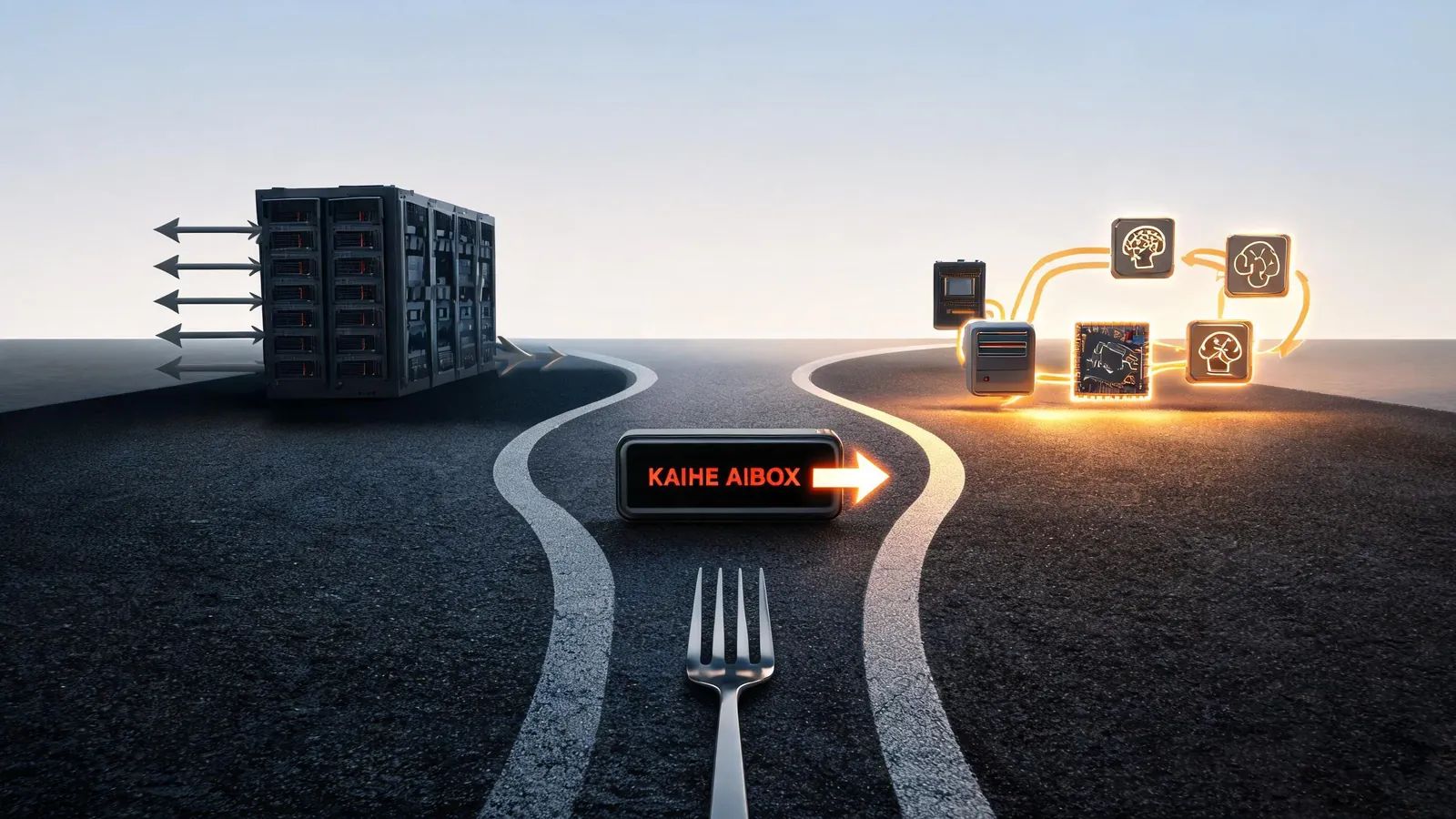
Edge-Cloud Collaboration. Not every task needs the most powerful model. Daily chat runs on small models (locally), complex tasks call large models (cloud APIs). Kaihe AIBOX follows this approach — Agent framework and daily tasks run on-device, calling cloud LLMs when needed. No lock-in to any single provider.
Multi-Model Collaboration. Don't rely on one model for everything. Let models with different specialties work together: GLM-5.2 for coding, GPT-5.5 for reasoning, DeepSeek V4-Flash for daily conversation. Each model excels in its domain, and the combined effect beats any single "strongest" model.
AI Box (also known as Agent Computer or AI Box) is a dedicated local hardware device that runs AI Agents, pre-installed with an AI agent management system, plug-and-play, running 24/7. Kaihe AIBOX supports multiple LLMs without locking into any single provider — when model capability hits a plateau, choice and flexibility matter more than any one model.
Want to Go Deeper?
Getting Started - Kaihe AIBOX Official Website (agentaibox.com) — see how a multi-model Agent Computer works - "GLM-5.2 Goes Open-Source and Tops the World: China's LLMs Enter a New Era" — open source is catching up
Going Further - "GPT-5.5 vs DeepSeek V4: Same-Day Showdown — Closed-Source Flagship vs Open-Source Value" — closed vs open deep comparison
-#KaiheAIBOX #LLM #ScalingLaw #AIBOX #AIBox
Kaihe AIBOX | The Agent Computer That Works 7×24 for You · AI Frontier