📖 Glossary
AI Box (also known as Agent Computer / Agent PC), is a dedicated local hardware device that runs AI Agents. Pre-installed with an AI agent management system, plug-and-play, running 24/7. Users can remotely command AI to work via Discord, Slack, Telegram, WhatsApp, and more.
Abstract: In April 2026, OpenAI released GPT-5.5, claiming a 52.5% hallucination reduction in high-sensitivity domains. Yet third-party testing by AA-Omniscience tells a starkly different story—GPT-5.5 still hallucinates at 86%. How can one model produce such contradictory results? This article dissects the real progress in hallucination governance, exposes the data trap, and argues why local deployment with private data remains the irreplaceable foundation of enterprise AI security.
I. GPT-5.5's Progress Is Real—But the Narrative Needs Calibration
On April 23, 2026, OpenAI released GPT-5.5 (codename: Spud), a MoE architecture positioned as an Agent-native flagship model. On May 6, GPT-5.5 Instant replaced GPT-5.3 Instant as the default ChatGPT model. The iteration speed is staggering—four versions in just five months (5.2→5.3→5.4→5.5), a cadence the market has interpreted as "panic-driven iteration."
The improvements are equally tangible:
- 52.5% hallucination reduction in legal, medical, and financial high-sensitivity domains (OpenAI's official benchmark)
- 37.3% reduction in user-flagged inaccuracies from real ChatGPT user feedback
- AIME 2025 math test: 81.2 vs. GPT-5.3's 65.4 (24% improvement)
- MMMU-Pro multimodal reasoning: 76 vs. 69.2
- Terminal-Bench: 82.7% vs. GPT-5.4's 75.1%
- ARC-AGI-2: 85%
- Token efficiency: 40% fewer tokens for the same task vs. GPT-5.4
- Cost: roughly half of competing frontier coding models
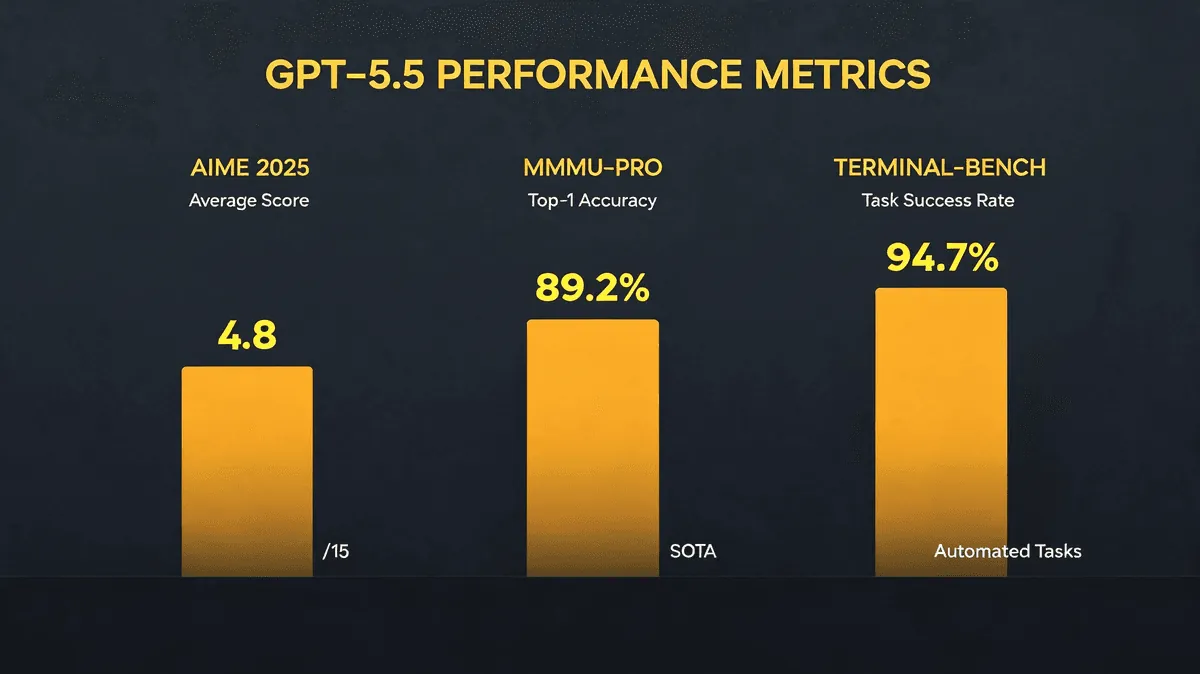
Impressive numbers. But concluding from these metrics that "the hallucination problem is essentially solved" would be a dangerously premature judgment.
II. 52.5% vs. 86%: Two Data Points, One Model
OpenAI's 52.5% hallucination reduction comes from its internal evaluation framework—relatively constrained test scenarios with well-defined problem domains, benchmarked against its own previous-generation model. It's like a student comparing against their own previous exam: the improvement is genuine, but the reference frame is narrow.
AA-Omniscience offers a different perspective: GPT-5.5's hallucination rate is 86%, while Claude Opus 4.7 scores 36%.
Why such a dramatic gap?
The answer lies in test definitions. AA-Omniscience employs a "strict hallucination" standard: any statement deviating from verifiable facts, any unsourced assertion, any overgeneralized conclusion—all count as hallucination. This more closely mirrors real enterprise scenarios. Clients won't accept "mostly correct" contract clauses. Doctors can't tolerate "roughly accurate" medication recommendations. Financial analysts can't rely on risk assessments that are "directionally right but numerically off."
Official benchmarks tell you a model's ceiling under ideal conditions; third-party tests reveal its floor in the real world. Enterprises need to focus on the latter.
This doesn't mean OpenAI fabricated its data. Both datasets are real—but they answer different questions. OpenAI answers "how much improvement?"; AA-Omniscience answers "how far to go?" For enterprise decision-makers, the latter is the critical metric.
III. One Year of Hallucination Governance: From "Elimination" to "Containment"
Since mid-2025, the industry's attitude toward hallucination has undergone a pivotal shift: from "complete elimination" to "systematic containment."
OpenAI's approach is model-layer governance. GPT-5.5 deploys "the strongest safety suite in history," combined with Codex self-optimization—the model can refine its own reasoning systems, boosting token generation speed by over 20% and indirectly reducing hallucinations caused by broken reasoning chains. This is genuine technical progress.
But model-layer governance has a fundamental bottleneck: the model doesn't know what it doesn't know. When training data lacks a company's internal processes, the latest industry regulations, or a client's unique requirements, the model won't say "I don't know"—it fills the gap with generic knowledge. That's the very origin of hallucination.
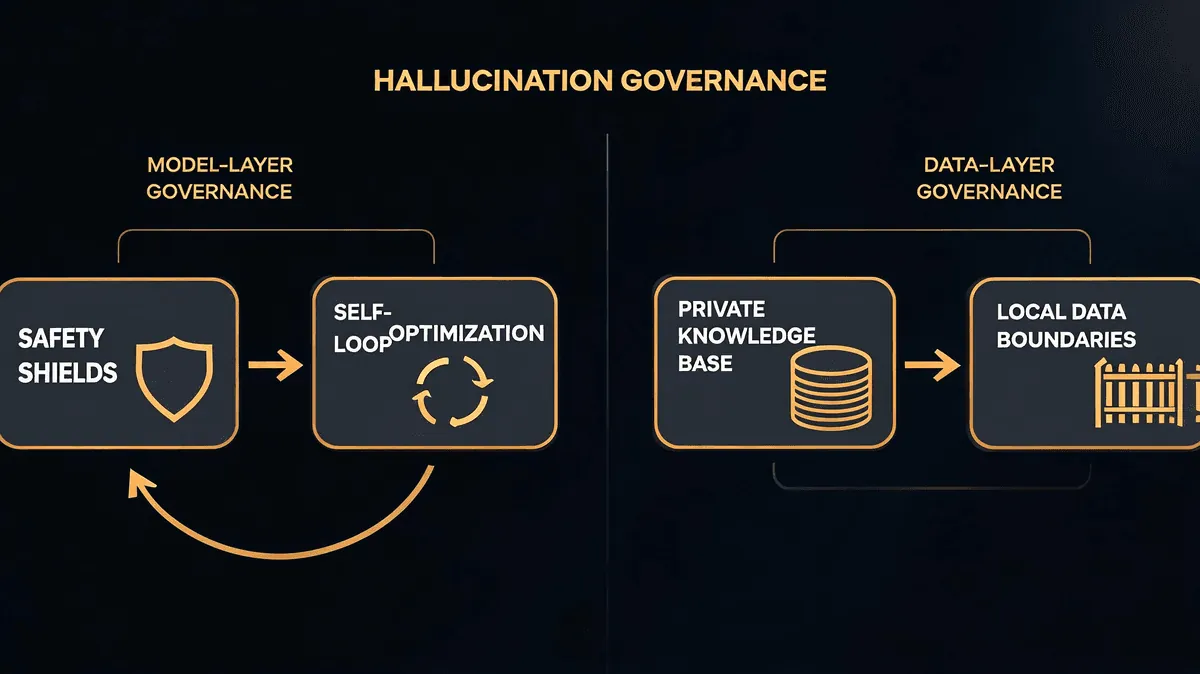
This partly explains why Claude Opus 4.7 performs better on AA-Omniscience. Anthropic's training philosophy favors "refuse rather than fabricate," at the cost of narrower response coverage. Both strategies have trade-offs, but neither fundamentally solves the "data not in training set" problem.
IV. The Enterprise Reality Check: Why Customers Are Voting with Their Feet
Ramp's data reveals a fact OpenAI would rather not highlight: over the past 12 months, enterprise AI market share has shifted dramatically—Anthropic surged from under 10% to over 60%, while OpenAI plummeted from 90% to 35%.
Behind these numbers lie real enterprise pain points:
1. Compliance-Driven Requirements
Financial, healthcare, and legal industries impose strict data sovereignty constraints. Sending client data to third-party APIs—even with encrypted transmission—fails to meet "data never leaves the internal network" compliance mandates. This isn't a technical problem; it's a legal one.
2. Asymmetric Cost of Hallucination
The time saved by 100 correct AI responses cannot offset the loss from a single severe hallucination. One erroneous contract clause can trigger million-dollar claims. One incorrect medication suggestion can endanger lives. For these scenarios, an 86% non-hallucination rate falls woefully short—you need 99.99%+ certainty, achievable only by anchoring AI to your private data.
3. Knowledge Currency
GPT-5.5's training data has a cutoff date. Your company's internal policies from last quarter, client information updated yesterday, project code modified just hours ago—the model knows none of it. It answers new questions with old knowledge, which is itself a form of hallucination.
Cloud-based large models excel at breadth of general knowledge, but an enterprise's competitive edge lies in the depth of its private knowledge. No single model can do both.
V. Local Deployment Isn't Regression—It's Necessary Layering
Skeptics ask: as models grow stronger and hallucination rates decline, is local deployment still necessary?
The answer: the stronger the model, the more it needs local deployment to constrain its knowledge boundaries.
The reasoning is straightforward—stronger models produce hallucinations that are harder to detect. In the GPT-4 era, hallucinations were often clumsy—awkward phrasing, logical gaps that human eyes could catch. GPT-5.5's hallucinations are "fluently confident," delivering rigorous-sounding arguments over entirely fabricated content, making them extremely difficult for non-experts to identify. Greater capability means greater hallucination lethality.
The right approach is layered architecture:
- Cloud large models: handle tasks demanding creativity—general reasoning, creative generation, multimodal understanding
- Local models + private data: handle tasks demanding accuracy—knowledge retrieval, compliance review, customer service
- Hybrid orchestration: local systems perform fact-checking and knowledge anchoring; cloud systems enhance reasoning and creative divergence
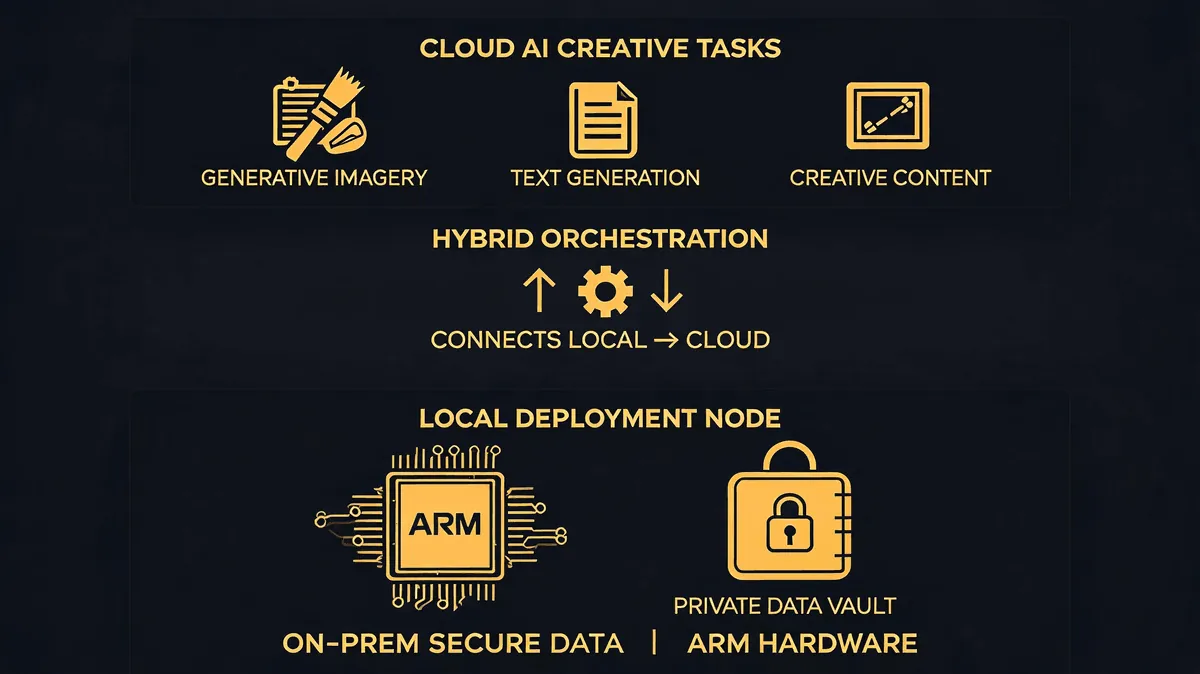
KaiheAiBox A1 is designed as the local node for this layered architecture. ARM architecture, 6 TOPS compute, 24/7 operation, ultra-low power consumption—scan a WeChat QR code and start using it. No IT department deployment needed, no development environment configuration required. Place it on your desk, and it's an "agent computer." Its value isn't competing with cloud models on raw compute—it's ensuring that within your own data boundaries, AI only answers what it definitively knows.
Physical isolation delivers more than security compliance—it delivers certainty. When AI runs on hardware you control, accessing data you've authorized, executing workflows you've defined, the hallucination rate formula changes. It's no longer "model accuracy in the open domain" but "model reliability in the private domain." The latter can reach exceptionally high levels because your private domain is bounded and verifiable.
VI. Conclusion: 52.5% Is Good News; 86% Is the Real Problem
GPT-5.5's progress deserves acknowledgment. Four iterations in five months, a 52.5% hallucination reduction on official benchmarks, across-the-board improvements in math reasoning, multimodal understanding, and code generation, plus a 40% token efficiency gain—these numbers confirm OpenAI's iteration speed in model capability remains industry-leading.
But the 86% third-party hallucination rate sounds an alarm: under strict definitions used in advanced testing, even the most sophisticated large models still hallucinate severely. This isn't unique to GPT-5.5—Claude Opus 4.7 scores 36% on the same test, which is better but still far from enterprise-grade certainty.
For enterprises, the right strategy isn't "wait for hallucinations to disappear" but "design architectures where hallucinations can't cause unacceptable damage." Local deployment with private data is the cornerstone of that architecture. It doesn't eliminate hallucination—it confines it to a controlled, verifiable, bounded environment, reducing risk to acceptable levels.
Cloud models will keep getting stronger. Hallucination rates will continue to decline. But for the foreseeable future, enterprises' core knowledge assets still need to run on their own infrastructure. That's not conservatism—it's rationality.
KaiheAiBox | Agentaibox that lets AI work for you 24/7 · AI Frontier