Harness Is Now Open Source — Anyone Can Build an Agent, But Is Your Agent Still Working at Night?
📖 Glossary
AI Box (also known as Agent Computer / Agent PC), is a dedicated local hardware device that runs AI Agents. Pre-installed with an AI agent management system, plug-and-play, running 24/7. Users can remotely command AI to work via Discord, Slack, Telegram, WhatsApp, and more.
Abstract: DeepSeek just open-sourced its agent framework, Harness, and it gained 24,000 GitHub stars in just an hour and a half. The official formula is blunt: Model + Harness = Agent. The barrier to building a "working" AI keeps dropping. But this piece is about the part nobody talks about — a framework solves "how" it works, not "when" it works. Whether your agent has a 7×24 home is the real dividing line.
The biggest AI story lately is DeepSeek open-sourcing its agent framework, Harness. Within an hour and a half of going live, it had pulled in 24,000 GitHub stars — a pace you rarely see even in the open-source world. Plenty of famous projects take years to reach a number like that.
Plenty of people didn't immediately grasp what it means. DeepSeek put it in a very plain formula: Model + Harness = Agent. In plain English — take a large model you already have, wrap it in Harness, and you get an AI that can "do things on its own."
Why should ordinary people care? Because before this, building an agent had real friction. You needed to know a bit of code, understand how to wire up frameworks, and figure out how to chain models, tools, and task scheduling together. Harness packages all of that for you, and the barrier is visibly dropping — which matters more than it sounds, because it means the "personal AI assistant" is finally moving out of the programmer's terminal and into everyday life.
Put another way: "owning an AI assistant" used to be the privilege of a technical few. Now it's turning into something "anyone can pick up." It's the same arc as the personal computer — once the tool's barrier is torn down, the people who get real value out of it spread from a narrow circle to every ordinary person.
1. After open-sourcing, building an agent got genuinely easy
In the past, if you wanted an agent that automatically collects email and produces a daily report, just stringing together "model calls, tool selection, and continuous execution" was enough to keep you busy for a while. What Harness does is wrap up all that dirty work, so you can focus on "what do I want it to do."
Put simply, it's a skeleton of "brain and hands": how to schedule the model, how to invoke tools, how to break a complex task into steps and carry them out one by one. Plug in a model, hang on some tools, and a working agent takes shape.
Before this, the same job would have meant writing your own scheduling logic, handling edge cases, and debugging over and over. Harness abstracts all of that away — you don't even need to read the full source, just wire up the interface per the docs and you have an agent that executes tasks continuously. For people without a programming background, that's a genuine liberation.
This is, of course, good news. Open source means free, transparent, and modifiable. It means ordinary people have never been closer to owning a personal AI assistant.
But amid all the excitement, there's a question most people overlook — and it matters more than it seems.
2. A framework solves "how" — not "when"
As strong as Harness is, it only solves the word "how": how to schedule, how to call, how to execute. It doesn't answer a simpler, more mundane question — "when to do it."
And that is exactly the trap most people fall into.
You excitedly build your agent and run it on your own computer. It works great during the day. Then? The moment you clock out and shut the computer down, it "clocks out" with you. You travel, you sleep, you step out for the weekend — your agent lies still inside your powered-off machine.
More realistically, many people can't even keep it running all day. Your computer has to do real work, host meetings, run games, install software — the agent gets squeezed into a corner, eating memory, and you constantly worry it'll clash with other programs. It's hard to set aside a machine that is dedicated, never shut down, and always on standby for it.
At 3 a.m. there's data to watch, a report to generate, and your agent is "sleeping" inside that turned-off computer. All the time you spent building this "personal AI assistant," and it's only actually working for you during the handful of hours you're sitting in front of the screen.
That is the part an open-source framework genuinely can't solve for you: an always-on, always-ready runtime environment. A framework gives you a smart brain and nimble hands, but it can't give you a heart that never stops beating.
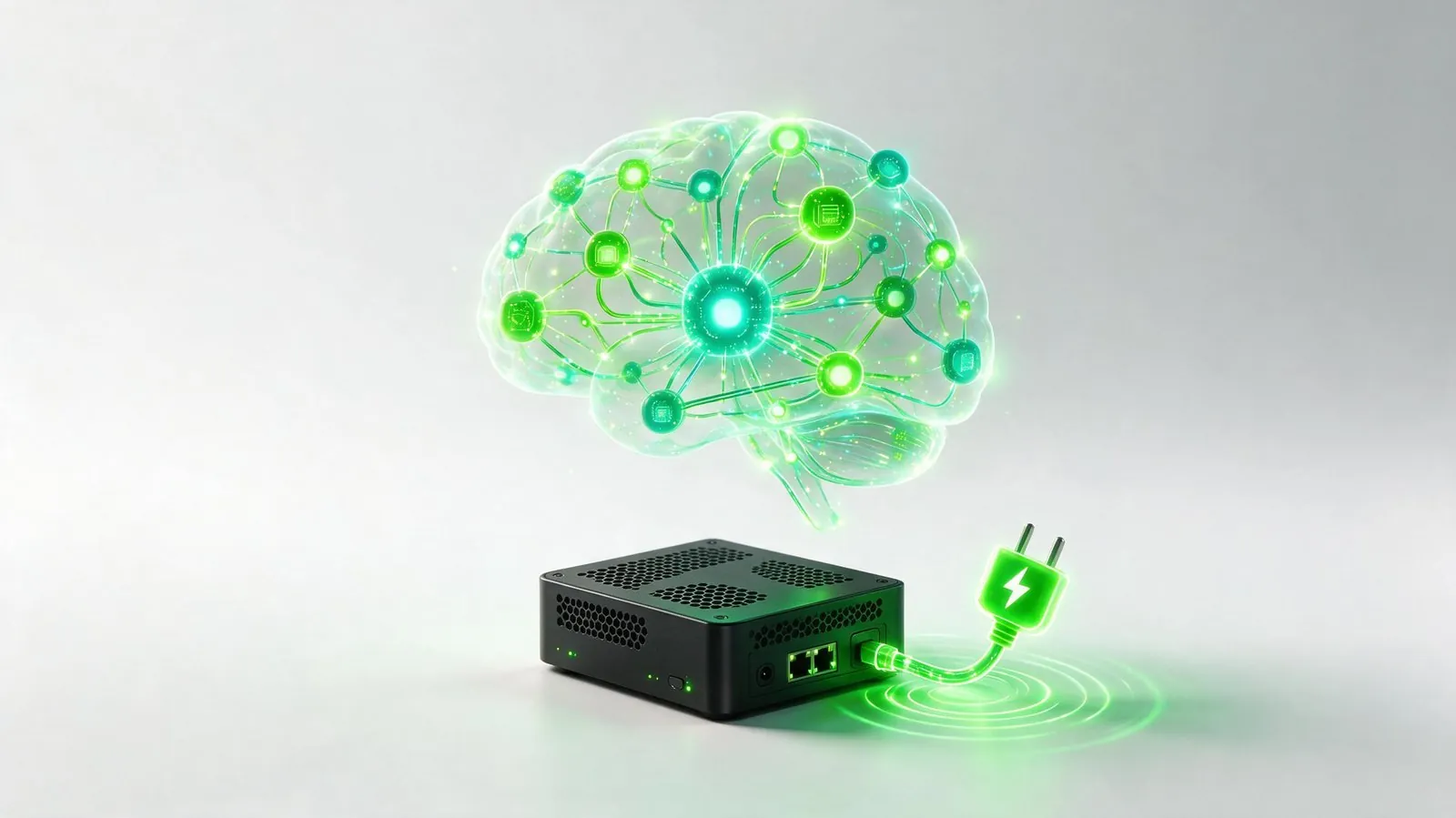
3. A real personal AI assistant is a standalone hardware box
Once you see this clearly, a lot of things fall into place.
A true "personal AI assistant" was never a piece of software installed on your computer. Software, by its nature, can only boot up and shut down together with your computer. What truly deserves the name "assistant" should be a standalone hardware box:
- Plug it in and it's online 7×24 — shut down your computer, lose the network, travel away, and it keeps running;
- While you work during the day, it watches data, collects email, and organizes materials at home;
- While you sleep at night, it runs tasks off-peak, produces the daily report, and monitors for anomalies;
- The next morning, the finished work is already there — check WeChat and see the result.
Here's an analogy that makes it click: an open-source framework is the "brain and hands," while this box is the "body that never loses power." A brain and hands matter, but without a body that can hold up, even the smartest brain only turns on when you have the time.
You may have noticed that cloud AI can also "stay online." But it carries two unavoidable costs: your data sits on someone else's server, and every task bills you by usage. A local hardware box flips both — data stays in your own home, and you buy once and run long-term. That's the only way the words "private" and "assistant" can both be true at the same time.
4. "Can build" is not the same as "can run"
Agent frameworks are getting more open-source and more free — that's the industry trend, and it's a real dividend for ordinary people. But we have to stay clear-headed: "can build" and "can run" are two different things.
Open-sourcing a framework solves "everyone can build." Always-on hardware solves "it can actually keep running." One is the barrier, the other is the environment. When the barrier drops but the environment hasn't caught up, the agent you built is still a half-finished product — smart, but it stops the moment the power cuts.
So what truly separates people from each other is no longer "do you know how to use the framework." Anyone can learn that. What really separates people is this: does your agent have a 7×24 home? People with a home get a round-the-clock workforce; people without one get a small tool that only runs during their screen time.
Think back: the people who get the most out of AI are rarely the most technical. They're the ones who figured out first how to "keep it running for me." Technology can be open-sourced and democratized, but an "always-on runtime environment" is something no framework can open-source — it has to be carried by hardware.

5. Kaihe AIBOX is that "home"
By now the answer writes itself.
Kaihe AIBOX is exactly that kind of standalone hardware: it stays powered on and never goes offline, comes preinstalled with OpenClaw and Hermes — two agent systems — and works out of the box. Plug in the open-source Harness, attach your model API, and it runs in the background for you, 7×24.
The most important part — your data stays in the local box and is never uploaded to the cloud. What your agent does and what it remembers is known only to you. That is the true meaning of the word "private."
Wire a brain like Harness into a box that never loses power, and your agent finally "comes alive": working for you by day, standing watch by night. You sleep, it works. The open-source framework gives it the intelligence, and the always-on box gives it the stamina — together they turn a clever script into a genuine assistant.
That is the one thing worth understanding in the open-source era: the framework can be free, but the environment that lets AI truly work for you around the clock deserves a real home.
Set one up at home — search "铠盒AIBOX" on WeChat.