Hermes Agent Paired with a Local Small Model: How a Palm-Sized Machine Can Run Your 7×24 Workload
📖 Glossary
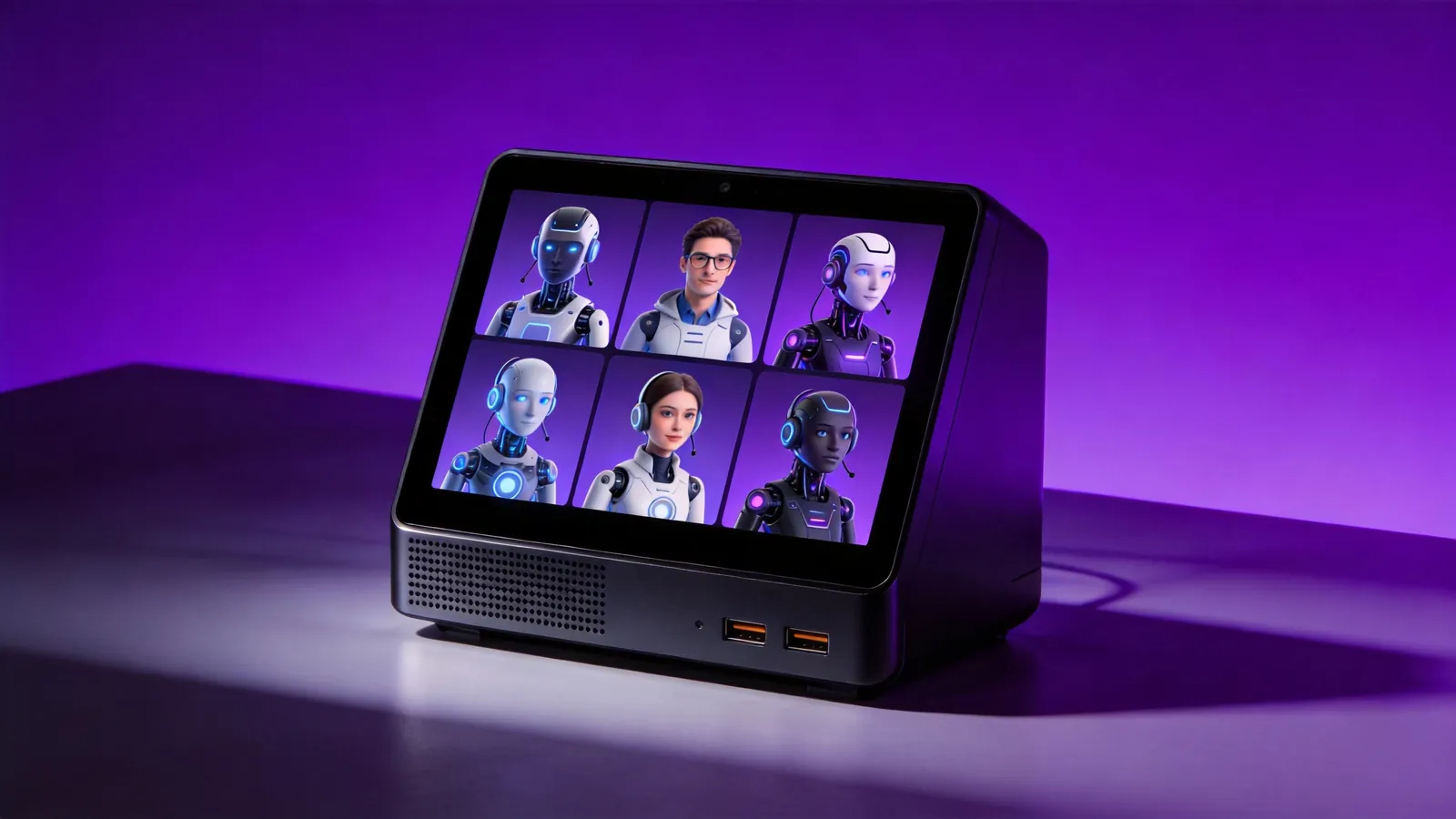
AI Box (also known as Agent Computer / Agent PC), is a dedicated local hardware device that runs AI Agents. Pre-installed with an AI agent management system, plug-and-play, running 24/7. Users can remotely command AI to work via Discord, Slack, Telegram, WhatsApp, and more.
Abstract: Hermes Agent is an open-source intelligent agent framework launched by Nous Research, excelling at encapsulating large model reasoning capabilities into long-running automated tasks. This article documents real-world testing of deploying Hermes Agent on the KaiheAiBox A1 Agent Computer, using a local 4B-parameter small model for agent scheduling while invoking cloud-based large model APIs on demand for complex reasoning — a "local scheduling + cloud reasoning" hybrid architecture that ensures 7×24 low-power uninterrupted operation while striking a balance between cost and privacy. Starting from practical scenarios, the article breaks down five worry-free use cases and provides a comparative analysis against pure-cloud solutions.
1. Why You Need an "Always-On" Agent Computer
Consider this data point: a Gartner 2025 report shows that enterprise knowledge workers spend an average of 2.1 hours per day on repetitive information processing — checking emails, organizing documents, syncing data, and monitoring dashboards. That amounts to 10.5 hours per week, meaning one out of every five workdays is devoted purely to "things machines should be doing."
Automation tools are not in short supply — Zapier, n8n, and Make can all string together workflows — but they share a common limitation: they rely on cloud-based scheduling. Once a service goes down or an API raises its prices, your automation grinds to a halt. Even more critically, these tools don't "think" — they merely execute if-then rules and freeze up when they encounter exceptions.
Hermes Agent takes a different approach. As Nous Research's open-source intelligent agent framework, it embeds the comprehension and decision-making capabilities of large models directly into the task execution loop: the Agent can not only run on schedule but also make its own judgments about what to do next when it encounters anomalies. But here's the catch — "thinking" requires running models, running models requires GPUs, and GPUs mean electricity bills and noise.
The KaiheAiBox A1 offers a compromise: use a local small model for scheduling (determining "should this task be triggered?" and "which tool should be called?"), and use cloud-based large model APIs for heavy reasoning (writing summaries, analyzing content, generating responses). The scheduling model has fewer than 4B parameters, which the A1's ARM chip can easily handle; the reasoning component is invoked on demand and incurs no cost when idle.
This "local scheduling + cloud reasoning" hybrid architecture enables a palm-sized mini PC to achieve 7×24 uninterrupted intelligent agent operation — consuming less than 15W, more energy-efficient than a desk lamp.
2. What Is Hermes Agent, and Why Is It Suited for Long-Term Operation
Hermes Agent is an open-source project released by Nous Research in late 2024, positioned as a "long-running autonomous agent framework capable of independent decision-making." Compared to predecessors like AutoGPT and MetaGPT, its core design distinctions are:
Lightweight Scheduling Layer. Hermes Agent decouples "deciding what to do" from "actually performing reasoning." The Planner — the scheduling component — runs on a lightweight model, responsible for parsing task queues, evaluating trigger conditions, and selecting tool invocations. Only when deep thinking is genuinely required (writing copy, conducting analysis) does it dispatch the task to a large model API.
Persistent State. The Agent's running state, task history, and error recovery points are all persisted to disk. After a power failure and restart, execution resumes from the last checkpoint with no lost progress. This is critical for 7×24 scenarios — you cannot afford to have a task that has been running for three days start over from scratch because of a single reboot.
Open Tool Ecosystem. Hermes Agent supports connecting external tools via the MCP protocol — email, calendars, file systems, databases, smart home APIs... as long as they can be wrapped in a standard interface, they can be called by the Agent. This means it is not a closed demo but an extensible automation foundation.
Deploying Hermes Agent on the KaiheAiBox A1 is not complicated. The A1 comes pre-installed with a Python runtime environment and Ollama. Pull a Qwen2.5-1.5B or Phi-3-mini model as the local scheduler, configure Hermes Agent's YAML file to point to the cloud API endpoint, and the entire process can be completed within 30 minutes. The local scheduler uses less than 2GB of memory, leaving the A1's 8GB RAM with plenty of headroom.
3. Five Worry-Free Use Cases: Let the Agent Monitor, Organize, and Sync for You
The following five scenarios have all been tested and verified on the KaiheAiBox A1. In each scenario, the scheduling logic is handled by the local small model, with cloud APIs invoked only when content generation or deep analysis is required.
1. Scheduled Task Monitoring
Set monitoring targets (such as website availability, API response times, server disk space), and Hermes Agent polls them at minute-level intervals. The local small model determines "is everything normal?" — if the returned values are within thresholds, it passes silently; if anomalies are detected, it triggers the cloud-based large model to generate an alert summary and remediation suggestions, then pushes them via enterprise WeChat or email.
Real-world results: an average of 1,200+ scheduling decisions per day, of which only 3–5 require cloud API calls. The vast majority of the time, the small model can independently determine that "everything is fine," at virtually zero cost.
2. Automated Email Processing
Hermes Agent periodically fetches new emails via the IMAP protocol, and the local small model performs first-level classification (customer inquiry / internal notification / spam / urgent matter). Urgent items trigger immediate push notifications; customer inquiry emails are dispatched to the cloud-based large model to generate a reply draft, which is saved to the drafts folder for human confirmation; spam is automatically archived.
An interesting data point: during the testing period, an average of 47 emails were received per day, and the local model could independently classify 89% of them, with only 11% requiring cloud-assisted judgment. The quality of email reply drafts generated by GPT-4-level APIs is already quite mature — minor edits suffice before sending.
3. Document Organization and Archiving
Download directories, WeChat files, email attachments... files generated each day are scattered everywhere. Hermes Agent periodically scans specified directories, and the local small model performs initial categorization based on file names, extensions, and metadata (contract / invoice / report / image / other), then invokes the cloud model for ambiguous files to make content-based judgments, ultimately archiving them automatically in a "project-type-date" directory structure.
This feature may seem simple, but it solves the chronic pain point of "spending half the day looking for a file." Local classification costs virtually nothing; only indeterminate files incur API call fees.
4. Data Backup and Synchronization
The KaiheAiBox A1 can mount external storage or connect to a NAS. Hermes Agent performs incremental backups according to policy — the local model determines which files have changed, with no cloud model involvement. After backup completes, the Agent generates a brief backup report (number of added/modified/deleted files), also assembled by the local model without any API calls.
This scenario perfectly demonstrates the advantage of the hybrid architecture: backup decisions are entirely localized, independent of external services, and continue to function normally even when the network is down.
5. Smart Home Control
Through Home Assistant's API interface, Hermes Agent can control lights, air conditioners, curtains, and other devices. The local model handles simple rules ("turn on the AC when temperature exceeds 28°C," "turn on lights after sunset"), and only invokes the cloud model for complex scenarios ("determine tonight's AC schedule based on tomorrow's calendar," "automatically switch to ambiance mode when guests arrive").
The significance of 7×24 uptime is especially pronounced here — you do not want an Agent controlling all your home devices to go offline for two hours due to cloud service maintenance.
4. Comparison with Pure-Cloud Solutions: Cost, Privacy, and Stability
| Dimension | Pure-Cloud Solution (e.g., Zapier + GPT-4) | KaiheAiBox A1 Hybrid Architecture |
|---|---|---|
| Monthly Operating Cost | Platform subscription $20–50 + API calls $10–60 | Electricity ~¥8 + API calls $2–10 |
| Privacy Risk | All data passes through third-party servers | Sensitive data processed locally; only necessary fragments uploaded during reasoning |
| Stability | Depends on cloud service availability; 4–12 hours average annual downtime | Local scheduling independent of external network; basic tasks continue running during outages |
| Latency | Network round-trip 100–500ms | Local scheduling <50ms; cloud reasoning same as above |
| Controllability | Subject to platform rules (call frequency, data retention) | Fully autonomous; open-source code is auditable |
The core of the cost difference lies in "scheduling frequency vs. reasoning frequency." In 7×24 scenarios, the Agent may make dozens of scheduling decisions per minute, but only a tiny fraction require deep reasoning. Pure-cloud solutions route every scheduling decision through an API, and costs add up quickly; the hybrid architecture keeps high-frequency, low-cost scheduling local and only spends money when actual "thinking" is needed.
On the privacy front, email content, file names, device status, and similar information must be uploaded to third parties under pure-cloud solutions. With the hybrid architecture, this sensitive data stays local — only when content generation or complex analysis is needed are necessary fragments sent to the API, and you can selectively mask privacy fields.
Stability is the most underrated advantage. Cloud services typically offer a 99.9% SLA, which sounds impressive, but translates to an 8.76-hour downtime window per year. For a 7×24 Agent, those 8 hours could be exactly when you need it most — a server alert at 3 AM, an email that needs automatic processing while you're on a business trip. The KaiheAiBox A1's local scheduling layer depends on no external service; network outages and cloud service downtime do not affect the execution of basic automation tasks.
5. Practical Recommendations: Who Is This Solution For
If you fall into any of the following categories, the Hermes Agent + KaiheAiBox A1 combination is worth serious consideration:
Individual Knowledge Workers. Buried each day by emails, documents, and information processing, needing an "always-on assistant" to filter and pre-process for you — but unwilling to spend hundreds per month on various SaaS subscriptions.
Small Team Tech Leads. Needing to build internal automation workflows, but unable to put all data on the cloud with limited budgets. One KaiheAiBox A1 plus minimal API calls can cover 80% of a team's automation needs.
Hardcore Smart Home Enthusiasts. Home Assistant users who want an automation engine that can "think," rather than scripts that only understand if-then logic.
Privacy-Sensitive Enterprises. Any automation involving customer data, financial information, or internal communications should not hand raw data in full to third parties. The hybrid architecture lets you control what stays local and what can go to the cloud.
Of course, this solution has limitations: the ceiling of local small models is what it is — a 4B-parameter model still makes mistakes on complex logical reasoning; the A1's ARM architecture cannot run models larger than 7B, so deep reasoning must rely on cloud APIs. If your scenario requires high-quality reasoning every minute, a pure-cloud solution may be more straightforward.
But for most 7×24 scenarios, the ratio of "90% of scheduling handled locally, 10% of reasoning on demand in the cloud" is precisely the most pragmatic balance point.
KaiheAiBox · Hermes Zone