Hermes Agent Self-Evolution Loop Tested: 100 Iterations Make Skills Sharper
📖 Glossary
AI Box (also known as Agent Computer / Agent PC), is a dedicated local hardware device that runs AI Agents. Pre-installed with an AI agent management system, plug-and-play, running 24/7. Users can remotely command AI to work via Discord, Slack, Telegram, WhatsApp, and more.
Abstract: Hermes Agent's core feature is "self-evolution" — after task completion, it automatically reviews, summarizes experience, and generates reusable skill files. Every 15 tool calls triggers self-iteration. No model weight changes — experience written as SKILL.md "operation manuals." The more you use it, the sharper skills get.
"AI gets smarter with use" — many AI products claim this, but most mean "as you use it more, we collect data to train the next model." The individual user's AI doesn't actually get smarter.
Hermes Agent is different. Its "smarter with use" is real — after each task, it automatically summarizes experience into a skill file stored locally. Next time a similar task comes up, it calls that skill directly instead of starting from scratch.
This isn't a model upgrade — it's experience accumulation. Like a new employee becoming a veteran — not a brain transplant, but accumulated work experience.
How the Self-Evolution Loop Works
Four steps:
Step 1: Task Execution. You give Hermes a task — "Analyze this Excel sales data, summarize by product category, generate a bar chart." Hermes calls tools (terminal, Python, file system, etc.) to execute.
Step 2: Error Detection. During execution, errors are recorded — Python script fails, wrong file path, API call fails. Successful steps are also noted.
Step 3: Experience Extraction. After task completion (success or failure), Hermes' background review mechanism activates. An "LLM judge" — a large model reviewing the entire execution process — analyzes which steps worked, which can be optimized, which errors can be avoided.
Step 4: Skill Write-Back. If the review finds reusable experience, Hermes auto-generates a SKILL.md file in the local skill library. This file includes: task description, execution steps, notes, common errors and solutions.
Next time a similar task arrives, Hermes checks the skill library first — if a matching skill exists, it executes per the skill file instead of starting from zero.
15 Tool Calls Trigger Iteration
Hermes doesn't generate a skill after every task — that would be too frequent, producing many low-quality skill files.
The trigger: every 15 tool calls triggers a self-iteration. Tool calls include: executing commands, reading/writing files, web searching, API calls. Meaning roughly every 2-3 medium-complexity tasks triggers one skill iteration.
This frequency is well-calibrated through testing — too frequent produces fragmented skills, too sparse learns nothing. 15 calls roughly corresponds to one complete task cycle of experience.
Results After 100 Iterations
Per community developer tests, after 100 iterations (roughly a few weeks of daily use):
Skill count growth. From 0 to ~30-50 skill files. Covering common task patterns — data processing, file operations, code debugging, information search, report generation.
Execution efficiency up. For tasks with existing skills, execution time drops 40-60% — no exploration or trial-and-error, just follow known steps. A task that took 10 minutes initially (including trial and error) takes 3-5 minutes with a skill.
Error rate down. Skill files record common errors and avoidance methods. Second encounter with the same pitfall, Hermes references the skill file to avoid it. After 100 iterations, error rate for similar tasks drops ~70%.

Personalization. Skill files aren't just generic methodologies — they record your specific preferences. If you always have Hermes use Python's pandas for data processing, matplotlib for charts, save as PNG — these preferences get written into skill files and auto-followed next time.
Difference from Traditional AI Assistants
Traditional AI assistants (ChatGPT, Claude) have "memory" that's conversation-level — they remember what's said in the current conversation. Start a new conversation, everything before is forgotten. You must re-explain preferences, project context, desired format every time.
Hermes' skill memory is persistent — skill files exist on local disk, cross-session, cross-time. A skill learned three months ago is still in use three months later.
Another difference: traditional AI needs manual teaching — "Please follow these steps for this task going forward." Hermes learns automatically — it summarizes from your task execution, no extra teaching needed.
No Model Weight Changes
Important clarification: Hermes' "self-evolution" is not "training a model."
It doesn't modify the underlying LLM's (GPT, Claude, DeepSeek) parameters. It organizes experience into "operation manuals" (SKILL.md files) that are referenced during future task execution.
Analogy: not replacing the employee's brain, but writing a work manual. Same employee, but with a manual, they work more efficiently and make fewer mistakes.
This means: - No GPU needed for model training — any device running Hermes can self-evolve - No waiting for model upgrades — every task accumulates experience - Skills are portable — SKILL.md files can be shared with other Hermes users
Real Experience on Kaihe AIBOX A1
A1 comes pre-installed with Hermes Agent. In daily use, self-evolution manifests like this:
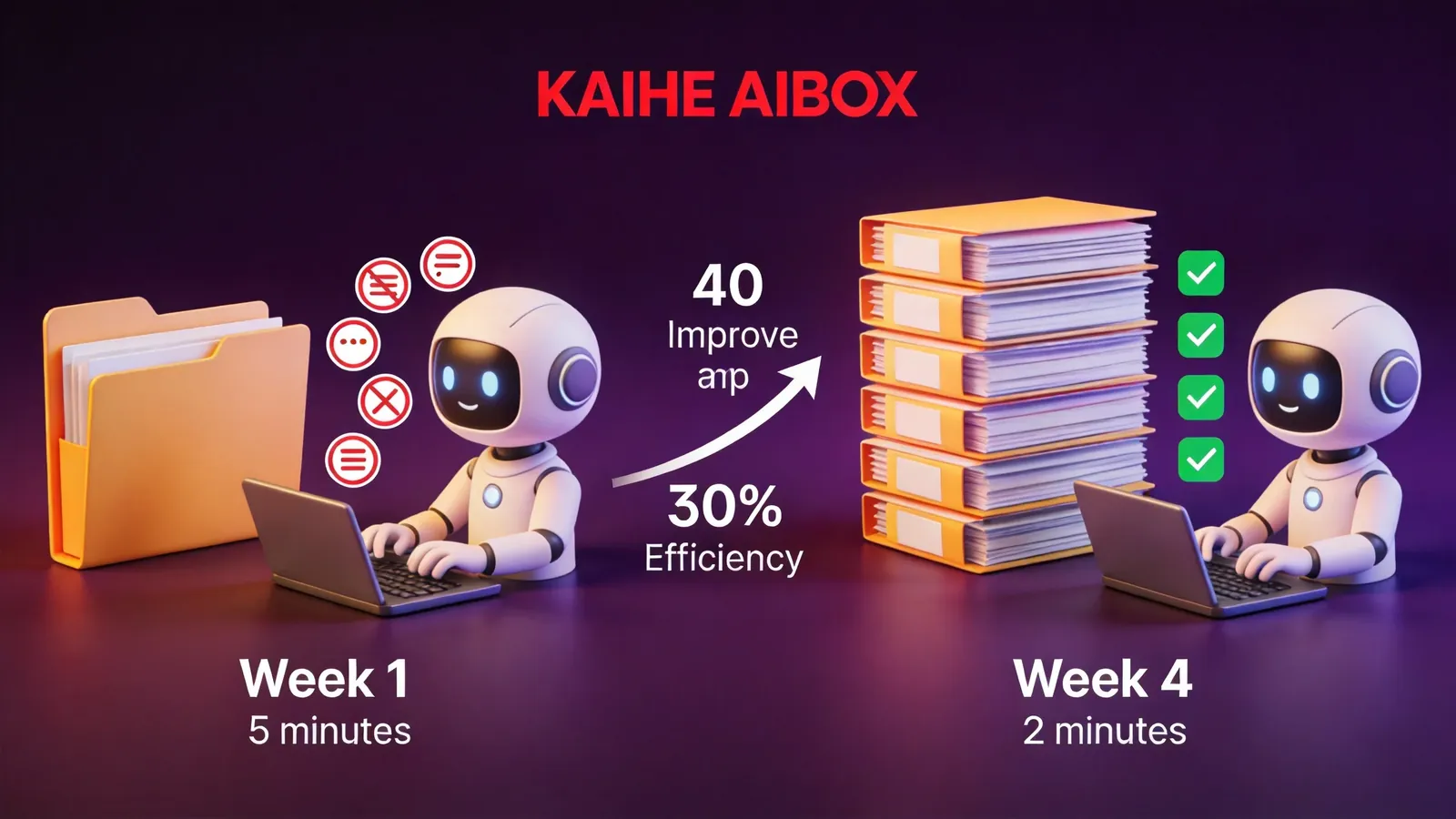
Week 1: Hermes is new, everything starts from scratch. You ask it to process an Excel file — it tentatively uses Python to read, check format, process data — about 5 minutes.
Week 2: After several similar tasks, Hermes generates an "Excel data processing" skill file. Next Excel task — it checks the skill library, finds a match, executes per known steps — 2 minutes.
One month later: Skill library has 20+ skills. Most daily tasks have corresponding skills. You clearly feel Hermes has "gotten smarter" — it hasn't actually gotten smarter, but it now has an experience manual. To learn more, visit the homepage.
Want to Go Deeper?
"Hermes Agent v0.7.0 Deep Dive: Pluggable Memory Interface" — memory system analysis "Your AI Isn't a Chatbot: Understanding Hermes and OpenClaw Collaboration" — architecture deep dive
-#HermesAgent #SelfEvolution #KaiheAIBOX #AIAgent #SkillLearning
Kaihe AIBOX | The Agent Computer That Works 7×24 for You · Hermes