Exclusive Interview with Hermes Founding Team: Why Open-Source Agents Must "Have Memory" — A Conversation Revealing Product Philosophy
📖 Glossary
AI Box (also known as Agent Computer / Agent PC), is a dedicated local hardware device that runs AI Agents. Pre-installed with an AI agent management system, plug-and-play, running 24/7. Users can remotely command AI to work via Discord, Slack, Telegram, WhatsApp, and more.
"If every time you talk to someone, they forget who you are — would you consider them intelligent?"
When the co-founder of Nous Research posed this question in a San Francisco coffee shop, the conversation at the table fell silent for two seconds. It's a seemingly simple yet soul-piercing question: today, the vast majority of AI Agents are precisely that "someone who forgets who you are every time."
Hermes, the open-source agent framework under Nous Research, is attempting to change this. It is not merely an Agent that can call tools and run tasks — its core ambition is to give agents genuine "memory."
This might sound like yet another trendy concept in the tech world, but after a deep conversation with the Hermes founding team, we discovered: memory is not a nice-to-have feature, but the foundational condition for an agent to evolve from a "tool" into a "partner." And open source is the only path to ensure this evolution doesn't spiral out of control.
1. The "Memory-less Agent" Dilemma: Every Conversation Is an Amnesiac Restart
In today's AI application ecosystem, the vast majority of Agents face an awkward reality: they have no persistent memory.
You spend an entire afternoon discussing project architecture with an Agent, mapping out technology choices, module divisions, and interface design. The next day, you open the same Agent, and it looks at you and says: "Hello, I'm an AI assistant. How can I help you?"
Everything resets to zero.
The Hermes team illustrated this problem with a more concrete example: imagine you have an Agent manage your code repository. The first time, you spend considerable effort explaining the project's directory structure, coding standards, and branching strategy. The Agent performs well — in that one conversation. But the next conversation, it has to learn everything from scratch again.
"It's like hiring a genius employee who loses their memory every morning," described a core team member. "They might have an IQ of 200, but you have to retrain them every day. This isn't an efficiency problem; it's a fundamental architectural flaw."
The pain points of memory-less agents extend far beyond "repetitive labor":
- Inability to accumulate experience: Agents cannot learn from past mistakes and may repeat the same errors
- Context fragmentation: Cross-session tasks cannot connect, and complex projects are split into isolated conversations
- Zero personalization: Agents don't understand your preferences, habits, or decision-making style — every response is a "standard answer"
- Soaring collaboration costs: Every new conversation requires rebuilding context, and the user's time cost far exceeds the Agent's compute cost
This is not an experience optimization problem; it's a structural defect. An agent without memory is essentially a stateless function call — input instruction, output result, leave no trace.
The economic dimension of this defect is often overlooked. Consider a software development team using an AI coding assistant for eight hours daily. If the agent has no memory, the team spends an estimated 90-120 minutes per day re-explaining context — project structure, coding conventions, recent design decisions, outstanding bugs. At a loaded labor cost of $50/hour per developer, that's $7,500-$10,000 per month in wasted productivity for a five-person team. Memory isn't a luxury; it's an economic necessity.
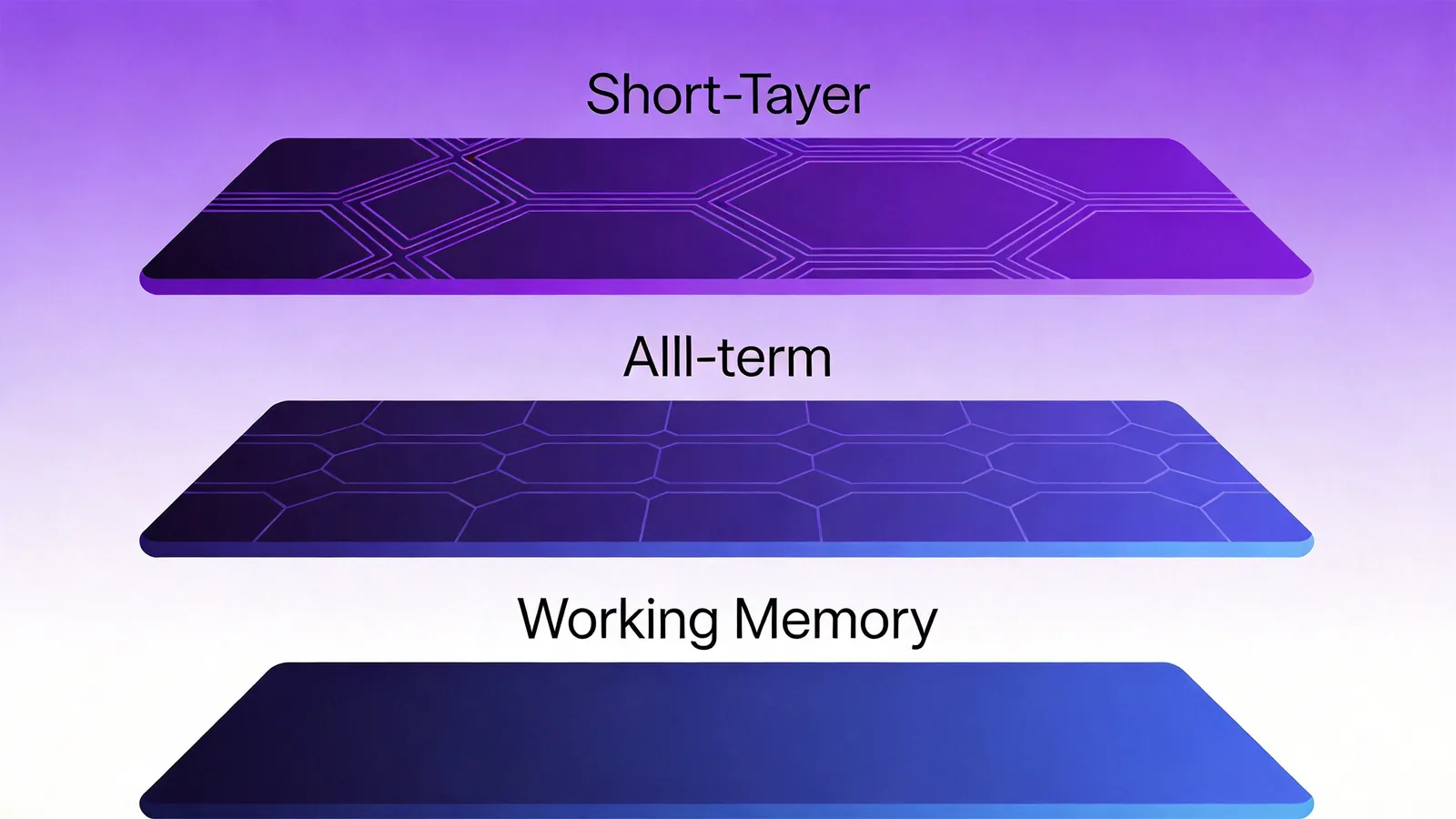
2. Hermes Memory Architecture: A Three-Layer System, from "Conversation" to "Cognition"
Faced with this structural defect, Hermes didn't opt for the simple "add a database" solution. The team designed a three-layer memory architecture, with each layer addressing a different dimension of the problem.
Short-Term Memory: Conversational Context Window
This is the most intuitive layer — the current conversation context. Hermes's short-term memory management is not simply stuffing all historical messages into the prompt; instead, it employs a dynamic context window strategy:
- Key information extraction: Extracting key decisions and conclusions from long conversations to avoid token waste
- Context priority ranking: Current task-related information takes priority; casual chat information gets deprioritized
- Window sliding mechanism: When conversation exceeds context length, gracefully "forgetting" the least important parts
"The goal of short-term memory is not to remember everything, but to maintain the highest information density within a limited window," the team explained.
The technical implementation uses a combination of extractive summarization and relevance scoring. Each message in the conversation is assigned a relevance score based on its relationship to the current task. When the context window fills, messages with the lowest scores are compressed into brief summaries rather than simply discarded. This approach preserves information density while respecting token limits — a critical balance for long-running agent sessions.
Long-Term Memory: Persistent Storage
This is the core of Hermes's memory system — cross-session persistent storage. Unlike simple "conversation history saving," Hermes's long-term memory functions more like a structured knowledge base:
- User preferences: Your preferred code style, commonly used tech stacks, preferred output formats
- Project knowledge: Project structure, key decision records, technical debt list
- Historical decisions: Choices made in the past and their rationale, avoiding repeated discussions of already-decided matters
- Error experiences: Mistakes made previously and their corrections, forming a "lessons learned" repository
Long-term memory is not saving all conversation records — that's data hoarding, not memory. The Hermes team emphasized that genuine memory is the compression and refinement of raw information, retaining only what has value for future decisions.
The storage format is particularly noteworthy. Hermes uses a graph-based memory model rather than a flat key-value store. Entities (people, projects, technologies, decisions) are nodes, and relationships between them are edges. When the agent recalls information about "Project Alpha," it can traverse the graph to find related decisions, team members, and outstanding issues — much like human associative memory. This graph structure also enables the agent to make connections that weren't explicitly stated: if you mentioned in one session that you prefer TypeScript and in another session that you're starting a new backend project, the agent might proactively suggest TypeScript frameworks without being explicitly asked.
Working Memory: Task Execution State
The third layer is working memory, focused on the "present": where the current task stands, which tools have already been called, and what the intermediate results are. The core challenge of this layer is: when executing complex tasks, agents often need to call multiple tools and complete multiple sub-steps; if intermediate state is lost, the entire task collapses.
Hermes's working memory mechanism ensures:
- Task state persistence: Execution can resume even after tool call interruptions
- Tool call chain tracing: Complete logging of tool call history, supporting retrospection and debugging
- Parallel task isolation: Multiple concurrent tasks don't interfere with each other
The coordinated operation of the three-layer architecture transforms Hermes's Agent from a "stateless API caller" into a truly capable agent that can accumulate, learn, and grow.
A practical example illustrates the three layers working in concert: Suppose you ask Hermes to refactor a Python codebase. Short-term memory maintains the current conversation about the refactoring plan. Working memory tracks which files have been modified, which tests have passed, and which remain failing. Long-term memory provides context about your coding preferences (e.g., "Kevin prefers type hints on all function signatures"), the project's architecture decisions (e.g., "this project uses dependency injection"), and past refactoring experiences (e.g., "the authentication module broke last time we changed the interface layer — proceed with caution"). Without all three layers, the refactoring would be either contextually unaware or unable to maintain continuity across sessions.
3. The Competitive Landscape: How Other Agent Frameworks Handle Memory
Hermes is not alone in recognizing the importance of agent memory. The broader agent ecosystem has been converging on this problem from different angles, each with distinct trade-offs.
OpenAI's Memory Feature for ChatGPT. The most widely deployed agent memory system, ChatGPT's Memory allows the model to recall user preferences and past conversation highlights across sessions. However, the memory is opaque — users cannot directly view, edit, or export the full memory contents. Memory is stored on OpenAI's servers, and migration to other platforms is impossible. The system is effective for casual use but lacks the transparency and control that professional users demand.
Anthropic's Claude Project Knowledge. Claude's approach ties memory to "projects" rather than individual users. Each project has a knowledge base that Claude can reference, but this knowledge must be manually curated and uploaded — the agent doesn't automatically learn from interactions. This design prioritizes precision over convenience: you control exactly what the agent knows, but you bear the burden of keeping it current.
Microsoft's Copilot Memory. Microsoft has been gradually adding memory capabilities to its Copilot products, leveraging the user's Microsoft 365 activity graph as a persistent context source. The advantage is rich, automatically collected context; the disadvantage is deep platform lock-in and significant privacy implications. Your Copilot's memory is only as portable as your Microsoft account.
LangChain/LangGraph Memory Modules. The developer-focused LangChain ecosystem provides flexible memory abstractions (ConversationBufferMemory, ConversationSummaryMemory, VectorStoreRetrieverMemory, etc.) that developers can compose into custom memory architectures. This approach offers maximum flexibility but requires significant engineering effort to implement correctly. Hermes's three-layer architecture could be seen as a "batteries-included" opinionated alternative to LangChain's "build-your-own" approach.
MemGPT/Letta. The research project that pioneered the concept of virtual context management for LLMs — treating memory as a paging system where the LLM manages its own memory reads and writes. Hermes's architecture shares conceptual DNA with MemGPT but adds the open-source data sovereignty layer and the three-layer organizational framework.
The competitive picture reveals a fundamental tension: convenience versus control. Closed-source products offer convenient memory that users can't fully control. Developer tools offer full control but require significant effort. Hermes positions itself as the open-source middle ground — convenient memory with complete user control.
4. Open-Source Memory vs. Closed-Source Memory: The Watershed of Data Sovereignty
When memory becomes a core capability of agents, a fundamental question surfaces: Where is your Agent's memory stored? Who controls it?
The importance of this question far exceeds most people's imagination.
The Memory Dilemma of Closed-Source Products
Current mainstream closed-source AI products (ChatGPT's Memory, Claude's project memory, etc.) all provide some degree of memory capability. But they share a common underlying architecture: memory is stored on the vendor's servers.
What does this mean?
- You cannot audit: What information has your Agent memorized about you? You don't know. You can only see the parts it "chooses to show" you.
- You cannot migrate: Want to switch to a different Agent platform? Your memories cannot come with you. A year of accumulated context with one Agent resets to zero the moment you switch platforms.
- You cannot truly delete: You clicked "clear memory," but what about server-side backups? Residual data in training datasets? You cannot confirm.
- You cannot control access: Who can read your Agent's memories? Vendor employees? Partners? Government data requests? The vague language in terms of service gives too much room for interpretation.
The Hermes team has a precise analogy for this: "Memory in closed-source products is like writing your diary in someone else's notebook. You can write, you can read, but the notebook is in someone else's hands."
The Core Promise of Open-Source Memory
Hermes chose open source not just for code openness — it's a promise of data sovereignty:
- You decide the storage location: Whether memory is stored locally, on a private cloud, or on a public cloud is your choice. Hermes supports multiple storage backends that users can configure themselves.
- Fully transparent data: All memory data formats, structures, and storage methods are completely public. You can view, export, and edit at any time.
- Zero-cost migration: Because formats are open and protocols are standardized, you can migrate memory from one Hermes instance to another, or to compatible third-party systems.
- Encryption and access control: Worried about privacy? Hermes supports end-to-end encrypted memory storage that only your key can decrypt. No one — including Hermes's developers — can read your encrypted memories.
"The essence of open source is not 'free,'" the team repeatedly emphasized during our conversation. "It's 'controllable.' When your Agent remembers all your preferences, habits, and project secrets, you must have the ability to audit and control those memories. This isn't a feature requirement; it's a right."
5. Memory Security: When Privacy Meets Intelligence
The stronger the memory capability, the greater the privacy risk. This is one of the issues the Hermes team takes most seriously.
The team shared a thought-provoking scenario: an Agent has memorized all your work conversations from the past three months. These conversations may contain API keys, business plans, client information, personal health conditions... If these memories were leaked, the consequences would far exceed an ordinary data breach — because an Agent's memory is structured and relational. An attacker wouldn't need to piece together fragments; everything is already organized.
Hermes's memory security strategy includes:
- Layered encryption: Memories of different sensitivity levels use encryption of varying strengths. Casual preference data might use standard AES-256, while credentials and business secrets use additional envelope encryption with user-managed keys.
- Access control: Fine-grained permission management controlling which Agent instances can access which memories. A coding agent shouldn't be able to read financial memories, and a research agent shouldn't access authentication credentials.
- Memory forgetting: Support for precisely "forgetting" specific information without affecting other memories. This is technically harder than it sounds — removing data from a graph-structured memory requires updating all edges that reference the forgotten node.
- Audit logging: All memory access behaviors have complete logs, supporting post-hoc tracing. If a memory was accessed unexpectedly, the audit trail reveals exactly when and by which agent instance.
- Local-first: Sensitive memories are stored locally by default, without network transmission. The local-first principle isn't just about privacy — it's also about reliability. When your agent's memory is stored locally, it works even when the internet doesn't.
"Security is not a feature," the team said. "It's the infrastructure of the memory architecture. If your Agent memory system isn't designed security-first, then the stronger the memory capability, the more dangerous it becomes."
6. Technical Implementation: What Developers Need to Know
For developers interested in building on Hermes's memory system, the team shared key implementation details.
Memory API. Hermes exposes a RESTful memory API with three core operations:
PUT /memory/{namespace}/{key}— Store or update a memory entryGET /memory/{namespace}/{key}— Retrieve a specific memoryQUERY /memory/search— Semantic search across all memories
The namespace concept is critical for multi-tenant and multi-agent deployments. Each agent instance gets its own namespace, preventing cross-contamination while allowing controlled sharing through a separate sharing API.
Storage Backends. Hermes currently supports three storage backends:
- SQLite (default): Local file-based storage, suitable for single-device deployments. Zero configuration required.
- PostgreSQL + pgvector: For production deployments requiring concurrent access and semantic search. Supports horizontal scaling.
- Custom backend: The storage interface is pluggable — developers can implement their own backend for specialized requirements (e.g., encrypted cloud storage, hardware security module integration).
Memory Compression. As conversations grow, raw memory data can expand rapidly. Hermes employs a tiered compression strategy:
- Conversations less than 7 days old are stored in full
- Conversations 7-30 days old are compressed to key decisions and action items
- Conversations older than 30 days are compressed to patterns and preferences only
This compression strategy mirrors human memory: we remember recent events in detail, but distant events only as general patterns and lessons learned.
7. Future Direction: From Individual Memory to Collective Intelligence
At the end of the conversation, we asked about the future direction of Hermes's memory system. The team's answer revealed a larger vision.
Cross-Agent Memory Sharing
When multiple Agents collaborate, they need to share context. For example, your code Agent and documentation Agent need to share project knowledge; your research Agent and writing Agent need to share material libraries. Hermes is designing a secure cross-Agent memory sharing protocol that enables collaboration while protecting privacy.
The technical challenge is significant: how do you share relevant context without exposing private information? The team is exploring differential privacy techniques and selective disclosure protocols that allow agents to share derived insights without revealing raw memory data.
Memory Compression and Retrieval Optimization
As usage time grows, memory data continuously expands. Hermes is developing more efficient memory compression algorithms — not simply deleting old memories, but intelligently extracting patterns and rules. Just as humans don't need to remember the verbatim record of every conversation but do remember the other person's personality and preferences.
Metacognitive Capability
The most distant vision: enabling Agents not only to have memory but to "reflect" on it. Knowing which memories are reliable, which may be outdated, and which need updating. This approaches human "metacognition" — thinking about one's own thinking process.
Federation and Interoperability
Looking beyond individual deployments, the team envisions a federated memory network where Hermes instances across different organizations can share anonymized, privacy-preserving knowledge. Think of it as a "collective intelligence" layer where your agent benefits from the experiences of millions of other agents without any individual's data being exposed.
8. Product Philosophy: Open Source Is a Promise of "User-Controlled Data"
Looking back at the entire conversation, the Hermes team repeatedly returned to a core proposition: Open source is not just code openness; it's a promise of "users controlling their own data."
In the Agent era, memory is data, and data is power. If Agent memories are monopolized by a few companies, users will lose fundamental control over their digital lives. This is not alarmism — when an Agent remembers all your decision preferences, work habits, and interpersonal relationships, its understanding of you may exceed your own self-knowledge.
Open source is a structural solution to balance this power. Open code means anyone can audit the memory system's implementation; community-driven means no single point of control; local deployment means data never leaves your sphere of control.
"We believe," the team said before the conversation ended, "that the future of agents is not about having a smarter tool do things for you, but about you having a digital partner that truly understands you, respects you, and is under your control. Memory is the cornerstone of this vision, and open source is the guardrail ensuring it's not abused."
9. Kaihe: Making "Memory Never Leaves Local" a Reality
Hermes's open-source memory philosophy finds its most natural landing point on Kaihe's Agent Computer.
The Kaihe A1 is a locally-operated Agent Computer — all computation, storage, and network communication of the Agent are completed locally. This means Hermes's long-term memory can be stored entirely on the local hard drive, without any cloud intermediary. Your Agent remembers all your preferences and project knowledge, and these memories have never left the device sitting on your desk.
"Memory never leaves local" is not a marketing slogan; it's the natural consequence of Kaihe's hardware architecture. When computing is local, storage is local, and network egress is local, your Agent's memory inherently possesses data sovereignty — no need to trust any third party, because you are the alternative to the third party.
The technical integration between Hermes and Kaihe is straightforward. Hermes's SQLite backend stores its memory database on the A1's local SSD. The agent's API calls to online LLM services (Claude, GPT-4, etc.) transmit only the current inference request — never the persistent memory store. This architecture ensures that even if a network adversary intercepted every API call, they would see isolated reasoning requests without the contextual memory that makes them meaningful.
For developers and enterprises concerned about privacy, the Kaihe + Hermes combination provides a reassuring equation: Open-source Agent framework + Local Agent Computer = Fully controlled memory. No cloud vendor can read your memories; no platform migration will lose your context; no terms-of-service change will threaten your data sovereignty.
This is not a hypothetical future. Today, you can deploy Hermes on the Kaihe A1 and experience an agent with memory, experience, and growth — all under your control.
KaiheAiBox · Hermes Zone
Memory in Practice: Real-World Deployment Scenarios
Understanding memory architecture in the abstract is valuable, but seeing how it performs in real deployment scenarios brings the concepts to life. The Hermes team shared several anonymized case studies from their early adopters.
Scenario 1: A Legal Research Agent. A law firm deployed Hermes as a legal research assistant. The agent's long-term memory stores the firm's case history, preferred citation formats, jurisdiction-specific rules, and each attorney's research preferences. Over three months, the agent accumulated approximately 12,000 memory entries covering 200+ cases. The key insight: the agent began proactively surfacing relevant precedents from past cases without being explicitly asked — a behavior that emerged from the graph-based memory structure connecting case topics, jurisdictions, and outcomes. The firm estimated that the agent saved each attorney 2-3 hours per week on research tasks, with the savings increasing over time as the memory graph grew richer.
Scenario 2: A DevOps Automation Agent. A technology company uses Hermes to manage its infrastructure. The agent's working memory tracks ongoing incidents, recent deployments, and system health metrics. Long-term memory stores the team's incident response procedures, past incident resolutions, and infrastructure topology. When a service degradation occurs, the agent can immediately recall similar past incidents, their root causes, and their resolutions — reducing mean time to resolution by approximately 40%. The agent also learned from false alarms: after several incidents where high CPU utilization was caused by batch jobs rather than actual problems, it began checking batch job schedules before escalating CPU alerts.
Scenario 3: A Customer Support Agent. An e-commerce company deployed Hermes as a first-line customer support agent. The agent's memory stores customer purchase histories, previous support interactions, return policies, and product specifications. The most valuable memory feature, according to the company, was the agent's ability to remember a customer's communication style across sessions — some customers prefer detailed explanations, others want quick answers. After two weeks of operation, the agent's customer satisfaction score exceeded that of human agents on routine queries, primarily because it never forgot a customer's context or had to ask them to repeat information.
Scenario 4: A Personal Health Agent. A health-conscious individual uses Hermes to track diet, exercise, and wellness metrics. The agent's memory stores daily habits, food preferences, workout patterns, and health goals. Over time, the agent learned that the user tends to skip workouts on days with early morning meetings and began proactively suggesting shorter exercise alternatives for those days. This "personalization through memory" is fundamentally different from rule-based systems — it emerges from accumulated observations rather than explicit programming.
These scenarios illustrate a key principle: the value of agent memory compounds over time. A freshly deployed agent with no memory is functionally equivalent to a traditional chatbot. But as the memory graph grows richer, the agent becomes progressively more useful — not because it gets smarter, but because it accumulates context that enables more relevant and proactive behavior.
The Memory Privacy Paradox: Smarter Agents, Greater Risk
There is an uncomfortable paradox at the heart of agent memory: the more an agent remembers, the more useful it becomes — and the more damaging a memory breach would be.
Consider the legal research agent from the previous section. Its memory contains not just legal precedents (public information) but also the firm's case strategy, client details, and attorney work patterns. A breach of this memory would be far more damaging than a breach of the firm's email archive, because the memory is structured, searchable, and relational. An attacker wouldn't need to read thousands of emails to understand a case — the agent has already done that analysis and stored it in a queryable format.
This paradox creates a tension that the Hermes team acknowledges openly: "We want agents that remember everything, but we also need to ensure that 'everything' doesn't become a liability." Their approach — layered encryption, local-first storage, user-controlled access — is designed to mitigate this risk, but no system is perfectly secure.
The practical implication for organizations deploying memory-enabled agents is that memory security must be treated as a first-class concern from day one, not retrofitted after deployment. Key questions to ask:
- Where is the memory stored, and who has physical access to the storage?
- Is the memory encrypted at rest? If so, who holds the encryption keys?
- Can individual memories be selectively deleted without corrupting the memory graph?
- Is there an audit trail for all memory access operations?
- How is memory handled when an agent is decommissioned or transferred to another user?
The Hermes team's recommendation: start with local-only memory deployment, validate the security model, and only then consider remote or shared storage. "It's easier to add network capabilities to a secure local system than to add security to a networked system that was never designed for it."
The Competitive Landscape Revisited: Where Memory Meets the Market
The agent memory space is heating up, with several notable developments beyond what we covered earlier.
Google's Vertex AI Agent Builder now includes persistent conversation storage and knowledge bases, but the memory is tightly coupled to Google Cloud infrastructure with no export capability. Enterprise users report that the memory works well within Google's ecosystem but creates significant lock-in.
AWS Bedrock Agents offer session-level memory (within a single conversation) and integration with Amazon DynamoDB for persistent state, but the memory model is more like a key-value store than the graph-based approach Hermes uses. This limits the agent's ability to make associative connections between memories.
Open-Source Competitors. Beyond Hermes, several open-source projects are tackling agent memory from different angles. Mem0 (formerly EmbedChain) focuses on embedding-based memory retrieval, offering a simpler but less structured approach. Letta (the commercial entity behind MemGPT) is building a managed memory service on top of the open-source MemGPT framework. LangGraph's checkpointing system provides durable state for LangChain-based agents but lacks the semantic memory capabilities of Hermes.
The market is converging on a recognition that memory is essential, but diverging on implementation approaches. The key differentiators are:
- Memory structure: flat key-value vs. graph-based vs. embedding-based
- Data sovereignty: cloud-hosted vs. local-first vs. hybrid
- Openness: proprietary format vs. open format with export capability
- Security model: vendor-managed encryption vs. user-managed encryption vs. no encryption
Hermes's positioning — graph-based, local-first, open format, user-managed encryption — targets the segment of the market that prioritizes control and transparency over convenience. This is a smaller but rapidly growing segment, particularly among enterprises in regulated industries, privacy-conscious developers, and organizations subject to data residency requirements.
For KaiheAiBox users, the Hermes + Kaihe combination offers a unique proposition: the most capable open-source agent memory system, running on hardware that ensures memory never leaves the device. In a market where most memory solutions require cloud connectivity, this local-first approach is a genuine differentiator — and one that becomes more valuable as data privacy regulations tighten globally.
The Memory Standardization Question: Why Interoperability Matters
As agent memory systems proliferate, a critical question emerges: will memories be portable across different agent frameworks, or will each framework create its own walled garden?
The Hermes team is actively participating in early-stage discussions about memory interoperability standards. The core challenge is that different memory architectures represent knowledge differently — graph-based systems like Hermes use nodes and edges, while embedding-based systems use vector similarity, and key-value systems use flat lookups. Translating between these representations is non-trivial.
However, the team sees a pragmatic path forward: define a "memory interchange format" that captures the essential structure of agent memories in a way that different systems can consume. This is analogous to how email interoperates across different providers — Gmail, Outlook, and Yahoo all use different internal storage and indexing systems, but they interoperate through the standardized SMTP/IMAP/POP3 protocols.
A draft specification, tentatively called "Agent Memory Exchange Protocol" (AMEP), is being developed within the open-source agent community. The key elements under discussion include:
- Memory entry schema: A standardized JSON schema for individual memory entries, including content, metadata (creation time, source, confidence level), and relational links to other entries
- Memory graph serialization: A format for representing the relational structure of a memory graph, potentially using RDF (Resource Description Framework) or a simplified graph JSON format
- Access control annotations: Standardized fields for specifying who can read, modify, or delete specific memory entries
- Import/export API: A standardized set of API endpoints for bulk memory import and export
The practical benefit of standardization would be enormous. A user who has spent months building up a rich memory graph in Hermes should be able to export that memory and import it into a different agent framework — or run multiple agent frameworks simultaneously, each accessing the same memory store. Without standardization, each framework creates a memory silo, and users face the same lock-in problem that plagues cloud-based memory systems.
KaiheAiBox's local-first architecture provides a natural home for a standardized memory store. Because the memory resides on the device, it can serve as a neutral repository that multiple agent frameworks access through the AMEP protocol. The agent computer becomes not just a compute platform but a memory platform — the single source of truth for an organization's accumulated AI knowledge.
This vision is still years away from full realization, but the directional trend is clear. As agent memory becomes more valuable, the demand for interoperability will grow. And open-source projects like Hermes, with their commitment to transparent formats and user control, are best positioned to lead the standardization effort.
KaiheAiBox · Hermes Zone
Memory and Emotion: The Next Frontier
The Hermes team's most speculative — and most fascinating — research direction is the intersection of memory and emotional intelligence in AI agents.
Current agent memory systems are purely cognitive: they store facts, preferences, and procedural knowledge. But human memory is deeply entangled with emotion. We remember emotionally charged events more vividly than neutral ones, and our emotional state at the time of encoding affects what we remember and how we retrieve it.
The Hermes team is exploring whether a "emotional valence" annotation on memory entries could improve retrieval quality. The hypothesis: memories tagged with emotional significance (urgency, satisfaction, frustration) should be weighted differently during retrieval than emotionally neutral memories. A DevOps agent that "remembers" a past incident was stressful (long duration, multiple escalations, executive involvement) should prioritize avoiding similar incidents more highly than a routine memory entry would suggest.
This is early-stage research, and the team is careful to distinguish between genuine emotional modeling and mere priority tagging. "We're not trying to make agents that feel emotions," they clarified. "We're trying to make agents that understand which memories matter more to humans — and emotional significance is one of the strongest signals humans use for that judgment."
If this research matures, it could create agents that are not just knowledgeable but intuitively aligned with human priorities — a capability that would make the memory architecture we've discussed throughout this article even more powerful and more valuable.
KaiheAiBox · Hermes Zone