Opus 5 Meets Hermes: Near-Fable-5 Reasoning at Half the Price — Your Local Agent Just Got a Free Upgrade
📖 Glossary
AI Box (also known as Agent Computer / Agent PC), is a dedicated local hardware device that runs AI Agents. Pre-installed with an AI agent management system, plug-and-play, running 24/7. Users can remotely command AI to work via Discord, Slack, Telegram, WhatsApp, and more.
The Late-Night Drop That Shook the AI World
57 days. 4 product line updates. That's Anthropic's summer 2026 pace.
May 28: Opus 4.8. June 9: Fable 5 / Mythos 5. July 24: Opus 5.
Opus 5 is here. The official line: "Intelligence approaching Fable 5, at half the price."
Translation: you get near-flagship performance for 50% of the cost. And it's available everywhere — Claude.ai, API, all platforms.
If you're running Hermes Agent on a Kaihe AIBOX as your 24/7 coding assistant, switching the backend model from Opus 4.8 to Opus 5 requires no new hardware, no reinstallation, no reconfiguration. Your local agent upgrades in place. One minute. Done.
The Benchmarks: Let the Numbers Speak
Let's start with the headline number.
ARC-AGI 3: Opus 5 scored 30.2%. For context: GPT-5.6 Sol, the closest competitor, scored 7.8%. Opus 4.8 scored just 1.5%.
30.2% vs 1.5%. A 20x leap between two generations of the same product line. This benchmark measures AI's ability to solve "completely novel, never-before-seen problems" — one of the most challenging evaluations of general intelligence.
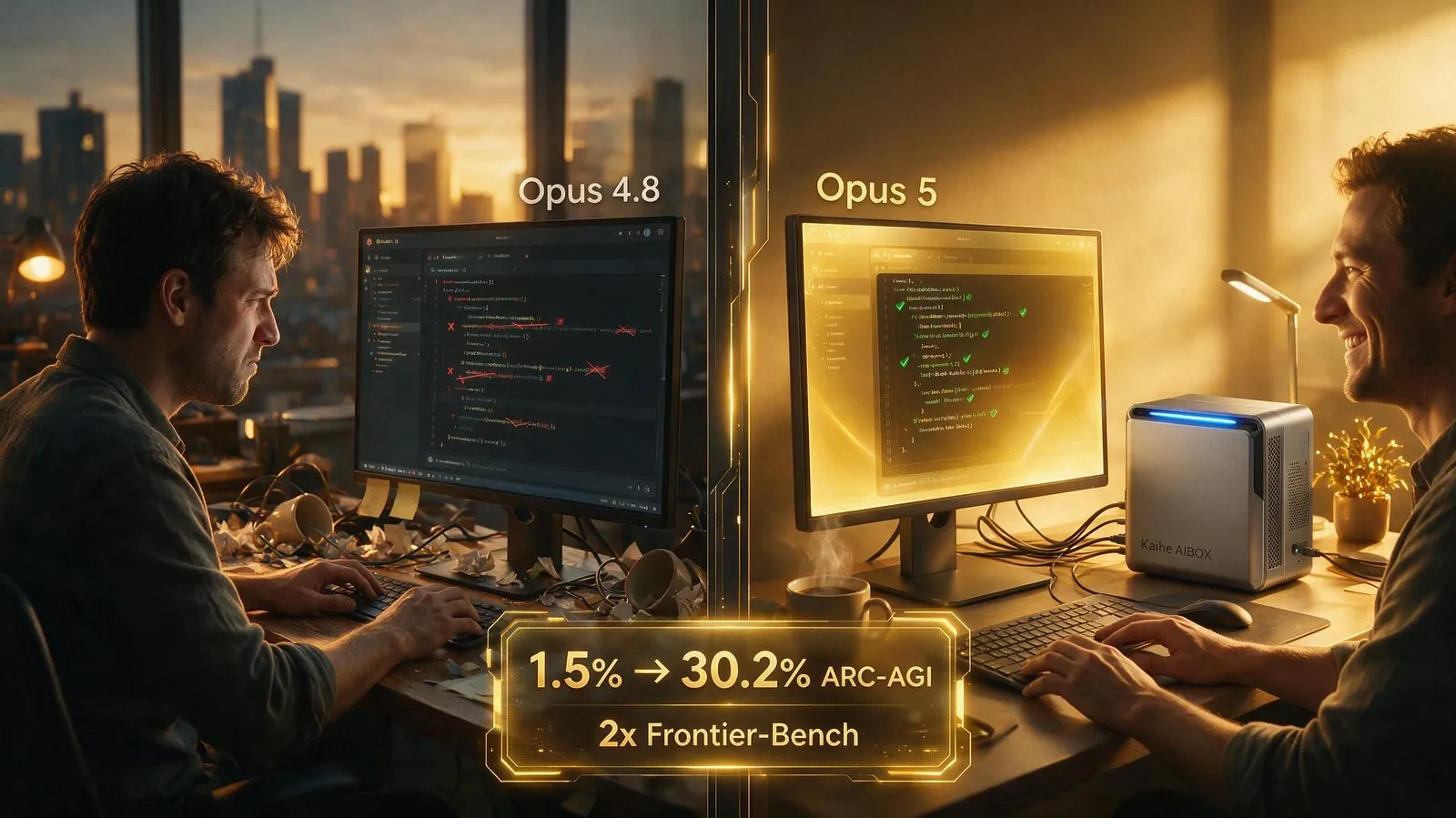
Frontier-Bench v0.1: Opus 5 scored 43.3% — more than double Opus 4.8's performance — while costing less per task. Frontier-Bench is among the hardest autonomous coding agent evaluations, simulating real-world "here's a codebase, figure it out yourself" scenarios.
CursorBench 3.2: At maximum effort, Opus 5 trails Fable 5 by just 0.5%. But each task costs half as much.
GDPval-AA: Opus 5 set a new industry record on this comprehensive coding and knowledge-work benchmark.
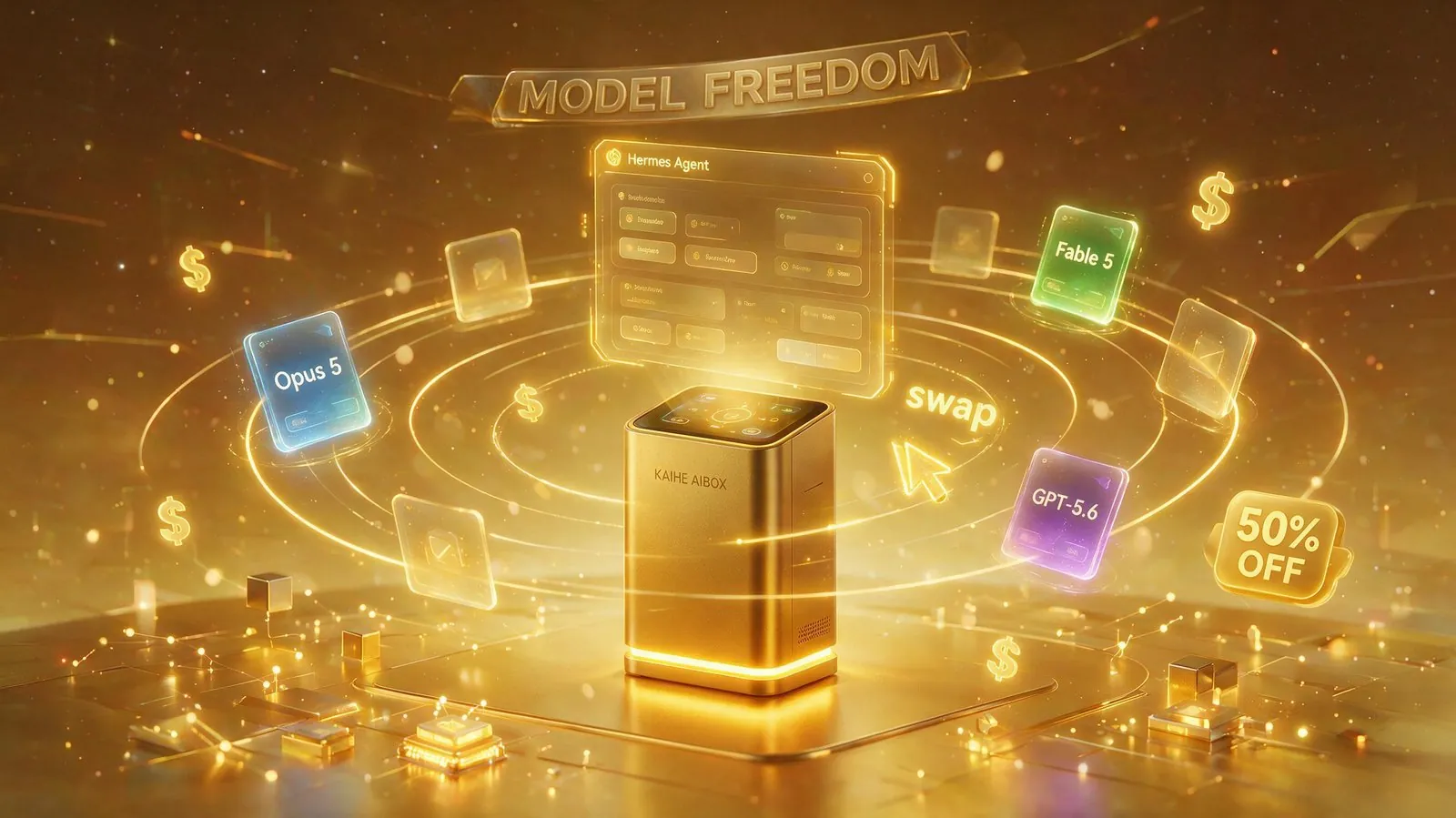
The Pricing Play: Fable 5 Intelligence at Opus 4.8 Prices
Opus 5 API pricing: $5/M input tokens, $25/M output tokens.
Let that sink in. Fable 5 costs $10/$50. Opus 5 is exactly half.
Compare to OpenAI's GPT-5.6 Sol: same input price, but Opus 5's output is 17% cheaper. The gap widens dramatically with long contexts — Sol doubles input price and increases output by 50% past 272K tokens, while Opus 5 maintains standard pricing for the full 1M token context window.
What this means in practice: for long-running agent tasks, Opus 5's real cost advantage is far more than "half." It could be one-third. Or less.
For Kaihe AIBOX users, this is the killer detail. Local agents run long-duration tasks — 24/7 operation, multi-turn conversations, continuous iteration. Every round of token consumption chips away at your API budget. Halving the model cost means doubling your agent's effective throughput on the same budget.
Real-World Test: Hermes + Opus 5 on Local Hardware
We ran three benchmark tasks on Hermes Agent deployed on Kaihe AIBOX, switching between Opus 4.8 and Opus 5.
The switch took one minute: change one model ID in the config file, restart the agent.
Task One: Complex Code Refactoring. A 1,200-line Python project — convert all synchronous I/O to async. Opus 4.8: 4 conversation rounds, 3 tool invocations, one manual correction needed. Opus 5: 2 rounds, direct pass on first attempt, zero corrections. Efficiency gain: immediately visible.
Task Two: Shell Script Security Audit. A 120-line production deployment script, line-by-line security review. Opus 4.8 missed a sudo privilege escalation risk and an unquoted variable expansion. Opus 5 caught everything, and proactively suggested adding set -euo pipefail as a best practice.
Task Three: Long-Form Document Structuring. A 47-page technical specification — extract all API endpoints, parameters, return formats, and error codes. Opus 4.8 missed 2 endpoints and 3 optional parameters. Opus 5: zero omissions, cleaner structured output.
The biggest takeaway from all three tasks wasn't "it's faster." It was "I have to intervene less." Error rate dropped. Manual correction frequency dropped. The overall output quality jumped a tier.
The Bottom Line: Model Freedom Is the Real Moat
Anthropic iterated 4 product lines in 57 days. OpenAI is shipping at a similar pace. China's AI model wars are far from over. Model capability is still evolving month over month.
In this environment, being locked into any single cloud provider is the worst possible position.
This is the core advantage of local agent hardware: you always get to use the best model available right now.
Cloud AI tools lock you into whatever model the platform decides to serve. Your Kaihe AIBOX doesn't. Opus 5 just dropped and you want to try it? Swap the API key. Next week there's a new model that beats Opus 5? Swap again. Hermes, OpenClaw, Workbuddy — these agent frameworks are designed to be model-agnostic from the ground up.
Today, Opus 5 gives your local agent a significant upgrade. Next month, it might be a different model pushing you even further. But you won't need new hardware. You won't need to switch platforms. You won't need to reconfigure all your workflows.
That's the real value of model freedom: not how much you save with Opus 5 today, but knowing you'll never be stuck on a model that's no longer the best.
Further Reading: - Codex, Hermes, Workbuddy, and Kaihe AIBOX: What's the Difference? - AI Still Working After Shutting Down Your PC? Local AI vs. Cloud AI - GitHub 220K Stars: ECC — The Secret Sauce That Makes Claude Code and Codex Run 10x Faster
Opus5 #Hermes #Claude #AICoding #KaiheAIBOX #LocalAgent
Learn more, contact: [email protected]
KAIHE AIBOX · 7x24 Agent Computer | AI Frontier