For KAIHE AIBOX users, there is one frustration that comes up repeatedly: cloud AI is convenient, but the moment you leave your desk, it stops working. Cloud AI assistants need your computer to stay on. KAIHE AIBOX does not.
This is the fundamental difference between cloud AI and a local AI device with scheduled automation built in. And it changes how you think about what AI can actually do for you.
The Biggest Hidden Cost of Cloud AI: It Needs Your Machine to Stay On
📖 Glossary
AI Box (also known as Agent Computer / Agent PC), is a dedicated local hardware device that runs AI Agents. Pre-installed with an AI agent management system, plug-and-play, running 24/7. Users can remotely command AI to work via Discord, Slack, Telegram, WhatsApp, and more.
Over the past two years, cloud AI assistants have become a daily tool for millions. But there is one limitation most people overlook: cloud AI stops the moment your device goes offline.
You leave the office at 6pm with a data processing task queued. You think it will finish by the time you get home. What actually happens depends entirely on whether your laptop stayed awake and connected. One wrong click of the power button, and the task waits until tomorrow.
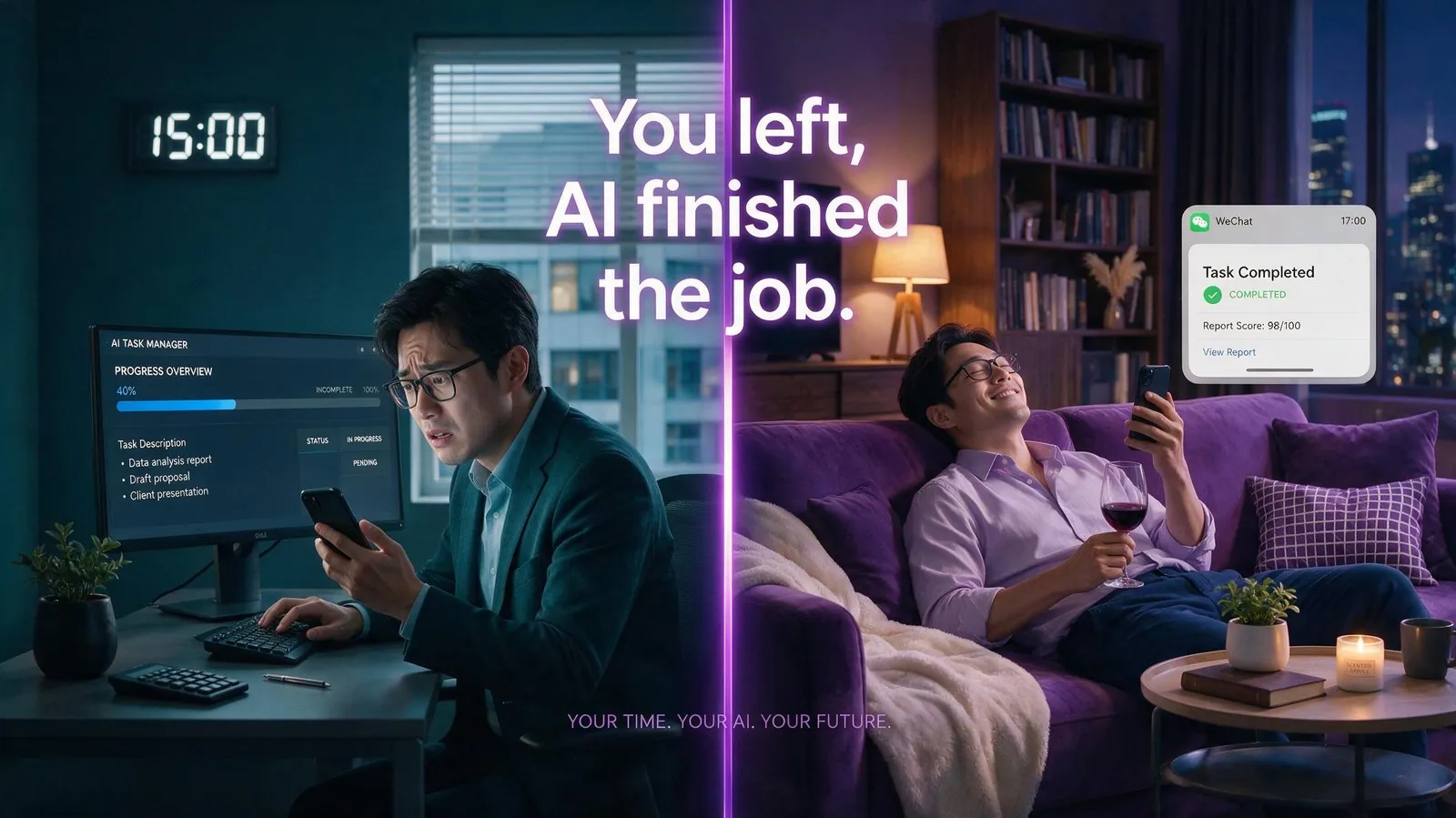
This is the fundamental constraint of cloud AI: it is a remote server that can respond to you, but it requires a "live terminal" — your computer — to be present and powered on. You have hired an assistant, but that assistant can only work when someone is standing next to them handing over materials.
You Leave, It Keeps Going: The Scheduled Automation Difference
The Hermes framework built into KAIHE AIBOX includes a feature called Scheduled Automation (Cronjob). In plain terms: you tell it "do X at time Y," and it executes automatically at the scheduled time, with no one needed to monitor.
Three real-world examples:
Daily news digest before 9am: Before leaving home at 8am, you ask Hermes: "Every day at 9am, search for today's top AI news, summarize it into 5 key points, and send to my WeChat." You walk out the door. At 9am sharp, your phone buzzes — the morning brief is already waiting.
Work report generated after hours: At 6pm, you are about to leave. You tell Hermes: "At 6pm, summarize emails and chat messages related to the project today, write a 200-word brief, and save it locally." You arrive home, the brief is ready.
Overnight monitoring: You set up: "Check server health every hour. If anything looks abnormal, send a WeChat alert immediately." You sleep. The AI keeps its shift.
The common thread in all three: the task runs after you left, and the result arrives before you need it. This is not about AI getting faster — it is about AI no longer needing you to be present.
How It Works Technically
Hermes scheduled tasks run on a dedicated, always-on AI server. KAIHE AIBOX itself is a low-power standalone device (only 5W power consumption, roughly $0.40/month in electricity). It does not require your laptop to be on, your phone screen to be lit, or any human presence.
When the scheduled time arrives, the Gateway daemon automatically triggers the task, spinning up an independent AI Agent session to execute the work. Results are delivered directly via WeChat, email, or saved to local storage.
Think of it this way: your computer is a "workstation" — the AI can only work if someone is at the workstation. KAIHE AIBOX is a "24/7 on-call colleague" — it continues working whether you are there or not.
This Is Not the Same as Remote Control
Someone might point out: WorkBuddy already lets you control your computer remotely via WeChat. True — but that still requires your computer to be on and connected. You leave the office, the laptop goes to sleep, and commands from your phone disappear into the void.
The difference with Hermes + KAIHE AIBOX is that tasks are set up before you leave, and execution requires no further action from you. Think of scheduled automation as a "time capsule" for AI tasks. You pack the task before you go out; it automatically opens at the scheduled time.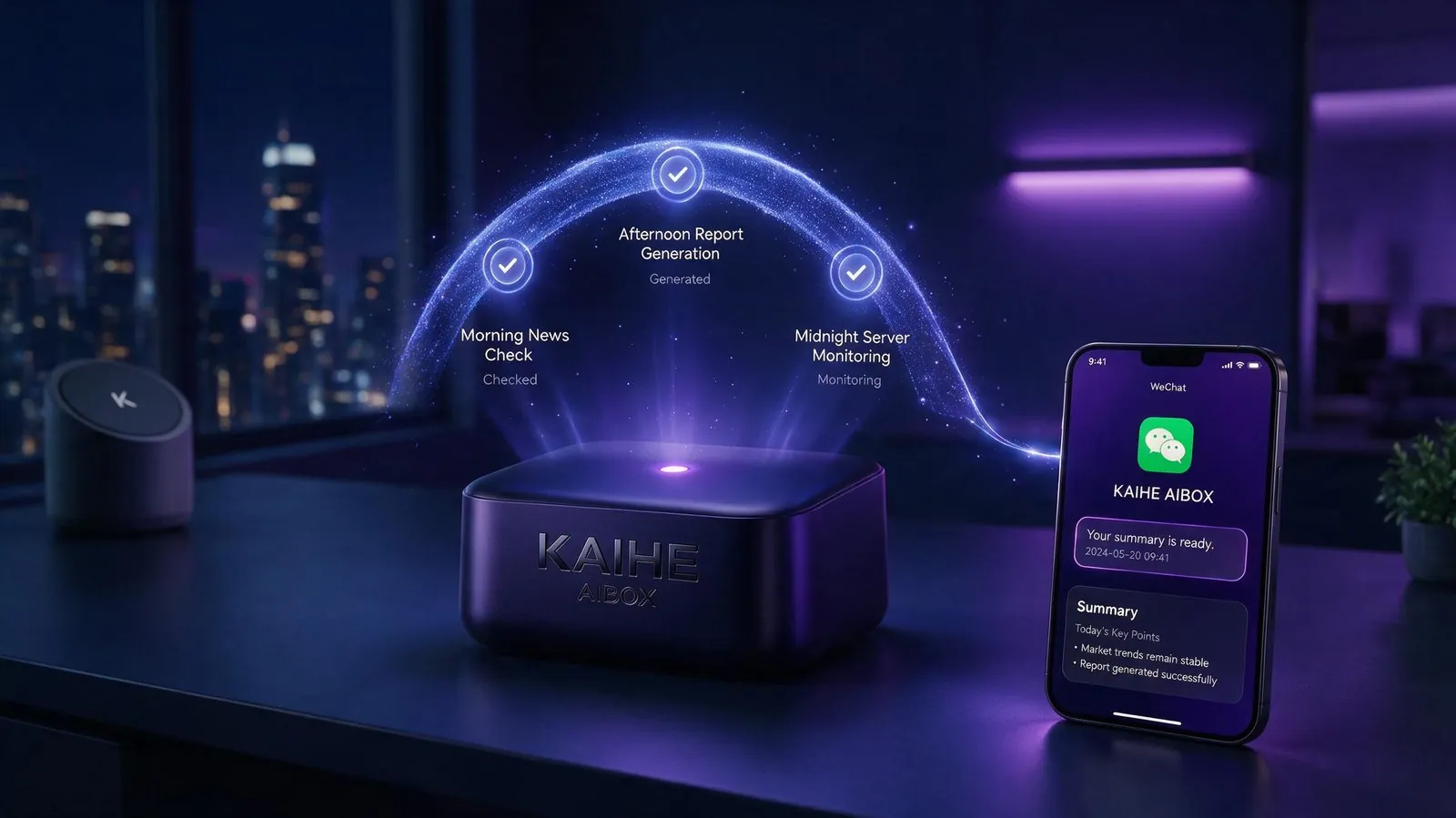
Who Benefits Most?
Knowledge workers with repetitive daily tasks — daily news review, weekly reports, trip summaries. No need to trigger these manually every day. Results arrive automatically.
Anyone who frequently leaves their desk — your workflow does not wait for you to return.
Privacy-conscious users — task configurations and execution results are stored on local disk. No data is uploaded to third-party servers.
The Bottom Line
Cloud AI is: you ask, it answers. Hermes + KAIHE AIBOX is: you assign, it executes. You are not there. It still runs.
The gap becomes obvious the moment you think "I wonder if that task finished" while already on your way home.
Further Reading
- Why KAIHE AIBOX Is Not Just Another AI Tool on Your Computer — the fundamental difference between an independent AI hardware device and a computer-bound AI assistant
- What It Is Like Having AI Night Shifts — real-world scenarios of 7×24 AI standby
- Hermes Autonomous Decision Mechanism: When AI Makes Its Own Calls — how Hermes decides when to act on its own
KAIHE AIBOX #LocalAI #PrivateAIAssistant #Hermes #Automation #WorkBuddy #SmartComputer
Learn More about KAIHE AIBOX Contact: [email protected] https://agentaibox.com/articles/hermes-work-while-you-leave-kaihe-aibox
KAIHE AIBOX · Your Always-On Private AI Assistant | Hermes Hub