Intel WildCat Lake Packs 18A into Thin-and-Light Laptops: The Last Mile of AI PC Popularization
📖 Glossary
AI Box (also known as Agent Computer / Agent PC), is a dedicated local hardware device that runs AI Agents. Pre-installed with an AI agent management system, plug-and-play, running 24/7. Users can remotely command AI to work via Discord, Slack, Telegram, WhatsApp, and more.
Abstract: In May 2026, Intel officially released the WildCat Lake processor family (Core 300 series), built on the 18A angstrom-class process node, packing a 64% power reduction and 40 TOPS of AI compute into a 15W thin-and-light form factor. When the world's largest chipmaker starts "personally guiding laptop design," the final barriers between AI PCs and mainstream consumers are being dismantled one by one.
I. The 18A Process: Angstrom-Era Breakthrough for Thin-and-Light Laptops
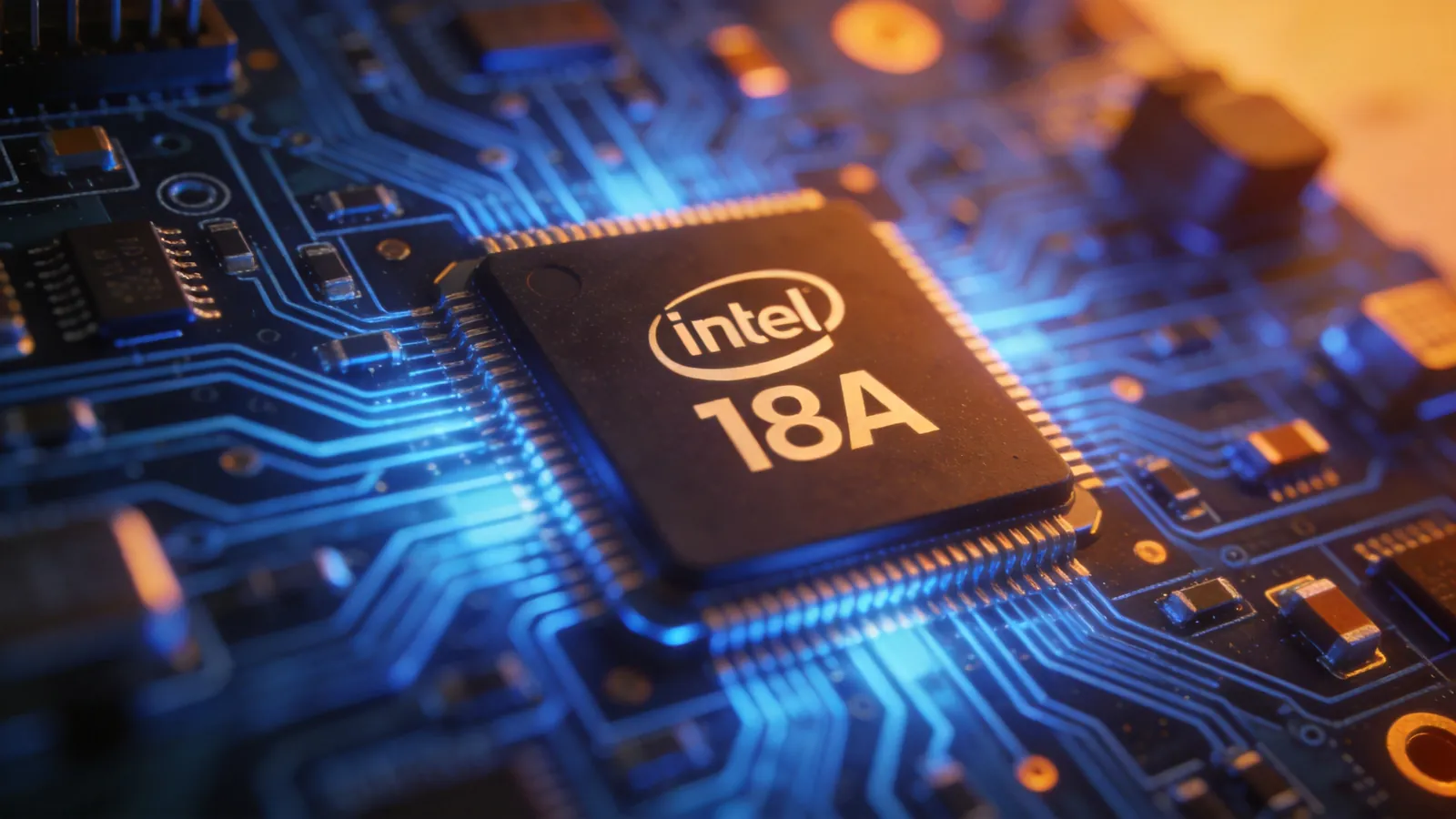
On May 18, 2026, Intel officially launched the WildCat Lake processor family in Shanghai, branded commercially as the Core 300 series. This is no ordinary product iteration—it marks the first time Intel has brought its 18A (1.8-nanometer-class) angstrom process technology down to the mainstream thin-and-light laptop market, and it represents a pivotal moment in the semiconductor industry's transition from nanometer-scale to angstrom-scale manufacturing.
What Does 18A Actually Mean?
To understand the significance of 18A, we need to step back and look at the broader trajectory of semiconductor manufacturing. For decades, the industry used nanometer-based naming conventions—7nm, 5nm, 3nm—to describe process nodes. These numbers had become increasingly disconnected from actual physical dimensions, serving more as marketing labels than precise technical specifications. Intel's adoption of the angstrom naming convention (1 angstrom = 0.1 nanometers) signals both a technical milestone and a branding reset. The 18A node, roughly equivalent to 1.8nm in legacy naming, represents Intel's most advanced manufacturing technology and its answer to TSMC's N2 and Samsung's 2nm process nodes.
The core significance of the 18A process lies in a qualitative leap in transistor density. Compared to the previous-generation Intel 4 process, 18A enables significantly higher integration within the same die area. This translates to three critical advantages: more compute units can be packed into the same silicon, higher clock frequencies can be achieved without proportionally increasing power draw, and lower leakage current reduces wasted energy at idle and low-load states. For thin-and-light laptops where every milliwatt matters—where battery capacity is physically constrained by chassis thickness and weight—18A hits the golden balance point between power consumption and performance.
Power Reduction by the Numbers
Intel's official figures are compelling: significant performance improvement at the same power level, and a 64% power reduction at the same performance level. This number is not a theoretical lab value but a measurement result based on real thin-and-light laptop scenarios, tested across multiple workloads including web browsing, video playback, productivity applications, and AI inference tasks.
What does a 64% power reduction actually mean for end users? Consider a thin-and-light laptop that previously delivered 7 hours of battery life on a 50Wh battery. With WildCat Lake's dramatic power efficiency gains, that same laptop can easily surpass 10 hours of battery life—and that's before accounting for any battery capacity improvements the OEM might implement in a new design. For professionals who spend their days in airports, coffee shops, and conference rooms, the difference between "I need to find a charger by 3 PM" and "I can work all day without worrying about power" is transformative.
But the power story goes beyond battery life. Lower power consumption also means less heat generation, which enables thinner chassis designs with quieter fans—or even fanless designs for certain configurations. This creates a virtuous cycle: thinner laptops are more portable, more portable laptops are used more often, and more frequent use drives demand for better AI capabilities, which in turn drives demand for more efficient processors like WildCat Lake.
When power consumption is no longer AI's shackle, thin-and-light laptops are no longer AI's forbidden zone.
II. 40 TOPS Compute: The AI Awakening of Lightweight Devices
The most eye-catching specification of WildCat Lake is its 40 TOPS NPU compute capability. TOPS (Trillions of Operations Per Second) is the hard metric for measuring AI inference capability—it represents the raw mathematical throughput of the neural processing unit, the specialized silicon designed specifically for machine learning workloads. Forty TOPS means this thin-and-light laptop can locally and smoothly run large language model inference, real-time image generation, speech recognition, and other AI tasks—without having to rely on the cloud for everything.
Why 40 TOPS Matters as a Threshold
The strategic significance of this number extends far beyond technology itself. Microsoft's minimum threshold for "Copilot+ PC" classification is 40 TOPS of NPU compute, and WildCat Lake hits that line exactly. In other words, thin-and-light laptops equipped with this chip will natively receive full support for Windows AI features—from real-time subtitle translation across 40+ languages to Recall memory search that lets you find anything you've ever seen on screen, from local Copilot inference that works without internet connectivity to third-party AI application acceleration that transforms how creative professionals work.
This threshold is not arbitrary. Microsoft determined through extensive testing that 40 TOPS represents the minimum compute required to run its core AI features smoothly—without noticeable latency, without draining the battery excessively, and without requiring the user to close other applications. Below 40 TOPS, the AI experience degrades in ways that frustrate rather than delight users: voice assistants respond too slowly, image generation takes minutes instead of seconds, and real-time translation stutters during video calls. At 40 TOPS and above, these features transition from "technically possible" to "genuinely useful."
The GPU AI Advantage
GPU-level AI performance is equally noteworthy and deserves attention that it often doesn't receive. Intel claims WildCat Lake's GPU AI performance is 2.7x higher than the previous generation, primarily due to the upgraded Xe LPG architecture and a significant increase in execution units. While the NPU handles sustained, low-power AI inference tasks like background noise cancellation or continuous speech recognition, the GPU excels at bursty, compute-intensive AI workloads that benefit from massive parallelism.
For image generation using models like Stable Diffusion, the GPU remains the primary compute engine, and the 2.7x improvement means generation times drop from over a minute to roughly 20-30 seconds for a standard 512x512 image. For video super-resolution that enhances streaming video quality in real-time, the GPU's parallel processing capabilities are essential. For lightweight 3D rendering and AI-assisted creative tools that are increasingly central to content creation workflows, GPU acceleration provides the responsiveness that makes AI feel like a natural extension of the creative process rather than a separate tool that interrupts the flow.
Three-Engine Architecture: CPU + GPU + NPU
The three-engine synergy of CPU + GPU + NPU is Intel's architectural definition of the AI PC, and it's worth understanding why this tripartite approach matters. Each engine has distinct strengths: the CPU excels at general-purpose computing and low-latency decision-making; the GPU dominates at parallelizable, compute-intensive workloads; and the NPU specializes in sustained, power-efficient AI inference. Modern AI workloads rarely fit neatly into a single category—a voice assistant, for example, needs the NPU for continuous speech recognition, the CPU for natural language understanding logic, and potentially the GPU for generating visual responses.
Intel's innovation with WildCat Lake is not just integrating all three engines onto a single die—that had been done before with Meteor Lake and Lunar Lake. The breakthrough is doing so within a 15W TDP while delivering 40 TOPS of NPU compute, 2.7x GPU AI performance improvement, and competitive CPU performance. This integration at mainstream power envelopes is what makes WildCat Lake a category-defining product rather than just another chip launch.
III. Core 5 320 and Core 3 304: AI Admission Tickets at Mainstream Price Points
WildCat Lake launches with two main models, each targeting a distinct segment of the thin-and-light laptop market while maintaining the common denominator of 40 TOPS NPU compute.
Core 5 320: The Mainstream Performer
The Core 5 320 features 6 cores and 6 threads, with a maximum turbo frequency of 4.6 GHz and a 15W TDP. All six performance cores (P-Cores) are based on the Lion Cove microarchitecture—Intel's latest high-performance core design that brings significant improvements in instructions per clock (IPC), branch prediction accuracy, and cache latency. Notably, there are no efficiency cores (E-Cores) in this configuration, which means every core delivers consistent, high-performance execution without the scheduling complexity that hybrid architectures can introduce.
For thin-and-light laptop users, the all-P-Core design has practical implications that go beyond benchmark scores. Applications that are sensitive to single-threaded performance—including most productivity software, web browsers, and many creative tools—benefit from the higher per-core performance that Lion Cove delivers. Applications that can leverage multiple cores, such as video encoding, compilation, and data analysis, benefit from having six high-performance cores rather than a mix of fast and slow cores where the operating system must constantly decide which tasks go where.
The 15W TDP design directly targets mobile scenarios. At this power level, laptop manufacturers can design cooling systems that are barely audible under typical workloads and completely silent during light use. The chassis can be thinner and lighter because the cooling solution doesn't need to handle the thermal output of a 45W or 65W processor. And battery life benefits doubly—from both the efficient 18A process and the modest power envelope.
Core 3 304: The Entry-Level AI Gateway
The Core 3 304 is positioned for the more entry-level AI thin-and-light laptop market. It also integrates an NPU unit, ensuring that even entry-level models can deliver a complete local AI experience. This is a crucial design decision: Intel could have reserved the NPU for higher-tier models, creating an artificial segmentation that would have slowed AI PC adoption. Instead, by making the NPU a non-negotiable component across the entire WildCat Lake lineup, Intel ensures that AI capability becomes a baseline expectation rather than a premium feature.
Pricing Strategy: AI for Everyone
The pricing strategy for these two processors is crystal clear: Core 5 320 covers mainstream thin-and-light laptops, while Core 3 304 covers the entry-level market. Terminals equipped with these chips are priced in the range of approximately 4,000–6,000 RMB (roughly $550–$830 USD), which is precisely the highest-volume price segment for thin-and-light laptops globally.
This price positioning is not accidental. The majority of laptop purchases worldwide fall within this range, and it represents the segment where consumers are most price-sensitive and least likely to pay a premium for features they don't understand. By delivering 40 TOPS NPU compute at this price point, Intel is effectively making AI capability a default feature rather than an upsell—a strategy that mirrors how touchscreens transitioned from premium features to standard equipment in the smartphone era.
AI PCs should not be exclusive to the high end. When 40 TOPS of compute enters mainstream price points, "AI thin-and-light laptops for everyone" is no longer marketing rhetoric.
IV. 70+ Terminals: The Signal of Ecosystem Explosion
Simultaneously with the WildCat Lake release, Intel announced that it is partnering with OEM manufacturers including Lenovo, ASUS, Honor, and HP to launch over 70 terminal products equipped with the Core 300 series. The "70+" figure is not a casually assembled number—it means virtually all mainstream laptop manufacturers have introduced WildCat Lake models at the first opportunity, signaling broad industry confidence in both the technology and the market demand.
Why Ecosystem Scale Matters
The significance of this ecosystem scale extends far beyond consumer choice. When 70+ AI PC models hit the market simultaneously, several reinforcing dynamics are set in motion:
Developer attention shifts. Software developers are rational actors who allocate resources toward platforms with the largest addressable audience. When WildCat Lake laptops number in the tens of millions within the first year, the economic calculus for AI application development changes dramatically. Developers who previously targeted only high-end workstations now have a mainstream audience worth optimizing for, and the NPU provides a consistent hardware target that simplifies optimization.
Enterprise procurement accelerates. Corporate IT departments don't evaluate individual laptop models—they evaluate platforms. When every major OEM offers WildCat Lake options across their product lines, procurement teams can standardize on AI-capable hardware without being locked into a single vendor. The availability of 70+ models means enterprises can choose based on their existing vendor relationships, specific feature requirements, or price negotiations, all while knowing they're getting the same AI compute foundation.
Consumer awareness builds organically. When AI PC options appear at every price point from every major brand, the category transitions from "something tech enthusiasts talk about" to "something my colleague just bought." This organic awareness is far more powerful than any advertising campaign, because it comes with social proof—real people using real AI features in real workflows.
The OEM Lineup
Lenovo YOGA, ASUS ZenBook, Honor MagicBook, HP ProBook—these established series have all introduced WildCat Lake versions, and each brings its own differentiation. Lenovo emphasizes its AI-driven adaptive performance tuning; ASUS showcases its collaboration with AI creative tools; Honor leverages its ecosystem connectivity between phones and laptops; HP focuses on enterprise security and manageability for AI workloads. The diversity of approaches demonstrates that AI PC is not a monolithic concept but a platform that enables each manufacturer to express its unique value proposition.
The enthusiastic OEM response signals something important: manufacturers are no longer treating AI PCs as a gimmick or a checkbox feature but as the core competitive selling point of their products. This represents a fundamental shift in how the industry thinks about laptop differentiation. For years, the primary differentiators were processor speed, display quality, and build materials. AI capability is now joining that list—and arguably becoming the most important differentiator of all.
V. "Reference Laptop Design": Intel Personally Guides Laptop Manufacturing
Perhaps the most intriguing detail in the WildCat Lake launch is Intel's "Reference Laptop Design" program. Simply put, Intel is no longer just selling chips—it has started providing OEMs with complete laptop design solutions, including motherboard layouts, thermal solutions, chassis mold references, and even port definitions. This represents a fundamental shift in Intel's relationship with its OEM partners and in the dynamics of the PC industry.
Historical Context: From Chipmaker to Platform Architect
This is not unprecedented in the broader technology industry. Qualcomm and MediaTek have long offered reference designs in the smartphone space, enabling dozens of manufacturers to quickly bring Android phones to market without needing deep hardware engineering expertise. Google's Pixel phones serve a similar purpose—demonstrating the "pure" Android experience that other manufacturers can build upon. Even Apple, with its tightly integrated ecosystem, essentially provides a reference design through its own hardware that third-party accessory makers target.
But in the PC industry, Intel providing reference designs represents an unprecedented posture. Traditionally, Intel designed chips, OEMs designed laptops, and Microsoft wrote the operating system. Each party stayed in its lane, and integration happened at the interface points—standardized sockets, buses, and APIs. This model worked well for decades because the performance bottleneck was consistently at the chip level, and improvements in silicon translated directly into improvements in the end-user experience.
Why AI PCs Changed the Rules
AI PCs fundamentally disrupted this model because the performance bottleneck shifted from the chip to the system. It doesn't matter how powerful an NPU is if the motherboard can't deliver clean power to it under load, if the thermal solution allows it to throttle after 30 seconds of sustained inference, or if the operating system can't efficiently schedule workloads across the CPU, GPU, and NPU. These are system-level problems that require system-level solutions.
Intel's reference design program addresses this directly by providing:
First, system-level optimization. NPU performance delivery does not depend on the chip itself but on the synergy of motherboard power delivery, thermal design, driver scheduling, and system adaptation. Under the traditional model, each OEM operates independently, and optimization levels vary widely. A well-designed thermal solution from Lenovo might deliver 95% of the NPU's theoretical performance, while a poorly designed solution from a smaller OEM might only deliver 70%. By providing reference designs, Intel essentially liberates the fulfillment standard of "chip performance" from OEM capability constraints.
Second, lower AI PC development barriers for OEMs. Not every OEM has Lenovo-level R&D resources. For smaller brands wanting to launch AI thin-and-light laptops, designing an optimized motherboard and thermal solution from scratch means uncontrollable costs and timelines. Reference designs allow them to directly build upon Intel's engineering expertise, accelerating time to market and reducing development risk. This democratizes the AI PC market—any manufacturer can compete, not just the ones with the deepest engineering teams.
Third, a unified AI experience baseline. When all WildCat Lake laptops are based on similar hardware architectures, Intel's driver optimization and software adaptation can cover a much larger user base. Developers also don't need to adapt for dozens of different architectures—this is a major boon for the AI application ecosystem. Consider the Android fragmentation problem that has plagued mobile developers for years: the same app runs differently on different phones because hardware configurations vary wildly. Intel's reference design approach is a deliberate effort to prevent similar fragmentation in the AI PC space.
Intel's shift from "selling chips" to "defining products" reflects the rigid demand for system-level coordination in AI PCs.
VI. The Last Mile of AI PC Popularization
Looking back at the development trajectory of AI PCs, three distinct phases can be clearly identified, each building upon the foundations of the previous one while addressing its critical shortcomings.
Phase One (2023–2024): Concept Validation Period
Intel's Meteor Lake, launched in late 2023, was the first mainstream processor to integrate an NPU directly onto the die. This was a watershed moment—it proved that AI-specific compute could coexist with traditional CPU and GPU compute on a single chip, sharing memory bandwidth and power budgets. However, the NPU in Meteor Lake delivered only approximately 10 TOPS of compute, which placed severe limitations on what could be achieved locally.
At 10 TOPS, basic AI features were possible: webcam background blur, noise cancellation during video calls, and simple photo enhancement. But more demanding tasks—running a local large language model, generating images with diffusion models, or performing real-time language translation—required either cloud connectivity or a discrete GPU. The AI PC of this era was more concept than reality, and many reviewers and consumers viewed the NPU as a feature in search of a use case.
Phase Two (2025): Compute Threshold Period
Lunar Lake, launched in 2024 and reaching broad market availability in 2025, pushed NPU compute to 48 TOPS—well above Microsoft's 40 TOPS threshold for Copilot+ PC classification. Simultaneously, Qualcomm entered the x86 laptop market with its Snapdragon X Elite processor, offering 45 TOPS of NPU compute and impressive power efficiency through its ARM-based architecture.
This phase established two critical milestones: the hardware threshold for "useful" AI PCs was firmly set at 40+ TOPS, and multiple chip vendors were now competing to deliver it. Competition drove innovation and gave OEMs choices, which in turn led to more diverse product offerings.
However, high pricing kept AI PCs in the premium market segment. Lunar Lake laptops typically started above 8,000 RMB ($1,100 USD), and Snapdragon X Elite devices were similarly positioned. The technology was proven, the user experience was genuinely improved, but the addressable market was limited to early adopters, creative professionals, and enterprise buyers with generous IT budgets.
Phase Three (2026–): Mainstream Popularization Period
With 15W TDP, 40 TOPS of compute, and mainstream pricing, WildCat Lake officially kicks off the scaled popularization of AI PCs. This is the true "last mile"—not the last mile of technological breakthrough, but the last mile of market penetration.
The essence of the last mile is this: transforming AI computing from an "optional feature" into a "default capability." When every newly purchased thin-and-light laptop comes with a 40 TOPS NPU, when Windows native AI features require no additional hardware or configuration, when local large model inference is no longer the exclusive domain of tech enthusiasts and researchers—AI PCs will have completed the transition from a "category" to a "norm."
This transition has profound implications for the entire technology ecosystem. Software companies can invest in AI features knowing their audience has the hardware to run them. Enterprise IT departments can deploy AI-powered productivity tools without worrying about hardware compatibility. Educational institutions can integrate AI into curricula knowing students' laptops can handle the workloads. And consumers can discover AI capabilities organically through daily use rather than through marketing materials.
VII. The ARM Threat: Why Intel Had to Win
WildCat Lake was not born in a vacuum. Intel faces more external pressure than at any point in its PC market history. Qualcomm's Snapdragon X Elite proved in 2025 that ARM architecture can deliver outstanding performance-per-watt in laptops, winning design contracts from virtually every major OEM. Apple's M4 series has long dominated the thin-and-light performance-per-watt benchmark, setting a standard that x86 processors have struggled to match. If Intel continued to lag in power efficiency, the migration of OEMs and users to ARM was only a matter of time.
The 18A process is Intel's answer. By the numbers, WildCat Lake achieves 40 TOPS of NPU compute at 15W TDP—an efficiency ratio approaching ARM territory. More critically, x86's ecosystem compatibility advantage is something ARM cannot replicate in the short term. Decades of accumulated Windows software ecosystem, enterprise management tools, professional design software (Adobe Creative Suite, Autodesk, SolidWorks), and legacy business applications all require native x86 instruction set support. For enterprises managing thousands of endpoints with Group Policy, SCCM, and custom deployment pipelines, ARM's compatibility layers remain a compromise rather than a solution.
Intel's strategy is clear: use the 18A process to close the efficiency gap, use x86 ecosystem strength to maintain the application moat, and use reference designs to reduce OEM migration costs. All three layers reinforce each other—WildCat Lake is not just a product iteration, it's Intel's defensive counteroffensive in the AI PC era.
But the pressure comes from within as well. Intel's process transition over the past two years has been anything but smooth. The cancellation of Intel 20A, ongoing losses in the foundry business, and a sustained stock price decline have all left the market skeptical about 18A's mass production capability. Can WildCat Lake ship in volume on schedule? Will real-world performance match the promotional claims? These questions will be answered in the second half of 2026, and the answers will determine whether Intel's comeback narrative has substance.
VIII. The Decentralization of AI Compute: A Macro Perspective
WildCat Lake represents something larger than a single processor generation: it embodies the "democratization" trend in AI infrastructure. Compute is no longer concentrated in cloud data centers accessible only through network connections—it's being distributed to every desktop, backpack, and pocket. This decentralization of AI compute will fundamentally change how humans interact with machines.
Consider the progression: in 2023, running a large language model locally required a dedicated GPU workstation costing thousands of dollars. In 2024, Copilot+ PC requirements brought NPU-based AI to premium laptops. In 2026, WildCat Lake brings the same capability to mainstream-priced thin-and-lights. Each step widens the addressable market by an order of magnitude.
The implications are profound. You no longer need to "go online" to use AI—AI is on your device, standing by 24/7. This shifts the relationship from request-response (you ask, AI answers) to continuous presence (AI is always available, always context-aware). And that, precisely, is the raison d'être of Agent Computers—when AI compute is everywhere, who helps you orchestrate and manage it? Who ensures stable 24/7 operation? Who makes AI accessible to non-technical users?
KaiheAiBox's answer: a hardware platform purpose-built for agent tasks. Local scheduling, cloud inference, and an experience designed so that anyone—not just developers—can delegate complex, long-running AI tasks to a machine that never sleeps. When WildCat Lake ensures the compute is available and KaiheAiBox ensures the compute is useful, AI truly becomes everyone's "colleague" rather than a specialized "tool."
The Edge-Cloud Continuum
It's worth noting that the decentralization of AI compute doesn't mean the death of cloud AI. Rather, it creates a continuum: lightweight inference and real-time interaction happen on-device via WildCat Lake's NPU, while complex reasoning, large-scale generation, and training remain in the cloud. The intelligence lies in the routing—which tasks stay local, which go to the cloud, and how they coordinate.
This is precisely where agent platforms add the most value. A well-designed agent system can transparently route tasks based on complexity, latency requirements, and data sensitivity. Simple queries like "summarize this email" run locally in milliseconds. Complex tasks like "analyze this 200-page contract and flag unusual clauses" offload to cloud models with superior reasoning capability. The user doesn't need to know or care where the computation happens—they just get results.
WildCat Lake's contribution to this continuum is ensuring that the local end is capable enough to handle a meaningful proportion of AI workloads, reducing cloud dependency for routine tasks and enabling always-available AI even when network connectivity is intermittent. This is especially valuable for mobile professionals, field workers, and anyone operating in environments with unreliable internet access.
IX. From Chips to Platforms: The Complete Puzzle of AI Deployment
WildCat Lake has resolved the hardware foundation problem for AI PC popularization—compute, power consumption, and pricing are all in place. But hardware is only the starting point. For AI to truly transform user workflows and deliver on its promise of augmented intelligence, a complete platform is needed to support it.
The Hardware-Experience Gap
Having 40 TOPS of NPU compute is necessary but not sufficient for AI to become a truly transformative technology for mainstream users. The gap between hardware capability and user experience is bridged by software platforms that abstract away complexity and make AI accessible to people who don't know what a neural network is, don't care about quantization formats, and don't want to configure model parameters.
Consider the analogy of personal computing in the 1980s. The hardware existed to run spreadsheets, word processors, and databases, but it was the combination of the IBM PC platform and user-friendly software like Lotus 1-2-3 and WordPerfect that transformed computers from specialist tools into business essentials. The hardware was the enabler; the software platform was the catalyst.
Complementary Strategies: Democratization Meets Accessibility
Intel's strategy is "hardware democratization"—ensuring every computer can run AI by putting capable NPUs into every price segment. This is a supply-side approach: if the hardware is ubiquitous, the software and applications will follow.
KaiheAiBox's Agent Computer takes a complementary demand-side approach: providing non-technical users with a hardware platform that stably runs AI tasks 24/7. Local agent scheduling handles task orchestration and automated execution—imagine an AI assistant that can monitor your email, draft responses, schedule meetings, generate reports, and manage your calendar without requiring you to prompt it for every single action. Cloud-based large model inference handles complex semantic understanding and generation—the kind of nuanced language comprehension and creative generation that requires models far larger than what can run locally on a 40 TOPS NPU.
The two approaches work in tandem: Intel's ubiquitous NPU ensures that AI capabilities are always available on the device, while KaiheAiBox's agent platform ensures that those capabilities are orchestrated into coherent, automated workflows that deliver tangible value without requiring technical expertise from the user.
The Network Effect of AI Ubiquity
When both hardware and platform reach critical mass, a network effect takes hold. More AI-capable devices in users' hands means more data about how AI is actually used, which means better AI models and features, which means more compelling reasons to use AI, which drives more adoption. WildCat Lake and platforms like KaiheAiBox's Agent Computer are simultaneously pushing on both sides of this equation—hardware availability and experience quality—and the compounding effect could accelerate AI adoption far beyond what either could achieve alone.
Enterprise Adoption: The Silent Accelerator
While consumer AI features grab headlines, enterprise adoption may be the more consequential trend. Organizations that deploy WildCat Lake-equipped laptops gain local AI processing capability without the privacy and latency concerns of cloud-based solutions. Sensitive documents stay on-device. Real-time transcription and translation happen without network dependency. Automated workflow agents can process proprietary data without routing it through external APIs.
For IT departments, this represents a paradigm shift. Instead of evaluating AI tools on a case-by-case basis—each with its own cloud service, data handling policy, and subscription model—they can standardize on a hardware platform that supports a diverse ecosystem of local AI applications. The management overhead drops dramatically, and the security surface area shrinks correspondingly.
KaiheAiBox's Agent Computer extends this logic further. While WildCat Lake provides the on-device AI compute for individual knowledge workers, KaiheAiBox provides the always-on agent infrastructure for teams and workflows that require 24/7 AI operation—monitoring dashboards, processing incoming data streams, generating periodic reports, and orchestrating multi-step business processes that don't fit neatly into a laptop's on-demand usage pattern.
Chips provide compute; platforms provide experience. When WildCat Lake packs 40 TOPS into mainstream-priced thin-and-light laptops, and when KaiheAiBox makes agent scheduling accessible to non-technical users, the puzzle of AI moving from "technological frontier" to "everyday tool" is complete.
The last mile of AI is not about making compute more powerful—it's about making compute more accessible.
Looking Ahead: What WildCat Lake Enables Next
The true impact of WildCat Lake won't be measured in benchmark scores or TOPS ratings—it will be measured in the applications and experiences it enables that simply weren't possible before. When every laptop has 40 TOPS of AI compute, developers can assume local AI capability as a baseline, not a premium feature. This unlocks a new category of applications: always-on personal assistants that understand context across apps, real-time collaboration tools that transcribe and summarize meetings as they happen, creative tools that generate and iterate on content in real-time, and productivity suites that proactively suggest actions based on your work patterns.
The next two years will determine whether WildCat Lake lives up to its promise. If Intel can deliver volume production on 18A, if OEMs can design compelling devices at mainstream price points, and if the software ecosystem can build experiences that justify the NPU investment, then 2026 may well be remembered as the year AI PCs went from niche to normal. And when that future arrives, the question won't be "Does my laptop have AI?" but "What can my laptop's AI do for me?"
KaiheAiBox · AI Frontier