Let me share a test I ran last month.
I picked four of the most common agent use cases. Ran each one on a cloud platform and on local hardware — same requirements, same prompts, same evaluation criteria. One question: how does local AI actually compare to cloud?
The results surprised me.
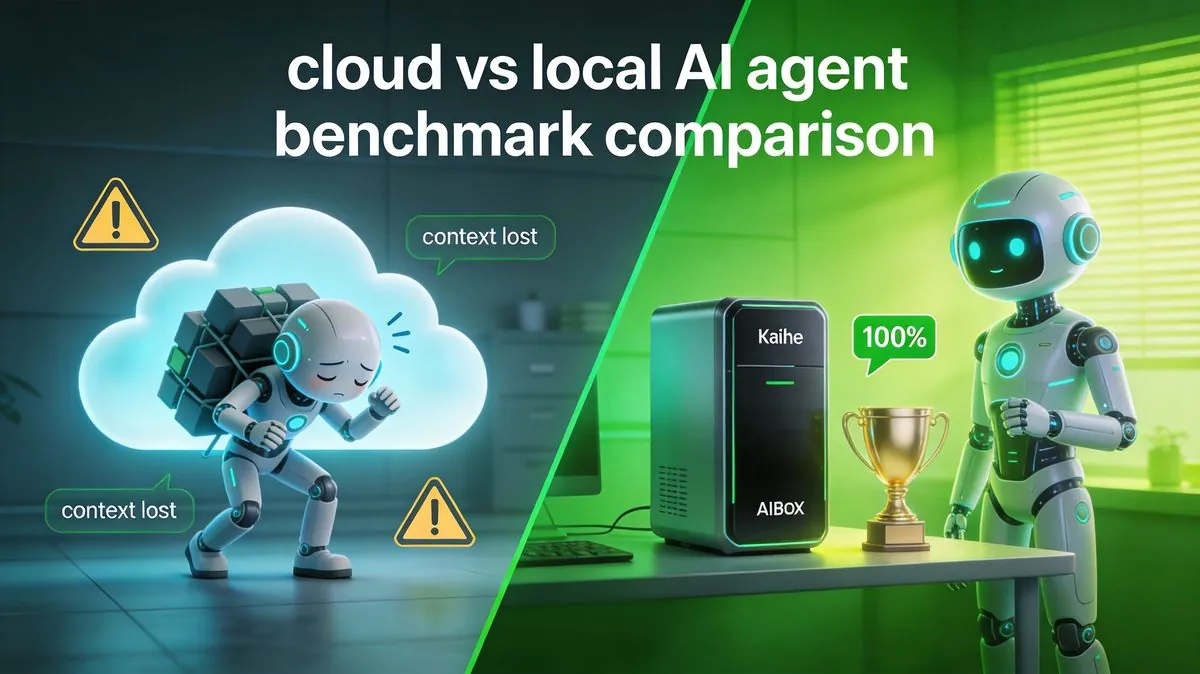
Test 1: 200-round conversation without losing context
Method: The agent plays a technical interviewer through 200 consecutive Q&A rounds. It must remember the candidate's background, previous answers, and interviewer ratings. We throw in 10 deliberate topic switches mid-conversation.
Cloud result: Flawless first 30 rounds. By round 50, subtle drift — the interviewer "forgets" the candidate mentioned Python skills but not Go. After round 80, context severely compressed, early information largely discarded. By round 120, the interviewer doesn't even recall what job they're interviewing for.
Local result: 200 rounds completed intact. Correctly returns to context after all 10 topic switches. At round 190, it still accurately references "three years of Java experience" mentioned in round 15.
The reason is straightforward: cloud platforms compress context beyond a fixed token window to control costs. The more you feed in, the sooner the beginning gets forgotten. Local AI has no such constraint — as long as memory allows, it remembers as far back as you need.
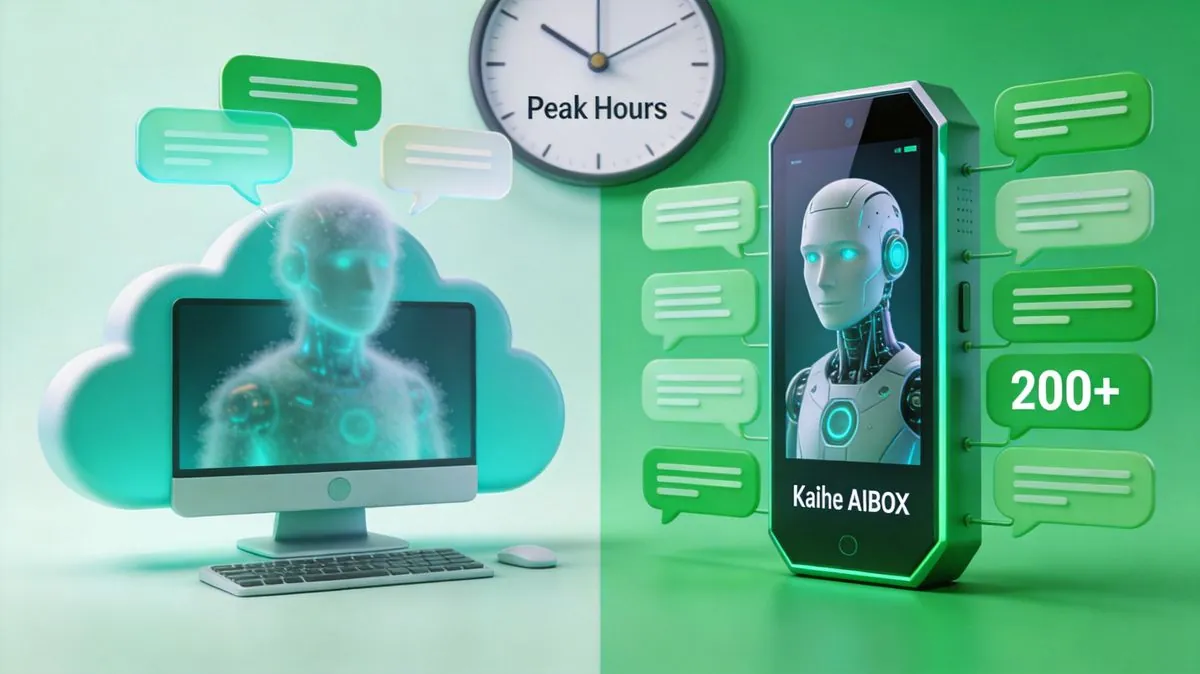
Test 2: 2 AM vs 10 AM vs 8 PM — peak vs off-peak
Method: Call the same agent to process a 2000-word document at 2 AM, 10 AM, and 8 PM. Record time-to-first-token and total processing time.
Cloud result: 2 AM — first token in 0.8s, total 18s. 10 AM — first token in 3.2s, total 45s. 8 PM — first token in 5.1s, total 72s, plus a "high traffic, please retry" error.
Local result: First token between 1.2-1.5s across all three time slots. Total processing between 22-25s. No queue. No retries.
During business hours, you're competing for compute with the entire world. Local AI compute is dedicated to one person — you — 24/7.
Test 3: Feed a 500,000-word novel, ask detailed questions
Method: Load the same 500,000-word PDF novel into both agents. Ask specific detail questions: "What color jacket is the protagonist wearing in Chapter 7?", "Who first appears in Chapter 32?"
Cloud result: First 3 questions correct. Question 4 gets fuzzy ("in late autumn... probably black or gray"). Question 6: "Current context does not support access to this chapter's content."
Local result: All 15 questions answered with precision. Even cross-chapter inference questions like "Is the blue jacket from Chapter 7 the same as the blue dress mentioned in Chapter 28?" receive well-reasoned analysis.
Fundamental difference: the cloud agent sees your question plus a few extracted passages — it guesses. The local agent actually reads the entire book.
Test 4: 30-day continuous operation, stability check
Method: The agent auto-scrapes 3 articles daily from specified websites, summarizes them, and pushes to WeChat — running 30 days straight.
Cloud result: Day 3 — API version update causes "behavior anomaly" (agent suddenly outputs in English). Day 12 — platform maintenance, 3-hour nighttime outage. Day 27 — notification: "API billing model changing next month, please migrate soon."
Local result: 30 days, zero interruptions. The only "anomaly" in logs: Day 19, target website redesign caused a scrape failure — the agent automatically switched to the old URL and recovered.
At a glance
| Metric | Cloud Agent | Local Agent (Kaihe AIBOX) |
|---|---|---|
| Long-conversation memory | Degrades after ~50 rounds | 200+ rounds intact |
| Response speed consistency | 3-5x slower during peak hours | Uniform 24/7 |
| Large document comprehension | Extracts snippets, infers | Reads everything, retrieves precisely |
| Long-term stability | Updates/maintenance affect uptime | Zero interruptions |
| Cost structure | Recurring monthly + usage-based | One-time investment |
📖 Glossary
AI Box (also known as Agent Computer / Agent PC), is a dedicated local hardware device that runs AI Agents. Pre-installed with an AI agent management system, plug-and-play, running 24/7. Users can remotely command AI to work via Discord, Slack, Telegram, WhatsApp, and more.
Bottom line: A cloud agent is like a capable intern — does the job, affordable, but might leave anytime. A local agent is like a dedicated personal assistant — always present, works only for you, and gets better the longer you use it.
Want to learn more about Kaihe AIBOX?
Website: https://agentaibox.com/ Email: [email protected]