2.7 trillion parameters. Fully open source.
That's what MiniMax is doing.
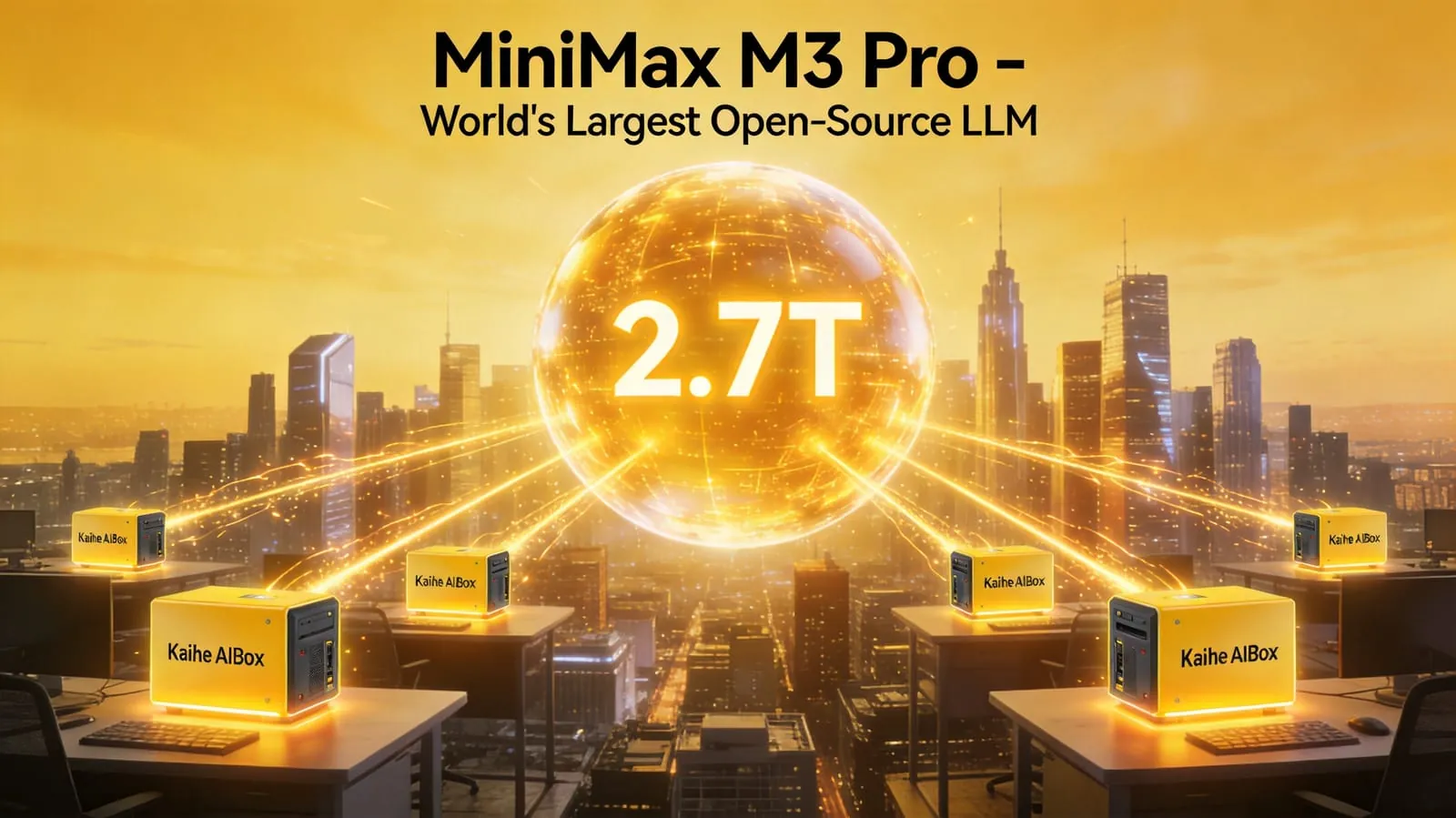
On July 8, The Information broke the story: Chinese AI company MiniMax is developing its next-generation large model, M3 Pro, with a staggering 2.7 trillion parameters. For context—DeepSeek-V3 is 671 billion, Alibaba's Qwen3 maxes out at 235 billion, Moonlight's Kimi K2 is 1 trillion. If open-sourced on schedule, M3 Pro will become the largest open-source large language model in the world. Period.
The news isn't entirely surprising. MiniMax's current flagship M3 (428 billion parameters) was open-sourced on June 15, and it already surpassed GPT-5.5 and Gemini 3.1 Pro on the SWE-Bench Pro coding benchmark, closing in on Claude Opus 4.7. M3 Pro pushes the parameter count to 6.3 times that of M3. The gap between these two model generations is bigger than OpenAI's jump from GPT-4 to GPT-5.
{
Why 2.7 Trillion Parameters Matters
Parameters aren't the only metric, but they are the foundational substrate of capability. Larger parameter counts theoretically enable stronger performance on complex reasoning, multi-step tasks, and long-chain logic.
MiniMax M3 has already proven itself on agent tasks—autonomous task decomposition, tool calling, multi-step reasoning, with generated code targeting "directly deliverable, not just runnable but needing human fixes." M3 Pro aims to push significantly further on each of these fronts.
More importantly, it's planned to be open-source. Not API access, not pay-per-token, not "we'll host your data for you." Full weight release—anyone can deploy and run it on their own hardware.
{
Large Models No Longer Belong Exclusively to Big Tech
The real weight of this news isn't about MiniMax. It's about the accelerating momentum of the open-source AI movement.
M3's June open-source release was already explosive. Million-token context windows, coding ability surpassing GPT-5.5, native multimodality—all open-source, Apache 2.0. The industry hasn't even finished digesting that when M3 Pro comes charging in.
When the world's largest open-source model is about to emerge from a Chinese company, the narrative that large models "can only run in the cloud" collapses entirely. Anyone can deploy these models on local hardware, without sending their data to someone else's servers, without paying monthly API fees.
This aligns perfectly with what Kaihe AIBOX is building. A 24/7 local agent hardware box, bound to no single model. When M3 Pro goes open-source, download and run it locally on Kaihe. When GPT-5.6 is stronger, route to the cloud API. You don't need to pick a side—you just pick the strongest model for the moment.
From MiniMax M3 to M3 Pro, from DeepSeek to Qwen, from Llama to Mistral—every heavyweight open-source release makes "AI running on your own hardware" more viable. Your AI is no longer a subscription service from some company. It's becoming your own infrastructure.
Want to learn more about Kaihe AIBOX? Contact us at [email protected]
KaiheAIBOX #MiniMax #M3Pro #OpenSource #LLM #LocalAgent #2.7Trillion
📖 Glossary
AI Box (also known as Agent Computer / Agent PC), is a dedicated local hardware device that runs AI Agents. Pre-installed with an AI agent management system, plug-and-play, running 24/7. Users can remotely command AI to work via Discord, Slack, Telegram, WhatsApp, and more.