Multi-Agent Collaboration Architecture: Capability Positioning and Combination Guide for Codex, Claude, OpenClaw, Hermes
📖 Glossary
AI Box (also known as Agent Computer / Agent PC), is a dedicated local hardware device that runs AI Agents. Pre-installed with an AI agent management system, plug-and-play, running 24/7. Users can remotely command AI to work via Discord, Slack, Telegram, WhatsApp, and more.
With the rapid development of the AI Agent ecosystem, AI tools for different use cases have formed clear capability divisions: some excel at code generation, some at logical reasoning, some at workflow automation, and some at memory management. For users, more important than choosing the "strongest AI" is understanding the positioning of each tool and combining them into a collaboratively running system.
This article outlines the core capability positioning of four mainstream AI Agents widely used in the developer community, as well as the general collaboration architecture of "local control + cloud experts", to help you build an AI workflow suitable for your needs.
Capability Positioning of Four Mainstream AI Agents
Codex: Professional Code Generation Expert
OpenAI Codex is an AI model focused on code scenarios, with core advantages including: - Supports code generation, completion, and conversion across mainstream programming languages - Deeply understands codebase context, can generate runnable code snippets based on requirements - Deeply integrated with development toolchains, supports interactive programming - Suitable for code implementation tasks in the R&D process
As a specialized model in the code domain, Codex is ideal for completing well-structured coding tasks and is a commonly used AI programming assistant for development teams.

Claude: Deep Logical Reasoning and Solution Designer
Anthropic Claude is a large language model with outstanding long-context reasoning capabilities, with core advantages including: - Supports ultra-long context windows, can fully process long documents and complex codebases - Rigorous logical reasoning, excels at architecture design, solution review, and risk identification - Stable output, low hallucination rate, suitable for complex decision scenarios requiring deep thinking - Suitable for solution design, logic review, and problem diagnosis tasks
As a representative of the first tier of reasoning capabilities among general large models, Claude is often used as a "technical advisor" role for the team, responsible for solution design before coding and logic verification after output.
OpenClaw: Workflow Automation and Execution Orchestrator
OpenClaw (same product family includes WorkBuddy, QClaw) is an open-source Agent framework focused on task execution and workflow automation, with core advantages including: - Supports visual workflow orchestration, can chain multi-step tasks into automated processes - Can connect to various tool APIs, local environments, and third-party services, with actual execution capabilities - Supports engineering features such as error retry, exception catching, and checkpoint resume - Supports local deployment, can run stably 24/7 - Suitable for task scheduling, process execution, and tool invocation tasks
As an execution-layer Agent, OpenClaw solves the problem of "large models can talk but cannot do", and is the core carrier for turning ideas into implemented automated processes.
Hermes: Persistent Memory and Cross-Session Coordinator
Hermes is a locally deployable Agent runtime framework with core advantages including: - Supports persistent memory storage, retains context and historical experience across sessions - Can run locally 24/7, supports both scheduled execution and passive response - Supports multi-tool invocation and subtask delegation, can coordinate multiple Agents to work together - Automatically records decision processes, accumulates knowledge documents, forming accumulable work experience - Suitable for context management, documentation, task coordination, and scheduled dispatch tasks
As the control-layer Agent, Hermes solves the problems of large model "amnesia per conversation" and inability to work stably long-term, and is the core component that makes the entire AI system continuously accumulate and become better with use.
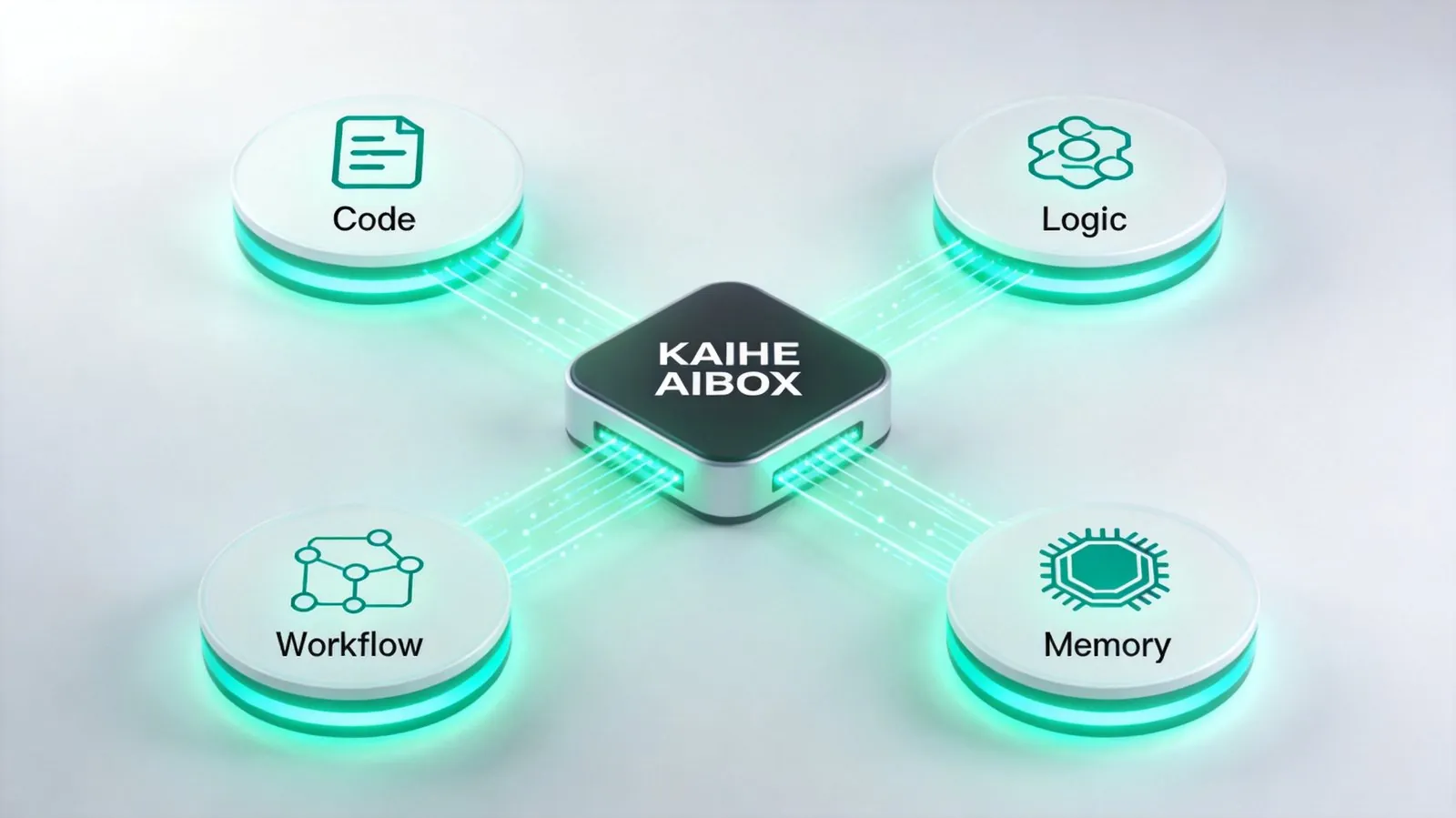
General Multi-Agent Collaboration Architecture: Local Control + Cloud Experts
As can be seen from the capability positioning, the four types of Agents each have clear applicable scenarios, and there is no "all-powerful Agent". The most commonly used collaboration architecture by enterprises and individual developers currently is the layered model of "local control + cloud experts":
| Layer | Role | Recommended Deployment | Core Value |
|---|---|---|---|
| Control Layer | Workflow Orchestration + Memory Management | Local device running 24/7 (such as KAIHE AIBOX) | Stable online, persistent memory, scheduling coordination, local data storage |
| Expert Layer | Code Generation + Logical Reasoning | Cloud API on-demand invocation | Strong professional capabilities, pay-per-use, no local computing power required |
This architecture has very obvious advantages: 1. Cost-effective: Local control device power consumption is only 5W, monthly electricity cost is about $0.5, cloud APIs pay per call, no cost when not in use 2. Data Security: Sensitive data, memory documents, private processes are all stored locally, not uploaded to the cloud 3. Stable and Reliable: Local devices are online 24/7, scheduled tasks and passive responses will not be interrupted by turning off your computer 4. Flexible Expansion: Call corresponding cloud experts when you need capabilities, no need to bind to a single vendor 5. Continuous Accumulation: All work experience, decision records, and effective prompts are stored in local memory, the system becomes more intelligent the more you use it
KAIHE AIBOX: Your Local AI Control Hardware
KAIHE AIBOX is a low-power hardware device designed for local AI operation, pre-installed with Hermes Agent runtime environment and OpenClaw workflow orchestration framework, ready to use out of the box, it is an ideal control node for building multi-agent collaboration systems: - 5W low power consumption, supports 24/7 uninterrupted operation - Pre-installed full set of Agent runtime environment, configure workflows out of the box - Local data encrypted storage, no privacy data leakage - Supports on-demand invocation of various cloud large model APIs, flexible combination of capabilities - Supports multi-channel message push such as WeChat and WeCom, real-time notification of task progress
You don't need to understand complex server configuration, just connect KAIHE AIBOX to power and network, and you can start building your own AI collaboration team.
Related Reading: - WorkBuddy, QClaw, OpenClaw, Hermes: What Is the Relationship? - Codex Complete Hands-On Guide: 10 Most-Used Commands and Your First Automation Script - Why Your AI Keeps Working Even When Your PC Is Off
KAIHEAIBOX #AIAgents #MultiAgent #AIProductivity
For more information, search [KAIHE AIBOX] or contact: [email protected]
KAIHE AIBOX · 7x24 Personal AI Assistant | AI Agents