From Mac mini to the "Shrimp Machine": How OpenClaw's Hardware Ecosystem Is Growing Wild
📖 Glossary
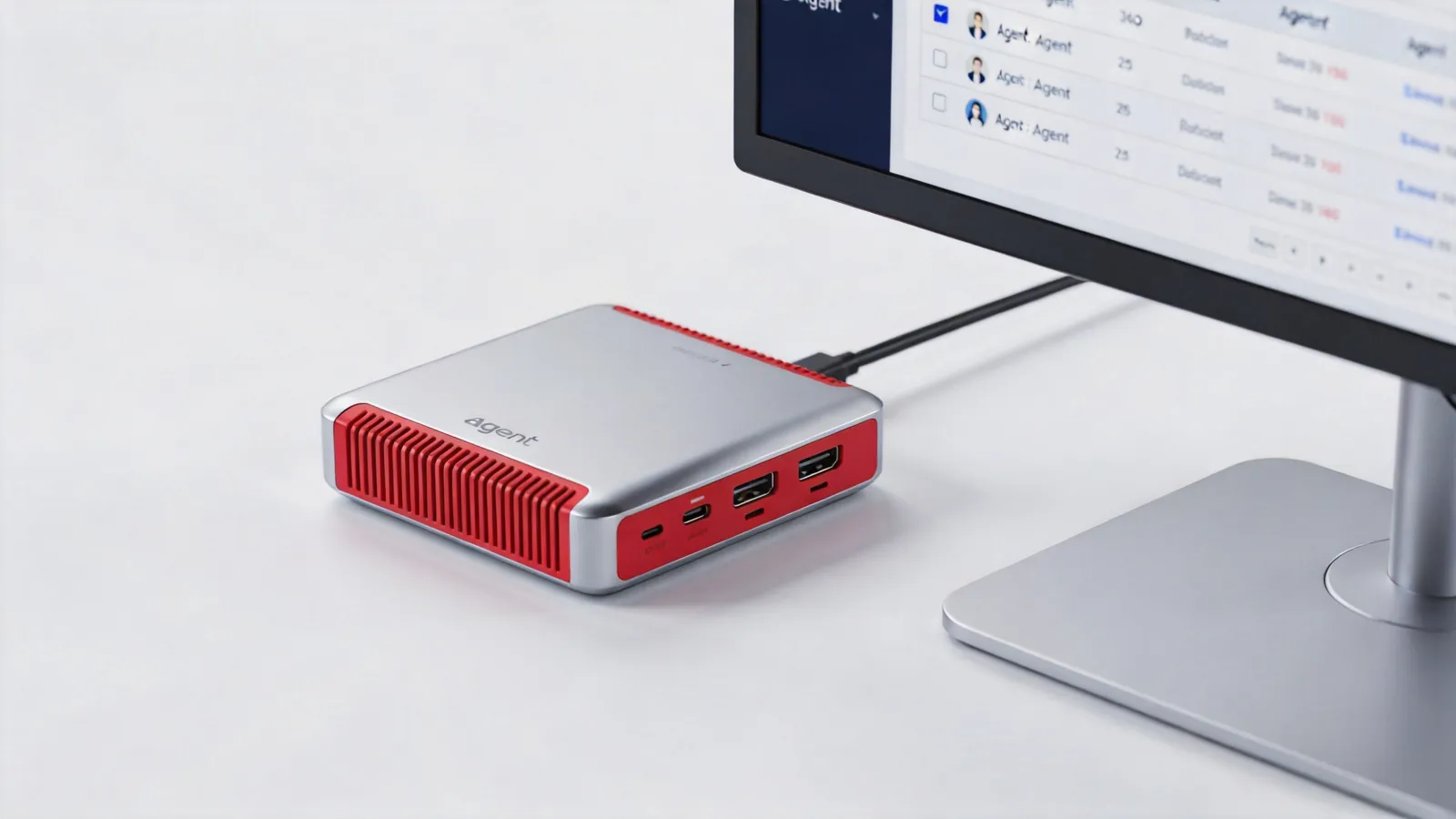
AI Box (also known as Agent Computer / Agent PC), is a dedicated local hardware device that runs AI Agents. Pre-installed with an AI agent management system, plug-and-play, running 24/7. Users can remotely command AI to work via Discord, Slack, Telegram, WhatsApp, and more.
Abstract: "Raising shrimp" became the breakout tech slang of 2025—it means running OpenClaw, whose logo is a lobster (claw = lobster claw). Lenovo rolled out the YOGA AI Mini, Think AI Tiny, and Laikuz AI MINI, all promising "one-click OpenClaw deployment." The "shrimp machine" concept has officially gone mainstream. From Mac mini to Lenovo's dedicated devices, OpenClaw's hardware ecosystem is rapidly taking shape. But Kaihe A1 takes a fundamentally different approach—it's not just about running OpenClaw, but about providing a complete intelligent agent computer management system. This article dissects the hardware logic behind the "shrimp-raising" phenomenon.
I. "Raising Shrimp": The Accidental Tech Slang That Broke the Internet
In the first half of 2025, the phrase "raising shrimp" (养虾) exploded across Chinese tech communities and social media platforms.
It has nothing to do with actual shrimp farming. "Raising shrimp" is slang for running OpenClaw. The OpenClaw logo features a lobster (Claw = lobster claw), and the community started calling OpenClaw deployment "raising lobster," which was later shortened to "raising shrimp" for convenience.
"Have you raised shrimp yet?" = "Have you deployed OpenClaw yet?" "Shrimp-raising machine" = "Hardware specifically designed to run OpenClaw"
The popularity of this nickname is itself evidence of OpenClaw's explosive growth. With over 300,000 stars on GitHub and an extremely active global developer community, "raising shrimp" has evolved from an inside joke into a cultural phenomenon.
The Cultural Mechanics of Tech Slang
What makes "raising shrimp" interesting beyond its humor is what it reveals about technology adoption patterns. When a technology project develops its own slang, memes, and inside jokes, it has crossed a critical threshold: it's no longer just a tool—it's a community and a culture.
This has happened before. "Rooting" became slang for gaining Android administrator access. "Jailbreaking" meant bypassing iOS restrictions. "Mining" was repurposed from physical extraction to cryptocurrency generation. Each of these terms signaled a technology moving from niche to mainstream awareness.
"Raising shrimp" is playing the same role for AI agents. It transforms the intimidating concept of "deploying an AI agent framework" into something approachable and even playful. You're not configuring software—you're raising shrimp. It's a linguistic reframing that lowers the psychological barrier to entry.
When a technology project earns its own slang and memes, it has graduated from "tool" to "culture." That's when adoption accelerates exponentially.
II. Lenovo's "Shrimp-Raising" Product Line: Three Dedicated Machines
Lenovo moved quickly to capitalize on the "shrimp-raising" trend, launching three mini PCs that support OpenClaw deployment, each targeting a different segment of the market.
2.1 YOGA AI Mini: The Flagship "Shrimp-Raising" Experience
The YOGA AI Mini sits in Lenovo's consumer product line as an AI-focused mini PC, positioned as a direct competitor to the Mac mini in the AI era:
- One-Click OpenClaw Deployment: A built-in OpenClaw installation wizard handles the entire setup process with just a few clicks. No command line, no configuration files, no Linux knowledge required.
- Native Adaptation: System-level driver optimizations ensure the NPU's hardware acceleration is available to OpenClaw, not just Lenovo's own software. This means inference workloads can leverage the neural processing unit for better performance per watt.
- System-Level Security: OpenClaw runs inside an isolated security sandbox, preventing it from affecting the main system's stability. If OpenClaw crashes, your computer keeps running. This containerized approach mirrors how modern operating systems handle application isolation.
- Design Language: The YOGA family's signature design—compact, elegant, at home on a desk or mounted behind a monitor.
The YOGA AI Mini's core selling point isn't raw compute power—it's the experience. You don't need to understand Linux command lines, configure environment variables, or troubleshoot dependency conflicts. The system handles all technical details invisibly.
This is the same philosophy that made the iPhone successful: the technology should be invisible, and the user should only see the result.
2.2 Think AI Tiny: Enterprise-Grade "Shrimp-Raising"
The Think AI Tiny targets enterprise users, extending the ThinkPad family into the AI agent domain:
- Enhanced Security Controls: Complies with enterprise IT security policies, including endpoint management, encryption at rest, and audit logging.
- Remote Management: IT departments can centrally manage OpenClaw instances across the organization—deploying updates, monitoring resource usage, and enforcing compliance policies from a single console.
- Long-Term Support Commitment: Five years of guaranteed system updates and security patches, aligning with enterprise procurement cycles.
The Think AI Tiny solves a specific pain point: enterprise IT departments generally prohibit employees from installing open-source software on company machines without approval. The Think AI Tiny provides a "compliant shrimp-raising solution"—OpenClaw that passes the IT audit.
This is significant because enterprise adoption is where OpenClaw will achieve its most transformative impact. Individual developers experimenting with agents is exciting, but Fortune 500 companies deploying agents across their workforce is where the economic value compounds.
2.3 Laikuz AI MINI: The Budget Option
The Laikuz AI MINI is produced by Lenovo's sub-brand Laikuz, targeting the entry-level segment:
- Starting Price: ¥4,499 (approximately $620)
- Processor: Intel Core Ultra 5 / Ultra 7
- OpenClaw Support: One-click deployment
- Positioning: Entry-level users and small teams
At ¥4,499, the Laikuz AI MINI brings the "shrimp-raising" entry point down to the price of a mid-range smartphone. This is the cheapest one-click OpenClaw solution currently available, making it accessible to students, freelancers, and small businesses that can't justify premium hardware investments.
The significance of this price point shouldn't be underestimated. When a new technology drops below the ¥5,000 threshold in China, it crosses from "early adopter luxury" to "mainstream consideration." The Laikuz AI MINI puts OpenClaw in the same purchase-decision category as a new monitor or a software subscription—not a capital expenditure requiring approval.
III. Three Macro Trends Behind OpenClaw's Hardware Ecosystem
Lenovo's dense product lineup isn't an isolated case. A growing number of hardware manufacturers are beginning to support OpenClaw, driven by three underlying trends:
3.1 From General-Purpose Computing to AI-Specific
Traditional PCs are general-purpose computing devices—they can do everything but optimize for nothing in particular. The new generation of mini PCs is beginning to take an "AI-specific" approach: integrated NPUs, memory architectures optimized for large model inference, and thermal designs engineered for sustained AI workloads rather than bursty office tasks.
OpenClaw, as currently the most popular open-source AI agent framework, has naturally become the primary compatibility target for these "AI-specific machines." If you're building hardware optimized for AI, making it run the most popular AI framework flawlessly is an obvious priority.
This mirrors the GPU revolution in gaming: early GPUs were general-purpose graphics accelerators, but they quickly became optimized for specific game engines and rendering pipelines. The same specialization is happening with AI hardware—it's becoming optimized for specific frameworks and workloads.
3.2 From DIY to Out-of-Box
In the early days, running OpenClaw required buying hardware, installing an operating system, configuring the environment, and debugging compatibility issues—a process that took at least half a day and often several days. Now Lenovo and other manufacturers offer one-click deployment, compressing the setup time to under 10 minutes.
This parallels the smartphone development trajectory: initially, only enthusiasts rooted and flashed custom ROMs; eventually, manufacturers pre-installed optimized experiences. "Raising shrimp" is transitioning from an enthusiast activity to a mainstream one.
The implications are profound. Every reduction in setup friction expands the potential user base by an order of magnitude. Going from "requires a weekend of configuration" to "requires 10 minutes" opens the door for millions of users who were interested but not dedicated enough to overcome the technical barrier.
3.3 From Personal Toy to Productivity Tool
OpenClaw started as a developer's experimental tool, but increasingly, non-technical users are adopting it for real work: automating office workflows, generating content, analyzing data, handling customer service, managing schedules, and more.
Hardware manufacturers have noticed this shift. The product line segmentation tells the story: YOGA AI Mini for individuals, Think AI Tiny for enterprises, Laikuz AI MINI for budget-conscious users. This kind of market differentiation signals maturation—it means the market is large enough and diverse enough to support differentiated products.
The evolution from "shrimp-raising" slang to dedicated product lines indicates that OpenClaw has graduated from a developer tool to a productivity platform. When hardware companies build products around your software, you've arrived.
IV. Kaihe A1: Not Just a "Shrimp Machine," But an Intelligent Agent Computer
While everyone is building "shrimp-raising machines," Kaihe A1 has taken a fundamentally different path.
4.1 Positioning Difference
A "shrimp-raising machine's" positioning is straightforward: run OpenClaw well. Hardware specifications, system optimizations, one-click deployment—all designed to make OpenClaw run more smoothly on this particular device.
Kaihe A1's positioning is different: intelligent agent computer. It's not just about running OpenClaw; it's a complete AI agent management system:
- Multi-Agent Orchestration: Not just running a single OpenClaw instance, but managing multiple agents with different functions—research agents, writing agents, coding agents, monitoring agents—coordinating them through a unified interface.
- Visual Operation Interface: No command line required. Drag-and-drop agent configuration, visual workflow builders, real-time monitoring dashboards.
- 7×24-Hour Stable Operation: System-level process guardianship, automatic recovery from power outages, comprehensive logging and audit trails.
- Local + Cloud Hybrid: Automatically selects local inference or cloud API based on task requirements, optimizing for both cost and quality without requiring user intervention.
4.2 "Running" vs. "Using": Two Fundamentally Different Problems
One-click OpenClaw deployment gets you "running" in 10 minutes. But "using" is a completely different challenge:
- How do you configure OpenClaw's agents to accomplish your specific tasks?
- How do multiple agents collaborate on complex workflows?
- How do you monitor and control token consumption across agents?
- How do you ensure stability during long-running operations?
- How do you diagnose and fix problems when they occur?
- How do you update agents without disrupting running workflows?
- How do you back up and restore agent configurations and memory?
"Shrimp-raising machines" answer the "running" question but not the "using" question. They solve installation but not utilization.
Kaihe A1's core value lies precisely in the "using" layer. It makes agent configuration, orchestration, monitoring, and optimization all visual and automated, enabling people without technical backgrounds to run AI agents 7×24.
4.3 The Browser vs. Operating System Analogy
If we compare OpenClaw to a web browser:
- A "shrimp-raising machine" = A computer that runs the browser very fast
- Kaihe A1 = An operating system where the browser is just one application
Running the browser fast is certainly important, but what you need isn't the browser itself—it's what the browser helps you accomplish. Similarly, running OpenClaw fast is important, but what you need isn't OpenClaw itself—it's what OpenClaw's agents can automate for you.
This distinction becomes even more important as the agent ecosystem matures. Today, most people are focused on "can I run OpenClaw?" But the more important question is becoming "can OpenClaw's agents handle my actual work?" And that question requires not just a fast runtime but a complete management layer—exactly what Kaihe A1 provides.
Hardware determines how fast OpenClaw runs, but the management system determines how useful AI agents actually are. Speed without usability is just expensive decoration.
4.4 The "Last Mile" of Agent Adoption
The technology industry has a well-known pattern: the "last mile" of adoption is always the hardest. Getting the technology to work in a lab or a developer's machine is the first 90% of the effort. Making it work reliably and easily for non-technical users is the last 10%—and it often requires more engineering than the first 90%.
"Shrimp-raising machines" have solved the first 90%: OpenClaw now installs easily on commodity hardware. Kaihe A1 is tackling the last 10%: making agents genuinely usable for people who don't read documentation or configure YAML files.
V. The Emerging Hardware Landscape: Beyond Lenovo
Lenovo's three-device lineup is the most visible example, but the broader hardware ecosystem for OpenClaw is expanding rapidly:
5.1 Intel-Based Solutions
Several manufacturers are building OpenClaw-optimized devices around Intel's Core Ultra processors, which combine traditional CPU cores with built-in NPUs. These devices offer strong x86 compatibility (important for running existing software ecosystems alongside OpenClaw) and moderate AI acceleration through the NPU.
5.2 ARM-Based Solutions
ARM-based devices (like the Lenovo P7 with its Cixin P1 chip) offer superior power efficiency for AI inference workloads. The trade-off is x86 software compatibility, which can limit the range of tools and applications available alongside OpenClaw.
5.3 Apple Silicon
Mac mini with M-series chips remains a popular platform for running OpenClaw, thanks to Apple's unified memory architecture and strong per-watt performance. However, Apple doesn't officially endorse or optimize for OpenClaw, so users are on their own for support.
5.4 Custom AI Accelerators
A growing number of startups are developing custom AI accelerator chips designed specifically for edge inference. These chips promise better performance-per-watt than general-purpose processors for the specific workload of running large language models locally.
The diversity of hardware options is healthy for the ecosystem—it means users can choose the platform that best fits their needs and budget. But it also creates fragmentation: OpenClaw must run well on ARM, x86, Apple Silicon, and custom accelerators, each with different optimization requirements.
VI. Future Outlook: Co-evolution of Hardware and Software Ecosystems
The "shrimp-raising" phenomenon reflects a larger trend: AI agents are moving from the cloud to the edge, from APIs to local deployment.
For the hardware industry, this represents an enormous opportunity. But hardware alone isn't sufficient—just as the PC industry wasn't just about CPUs and hard drives, but about operating systems, application ecosystems, and user experiences.
OpenClaw's hardware ecosystem is forming, but the software ecosystem and management layer need further development. The direction Kaihe A1 represents—"intelligent agent computer"—may be the ultimate form of this ecosystem: not a computer that runs OpenClaw fast, but a complete system that enables anyone to use AI agents.
The Next Phase: From Running Agents to Managing Them
The current phase of the "shrimp-raising" movement focuses on running agents. The next phase will focus on managing them:
- Agent lifecycle management: Creating, configuring, updating, and retiring agents.
- Resource allocation: Distributing compute, memory, and API quotas across multiple agents.
- Inter-agent communication: Enabling agents to share information and coordinate on tasks.
- Human-agent interaction: Providing intuitive interfaces for humans to direct, monitor, and override agent actions.
- Compliance and governance: Ensuring agents operate within organizational policies and regulatory requirements.
These management challenges are where the real innovation will happen in the next 12-24 months. The hardware race is commoditizing quickly—the differentiator will be the software and management layer.
"Raising shrimp" is just the beginning. The next step is making the shrimp work for you—and not just any work, but the specific, complex, knowledge-intensive work that humans currently do manually. That requires not just a fast runtime but a complete management system.
The companies that understand this distinction—hardware as the foundation, management as the value—will define the next era of AI agent computing.
KaiheAiBox · OpenClaw Zone