When AI Agents Enter Freight Transport: Manbang × Alibaba Cloud Launches Agent Algorithm Championship
📖 Glossary
AI Box (also known as Agent Computer / Agent PC), is a dedicated local hardware device that runs AI Agents. Pre-installed with an AI agent management system, plug-and-play, running 24/7. Users can remotely command AI to work via Discord, Slack, Telegram, WhatsApp, and more.
Summary: In May 2026, China's largest digital freight platform Manbang Group, in partnership with Alibaba Cloud's Tianchi platform and ModelScope community, launched the "Agent Algorithm Championship." Unlike traditional machine learning competitions focused on prediction accuracy, this contest challenges participants to build autonomous AI agents capable of making continuous, dynamic decisions in a simulated freight network. With a prize pool exceeding 200,000 RMB and 376 teams from 15 universities registered in its first week, this championship represents a landmark shift from theoretical Agentic AI toward real-world industrial adoption.
1. A Competition That Doesn't "Pose"
The 2026 algorithm competition landscape is undergoing a fascinating transformation. While previous competitions centered on "higher model accuracy" and "lower loss values," the Manbang-Alibaba Cloud championship takes a radically different approach — it doesn't test precision; it tests the ability to "make decisions like a human."
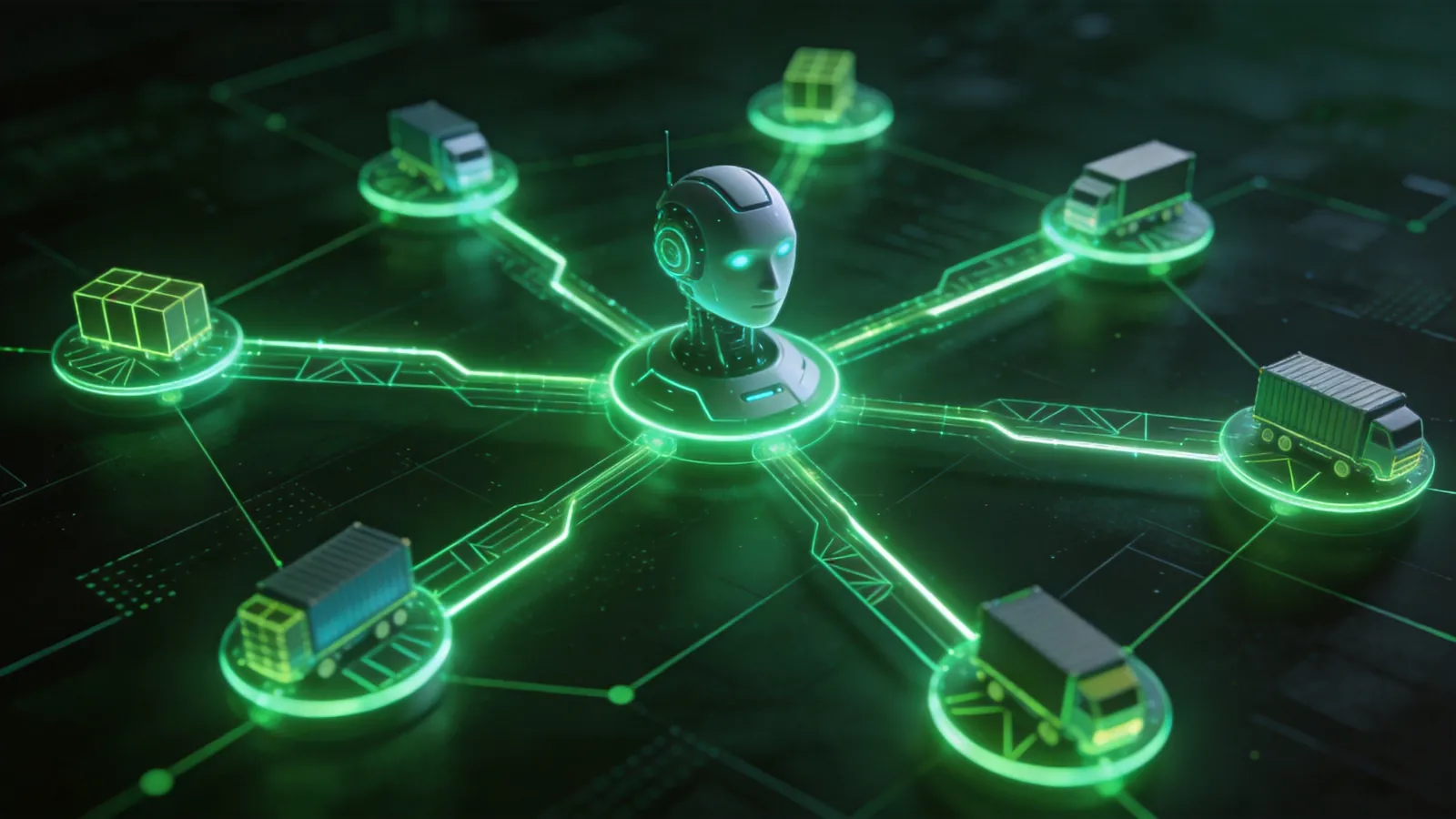
The core scenario: a truck driver faces hundreds of shipment listings daily and must make continuous decisions in limited time — where to load, which route to take, whether to accept price negotiations, and how to handle unexpected situations. This isn't a simple "given data → output result" prediction problem. It's a simulated business environment: drivers must continuously search for loads, bid on shipments, negotiate prices, and drive routes within a constantly changing network of time, location, supply, and profit — engaging in continuous game-theoretic competition just like real drivers.
Participants must build AI agents with autonomous perception, strategy formulation, and execution capabilities, then let them survive and maximize profit in this simulation system. The challenge lies in this fundamental truth: it's not a static optimization problem but a dynamic game-theoretic one — other agents in the market are also making real-time decisions, and optimal strategies must continuously adapt to an evolving market environment.
This is precisely what distinguishes Agentic AI from traditional machine learning. Traditional models are passive "predictors" — they receive input and produce output. Agents are active "decision-makers" — they autonomously perceive their environment, formulate strategies, execute actions, and learn from results.
2. Why Logistics
Logistics is a natural "test bed" for Agentic AI. China's logistics market exceeds 12 trillion RMB, with road freight accounting for approximately 75% of that total. This is an industry of enormous scale with equally enormous efficiency improvement potential.
Core pain point #1: Inefficient load matching. China has approximately 30 million truck drivers, the vast majority of whom are independent operators — buying their own trucks, finding their own loads, running their own transport. Traditional load matching relies heavily on information intermediaries (freight information offices, physical blackboards at logistics parks), with efficiency so low that empty return rates exceed 40%. Even with digital freight platforms like Manbang, load matching remains a highly dynamic, highly uncertain problem — drivers must judge in limited time which load offers the best profit, which route is most reasonable, and whether to accept price negotiation.
Core pain point #2: Decision environment complexity. A long-haul truck driver's decision tree is extraordinarily complex: where to start, where to pick up the load, which highway to take, where to rest, whether to pick up return freight, how fuel price fluctuations affect costs, and toll road differences across time and region. These variables interact in complex ways that traditional algorithms struggle to solve optimally.
Core pain point #3: Long-tail scenario handling. Logistics contains countless non-standard scenarios — oversized loads require special vehicles, cold chain requires temperature control equipment, hazardous materials require certifications, and fresh produce requires time-sensitive delivery. Each sub-scenario has unique rules and constraints. Rule-based programs cannot cover all situations, but AI agents — through autonomous learning and strategy evolution — can adapt to these long-tail scenarios.
By launching the Agent Algorithm Championship, Manbang is fundamentally exploring a proposition: When AI gains "autonomous decision-making" capability, can it understand logistics complexity like a human driver and make sound business decisions? If this proposition holds, the technical extension is enormous — from automated dispatch and intelligent load matching to the decision-making core of autonomous freight vehicles, agent technology could become the foundational support.
_2)
3. When "Campus Geeks" Meet "Highway Logistics"
The championship's participant makeup is equally noteworthy. Among the 376 registered teams, over 60% come from China's top 985 and 211 universities, including Tsinghua, Peking, and Nanjing universities. This means China's brightest young minds are applying cutting-edge agent technology to solve the efficiency problems of one of China's most traditional industries.
This collision of "campus geeks × highway logistics" has produced unexpected chemistry. During roadshow presentations, Manbang's technical team discovered that participating students proposed many innovative ideas beyond what internal engineers had anticipated. Some teams plan to use multi-agent game theory frameworks, allowing multiple agents to autonomously achieve dynamic balance in simulated freight market negotiations. Others attempt to combine large language models' common-sense reasoning capabilities with operations optimization, enabling agents to understand unstructured information like "it's raining today, so the highway might be congested" and adjust routing strategies accordingly.
This "industry-academia collaboration" model echoes the path of Go-playing AI after AlphaGo — when top university algorithm talent meets real industry data, unexpected technical breakthroughs often emerge. The championship's execution team has a vivid metaphor: "It's like throwing the world's best chess players into a real chess match — algorithms can find optimal solutions in this real business game."
_3)
4. Agents as "Digital Workers," Not "Digital Brains"
From a technical perspective, the championship's core value lies in defining the agent's real role in industry — not as a "digital brain" replacing human macro-level decisions, but as a "digital worker" executing repetitive business decisions.
What drains a truck driver's energy most daily is not driving — it's "finding the most profitable load from 300 listings." This isn't a high-level decision requiring deep industry expertise; it's a highly repetitive "information filtering + strategy matching" process. Agents excel precisely at this type of task — they can complete information filtering in milliseconds, make quick decisions based on preset business strategies ("prioritize high-price loads," "choose the shortest route," "match return freight to avoid empty running"), and continuously optimize their strategies.
This aligns perfectly with KaiheAiBox's design philosophy: An agent's value lies not in "how smart it is" but in "how reliable" and "how enduring" it is. A human driver can maintain concentrated focus on "quality load screening" for roughly 3-4 hours daily. A 24/7 running agent can execute this task year-round without fatigue or emotional interference.
The future vision for freight: If agent technology matures in logistics, a typical scenario might be — a truck driver tells their agent digital assistant by voice at night: "I'm going to Guangzhou tomorrow. Help me plan the optimal route and load plan." The agent then executes in the background: comparing all platform load information, calculating ROI for each plan, considering fuel costs and toll fees, assessing weather risk, generating the optimal plan, and submitting it for driver confirmation. The driver's only action: "confirm decision."
Key insight: In the Agentic AI era, the most revolutionary applications are often not about replacing humans on "big things" but about freeing humans to do what truly requires human judgment.
KaiheAiBox| Agentaibox that lets AI work for you 24/7· AI Agent