Microsoft Build 2026 Drops 7 MAI Models: Full Family, Zero OpenAI Distillation, 10x Cost Reduction
📖 Glossary
AI Box (also known as Agent Computer / Agent PC), is a dedicated local hardware device that runs AI Agents. Pre-installed with an AI agent management system, plug-and-play, running 24/7. Users can remotely command AI to work via Discord, Slack, Telegram, WhatsApp, and more.
Abstract: On June 4, Microsoft Build 2026 unveiled 7 in-house MAI models — reasoning, coding, vision, speech all covered. Flagship MAI-Thinking-1: 35B activated parameters sparse MoE, AIME 2025 math 97%, cost claimed at one-tenth of comparable top-tier models. Microsoft is no longer just OpenAI's reseller.
"Microsoft already has OpenAI — why build their own models?"
This was everyone's first reaction to Microsoft's MAI series announcement at Build 2026.
Simple answer: Microsoft doesn't want to be just OpenAI's dealer anymore. $13 billion invested gave it access to OpenAI models, but also over-dependence on one supplier. MAI models mean Microsoft has its own AI foundation — zero OpenAI distillation, trained from scratch.
The 7-Model MAI Family
At the June 4 Build conference, Microsoft unveiled 7 models covering four directions:
MAI-Thinking-1 (Flagship Reasoning). 35B activated parameters, 1T total parameters, 256K context window. Sparse MoE architecture. Positioned as "near top-tier performance at much lower cost." AIME 2025 math: 97%, SWE-Bench Pro coding: 53% (on par with Claude Opus 4.6). Trained completely from scratch — no third-party model data used.
MAI-Coding-1. Designed for GitHub Copilot. Optimized for code generation, completion, debugging scenarios. Supports major programming languages.
MAI-Vision-1. Multimodal image understanding. Supports image description, document recognition, chart analysis, OCR. Optimized for enterprise document processing.
MAI-Speech-1. Speech recognition and synthesis. Supports multiple languages, dialects, accents. For real-time voice interaction, speech-to-text, voice cloning.
All models available via Azure AI Studio — API access or private cloud deployment.
Why Self-Develop
Microsoft invested ~$13B in OpenAI. Azure is OpenAI's exclusive cloud provider — OpenAI inference runs on Azure. The relationship is deep.
But deep dependency carries risk: OpenAI's pricing, capabilities, roadmap changes directly impact Azure AI's business. What if OpenAI decides to sell enterprise services directly, bypassing Azure?
MAI is Microsoft's hedge. With MAI, Azure can offer complete AI capabilities without any third-party dependency. Copilot, GitHub Copilot, Microsoft 365 Copilot — Microsoft's core AI products — can all run on its own models.
Cost Advantage
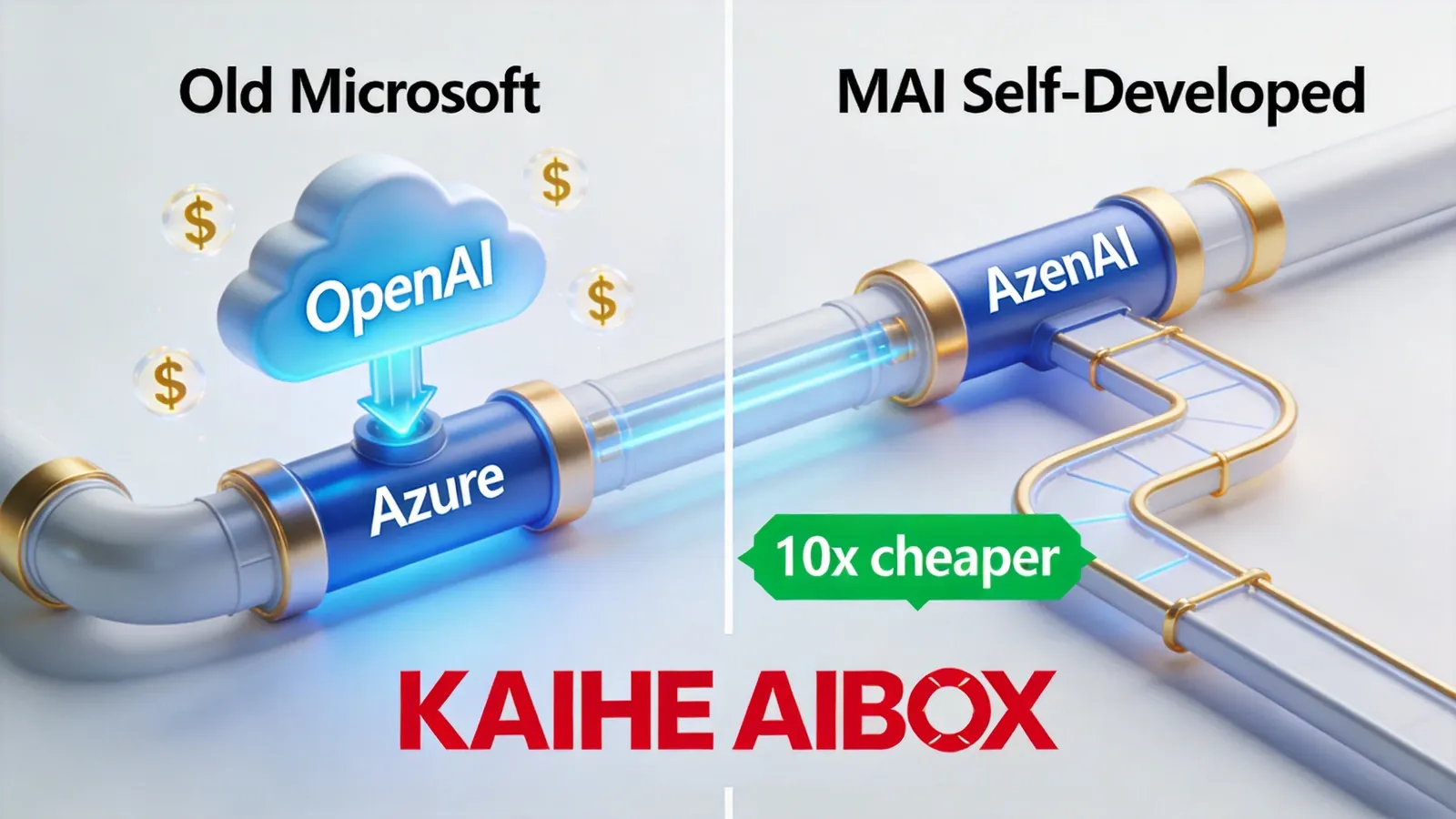
Microsoft claims MAI-Thinking-1's inference cost is "one-tenth of comparable top-tier models."
MoE architecture's natural efficiency. 1T total parameters, but only 35B activated per inference. Fewer activated parameters = less compute = lower cost. GPT-5.5 is also MoE but 1.8T total, 400B activated — more expensive.
Self-developed training optimizations. Microsoft's DeepSpeed framework deeply optimizes MoE training and inference. Higher distributed training efficiency, lower deployment cost.
Azure infrastructure. Microsoft deploys on its own Azure — no middleman, no API markup. Inference runs directly on Azure hardware — minimal cost overhead.
Combined: Microsoft claims "one-tenth the cost." The "AIME 97% at one-tenth cost" combination is compelling — pay less, get near-top performance.
Microsoft vs OpenAI: Not Adversarial, Backup
Microsoft and OpenAI aren't "breaking up." Their partnership continues — Azure remains OpenAI's exclusive cloud provider, GPT-5.5 continues running on Azure.
But Microsoft now has choices: same customer, recommend GPT-5.5 when suitable, recommend MAI when suitable, or when budget is limited — MAI's "10x cheaper" fits perfectly.
This is called "product portfolio" — not replacement, supplementation.
Connection to Kaihe AIBOX
MAI models are accessible via Azure AI Studio API. Kaihe AIBOX A1 supports Azure AI API integration — add Azure endpoint and API Key in A1's model configuration.
If you run OpenClaw or Hermes Agent on A1, add MAI as a model option. Use MAI for cost-effective inference, GPT or Claude for maximum capability — switch freely.
However, MAI currently deploys on Azure only. Accessing Azure AI from mainland China requires Hong Kong or overseas nodes — a barrier for most domestic users.
A Rational View
Initial capabilities below top-tier. MAI-Thinking-1: SWE-Bench Pro 53%. Claude Opus 4.8: 69.2%. GPT-5.5: 58.6%. Gap remains.
Cost claims need verification. "10x cheaper" is Microsoft's claim. Actual cost depends on usage volume, model version, deployment mode. Try before committing.
Ecosystem still building. OpenAI's API has mature SDK, community, third-party tools. MAI just launched — less mature ecosystem. Developers may encounter more documentation gaps and compatibility issues. To learn more, visit the homepage.
Want to Go Deeper?
"GPT-5.5 on Amazon Bedrock: Enterprise AI Zero Barrier" — enterprise AI deployment "One Device, All Models: Kaihe AIBOX Supports GPT/Claude/DeepSeek/Doubao" — model switching
-#MicrosoftMAI #SelfDevelopedModel #Build2026 #KaiheAIBOX #AIModel
Kaihe AIBOX | The Agent Computer That Works 7×24 for You · AI Frontier