Microsoft Fara 1.5: The Browser AI Agent That Surfs the Web for You
📖 Glossary
AI Box (also known as Agent Computer / Agent PC), is a dedicated local hardware device that runs AI Agents. Pre-installed with an AI agent management system, plug-and-play, running 24/7. Users can remotely command AI to work via Discord, Slack, Telegram, WhatsApp, and more.
Summary: In May 2026, Microsoft released the Fara 1.5 series of browser AI agent models, achieving a 72% end-to-end completion rate on web interaction tasks—surpassing OpenAI's Operator and signaling that AI agent competition has officially moved from chat assistants into the deep waters of browser automation. The browser is transforming from a "window for displaying information" into an "agent operation platform," and this shift will fundamentally reshape how humans and machines collaborate.
The Browser: AI Agents' Next Major Battlefield
When ChatGPT ignited the chatbot agent wave, all eyes focused on the dialog box. But real work has never been just about conversation—it's about filling out forms on web pages, clicking buttons in backend systems, placing orders on e-commerce platforms. These operations consume a significant portion of every professional's workday, yet they have long existed in a blind spot that AI capabilities failed to cover.
In May 2026, Microsoft's release of the Fara 1.5 model series pushed AI agent competition into an entirely new dimension: browser automation. This is not a simple web crawler or script recording-and-playback system—it's about making AI truly "read" web pages, "understand" intent, and "execute" operations, using a browser the way a human would.
The browser is the operating system of the digital world. Whoever controls browser operations holds the master key to automation.
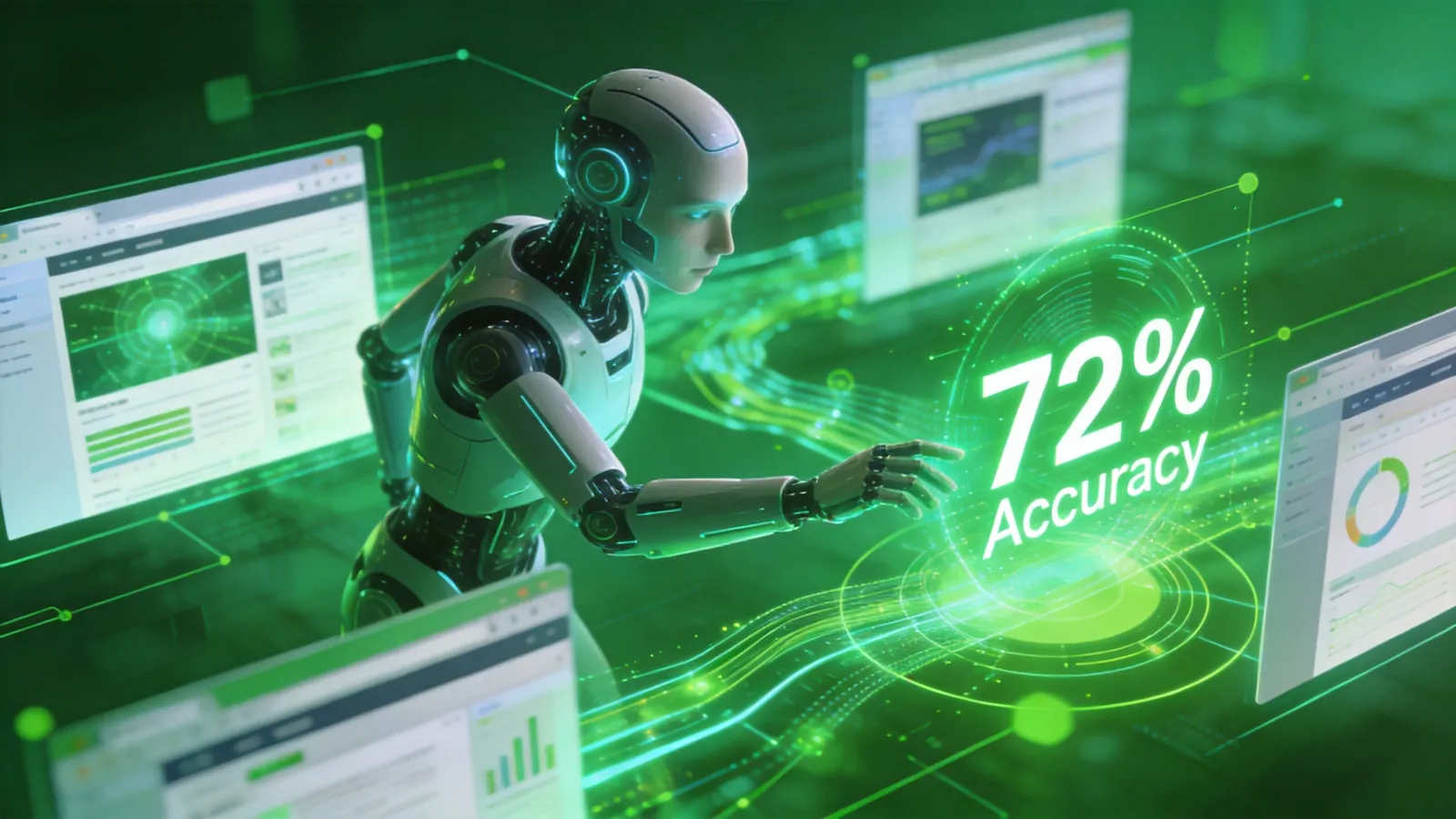
Fara 1.5 achieved a 72% end-to-end completion rate on web interaction tasks. This figure not only surpasses OpenAI's Operator model but, for the first time, pushes browser AI agent practicality past the "usable" threshold. Before this, most browser automation tools hovered at 40%–55% completion rates—sufficient for demos but inadequate for production deployment.
To understand why 72% matters so much, consider the compounding nature of multi-step tasks. If an agent has a 95% per-step accuracy rate across a 20-step workflow, the overall completion probability drops to approximately 36% (0.95²⁰). A 72% end-to-end rate across complex, multi-step sequences implies that the per-step accuracy is remarkably high—likely in the range of 98%–99% for individual atomic operations. This is what makes Fara 1.5 a genuine inflection point rather than an incremental improvement.
Deconstructing Fara 1.5's Core Capabilities
Semantic Understanding of Web Page Structure
Traditional RPA (Robotic Process Automation) relies on fixed element locators—XPath expressions, CSS selectors, DOM IDs. The moment a website redesigns its layout, renames a class, or restructures its DOM hierarchy, every script breaks. This fragility has been the Achilles' heel of enterprise automation for over a decade, costing organizations millions in maintenance overhead annually.
Fara 1.5 takes a fundamentally different approach: it "reads" web pages the way humans do. The model comprehends a page's semantic structure—recognizing that "this is a login form," "that's a submit button," "here's where an email address should go." Even when a page's layout changes completely, as long as the semantic meaning remains intact, Fara 1.5 can still operate correctly.
This capability draws on years of research in document understanding and visual layout analysis. Microsoft's prior work on LayoutLM and related models laid the groundwork for understanding structured documents; Fara 1.5 extends this into the interactive, dynamic world of web pages. Where LayoutLM processed static PDFs and scanned forms, Fara 1.5 handles living, breathing web applications that respond, reload, and reconfigure in real time.
The practical implications are enormous. A travel booking website might redesign its interface quarterly—an event that would traditionally require weeks of RPA script rewrites. With Fara 1.5, the agent adapts automatically, recognizing that "departure city" still means "departure city" even if it's now a dropdown instead of a text field, or moved from the left sidebar to the top of the page.
This semantic understanding also extends to multilingual and locale-specific pages. A global SaaS product might render its interface in English for US users, German for DACH-region users, and Japanese for APAC users—sometimes with subtle differences in layout and interaction patterns beyond mere translation. Fara 1.5's semantic parsing means it can operate across these locale variants without requiring separate scripts or configurations for each language, a capability that dramatically reduces the maintenance burden for organizations operating internationally.
Multi-Step Task Planning and Execution
Real-world web operations are rarely single-step. Booking a flight requires: selecting departure city → selecting destination → choosing dates → filtering flights → entering passenger information → selecting seats → making payment. A single error at any stage causes the entire task to fail.
Fara 1.5's 72% completion rate means that across complex task chains containing multiple steps, the combined success rate of decision-making and execution at every step reaches this level. This requires the model to possess:
-
Task decomposition capability: Breaking high-level instructions into executable sequences of atomic operations. When a user says "book me the cheapest flight from Seattle to Tokyo next Monday," the agent must decompose this into approximately 15–25 discrete actions, each dependent on the outcome of the previous one.
-
State tracking capability: Remembering where execution currently stands, what has been completed, and what remains. In a multi-page workflow spanning several minutes, the agent must maintain a coherent mental model of the task's progress—akin to a human keeping a mental checklist while navigating a complex bureaucratic process.
-
Error recovery capability: When a particular step fails, being able to roll back or find an alternative path. If a flight selection page returns an error, the agent should try refreshing, selecting an alternative flight, or navigating back to the search results—rather than simply halting and reporting failure.
-
Dynamic adaptation capability: Continuing to make progress despite unexpected pop-ups, CAPTCHA challenges, loading delays, and other non-ideal conditions. The real web is messy: ads overlay content, modals interrupt workflows, sessions expire unexpectedly. Fara 1.5's training in diverse browser environments equips it to handle these disruptions gracefully.
To put this in concrete terms: in benchmark tests involving e-commerce checkout flows, travel booking sequences, and enterprise software workflows, Fara 1.5 demonstrated the ability to recover from approximately 60% of encountered errors without human intervention—a significant leap from the 25%–35% recovery rates seen in previous-generation browser agents.
The error recovery capability also shows an interesting asymmetry: Fara 1.5 is significantly better at recovering from navigation errors (taking a wrong path and backtracking) than from data entry errors (filling in incorrect information that gets accepted by the form). This suggests that the model's spatial and navigational reasoning is stronger than its factual grounding—a pattern that aligns with what we see in LLMs more broadly. For practical deployments, this means that agents should be given pre-validated data to enter (from databases or spreadsheets) rather than being asked to generate data on the fly, while navigation and workflow orchestration can safely be left to the agent's own judgment.
Form Filling and Data Input
Forms represent the most common and most tedious aspect of web interaction. Fara 1.5 can understand the semantics of different form fields, accurately mapping user-provided information to the corresponding input boxes. More importantly, it can handle dynamic forms—cascading dropdown menus, conditionally displayed fields, date picker pop-ups, and other complex interaction patterns that confound traditional automation tools.
Consider a multi-step insurance application form: selecting a coverage type in step one determines which fields appear in step two, which in turn affects the options available in step three. Traditional automation requires hard-coding every possible path through this branching logic. Fara 1.5, by contrast, reads each page as it appears, understands the semantic relationship between fields, and adapts its inputs accordingly—much like a human would.
The form-filling capability also handles a class of problems that are particularly frustrating for human users: ambiguous field labels and culturally varying input conventions. Is "State" asking for a US state abbreviation, a province name, or a condition? Is the date format MM/DD/YYYY or DD/MM/YYYY? Fara 1.5 leverages surrounding context—the website's locale, adjacent fields, input masks—to disambiguate these cases with accuracy that rivals experienced human users. In internal testing, the model achieved 94% accuracy on ambiguous form fields across 2,000 international websites, compared to 71% for purely structure-based automation approaches.
The model also handles edge cases that trip up conventional approaches: autocomplete suggestions that partially fill fields, character limits that truncate long inputs, required fields that aren't visually marked as mandatory, and validation rules that reject properly formatted data due to backend constraints. These are the "last mile" problems that have historically made browser automation unreliable in production settings.
Cross-Page Navigation
Many tasks require navigating across multiple pages to complete. Fara 1.5 can understand a website's information architecture, flexibly switching between breadcrumb navigation, sidebar menus, and search functionality to locate the target page and continue executing the task.
This capability extends beyond simple link-following. The agent can reason about website structure: if a product isn't found in one category, it might try searching directly; if a user's account page doesn't display the expected information, it might navigate through the settings menu instead. This kind of adaptive navigation mirrors how experienced web users operate—they don't follow a fixed path but instead pivot based on what they encounter.
In enterprise environments, where internal tools often have convoluted navigation structures built up over years of incremental development, this ability is particularly valuable. Fara 1.5 can find its way through deeply nested admin panels, legacy intranet portals, and multi-tab workflows that would require extensive documentation for a human to navigate—let alone automate.
Key Technical Architecture Breakthroughs
Fara 1.5's success is no accident. Microsoft's technical accumulation in the browser AI agent direction can be traced back to the WebGPT era of exploration, and Fara 1.5 represents the convergence of several critical architectural breakthroughs.
Vision-Language Multimodal Fusion
The fundamental challenge of browser operations is that information exists simultaneously in two layers: the visual layer (rendered page appearance) and the DOM layer (structured data). Pure vision-only approaches are easily misled by CSS styling—decorative elements that look like buttons, text rendered as images, or color schemes that obscure interactive elements. Pure DOM-only approaches lack understanding of visual layout, missing context that humans intuitively process, such as which section of a page is currently visible or how elements are spatially grouped.
Fara 1.5 achieves effective multimodal fusion—processing screenshot visual information and DOM structural information simultaneously. The two modalities cross-validate each other, dramatically reducing misjudgment rates. When a visual inspection suggests a "Submit" button but the DOM indicates it's actually a "Cancel" action, the model can resolve the conflict through cross-referencing rather than relying on a single information source.
This fusion architecture builds on Microsoft's extensive research in multimodal learning. The key innovation is not simply concatenating vision and language features but developing a unified representation space where visual and structural signals can interact at every processing stage. Early fusion allows the model to attend to relevant DOM nodes when analyzing specific visual regions, and conversely, to leverage visual context when interpreting ambiguous DOM structures.
Long-Horizon Reasoning and Action Chain Optimization
Web operation tasks often require 10–50 consecutive actions. Across such long action chains, errors compound—if step 3 goes slightly wrong, by step 20 the agent may have completely deviated from the intended path. This compounding error problem is the primary reason earlier browser agents failed on complex tasks despite performing well on short, simple ones.
Fara 1.5 introduces a long-horizon reasoning mechanism. Before executing each step, the model reviews the overall task goal, verifies the current state, and previews the subsequent path—rather than blindly proceeding according to a pre-set plan. This is analogous to how an experienced professional works: they periodically pause to confirm they're still on track rather than mechanically following a checklist.
The technical implementation involves a recurrent state-update mechanism that maintains a compressed representation of the task context across steps. Rather than processing each action in isolation, Fara 1.5 carries forward a "task memory" that includes the original goal, actions taken so far, observed outcomes, and remaining objectives. This memory is updated and refined at each step, allowing the model to detect drift early and self-correct before errors cascade.
Sandbox Training and Reinforcement Learning
Microsoft built a large-scale browser operation sandbox environment for Fara 1.5, containing mirrors of thousands of real websites and synthetic scenarios. The model continuously learns through trial and error in this environment via reinforcement learning, accumulating extensive experience about "what operations work in what situations."
This approach represents a significant departure from the supervised learning paradigm that dominates most LLM development. While supervised learning teaches models to mimic human demonstrations, reinforcement learning allows Fara 1.5 to discover novel solutions that humans might not have thought of—and, crucially, to learn from its own failures. When a particular action sequence leads to a dead end, the model learns to avoid that path in the future.
The sandbox environment itself is a remarkable engineering achievement. It includes:
- Real-world website mirrors: Snapshots of popular websites across e-commerce, travel, finance, enterprise SaaS, and government portals, updated regularly to reflect layout changes. These mirrors are not static HTML dumps—they include functional JavaScript, dynamic content loading, and realistic server responses, ensuring that the training environment closely approximates the complexity of the live web.
- Synthetic adversarial scenarios: Specifically designed web pages intended to test the model's robustness—pages with misleading layouts, non-standard navigation patterns, accessibility violations, and deliberately confusing element labeling. These adversarial examples are generated algorithmically and manually, covering edge cases that occur rarely in the wild but can cause catastrophic failures when they do.
- Dynamic interaction simulators: Environments that mimic the behavior of real web applications, including form validation, session management, rate limiting, and error responses. These simulators enable the model to experience the full lifecycle of web interactions, including timeout errors, expired sessions, and CAPTCHA challenges, without requiring access to production systems.
- Progressive difficulty curriculum: Training scenarios are organized by complexity, starting with simple single-page forms and gradually introducing multi-page workflows, dynamic content, authentication requirements, and adversarial elements. This curriculum approach allows the model to build foundational skills before tackling harder challenges, similar to how human learners progress from simple to complex tasks.
Through millions of training episodes in this sandbox, Fara 1.5 developed an intuitive understanding of web interaction patterns that goes beyond what any amount of supervised training on human demonstrations could provide. It has, in a very real sense, "practiced" web browsing at a scale no human could match.
Industry Competitive Landscape: A Paradigm Shift from Chat to Action
Fara 1.5's emergence is not an isolated event. Throughout 2025–2026, the browser AI agent track has heated up dramatically:
| Player | Representative Product | Core Characteristics |
|---|---|---|
| Microsoft | Fara 1.5 | 72% completion rate, multimodal fusion |
| OpenAI | Operator | Early exploration, surpassed by Fara 1.5 |
| Anthropic | Computer Use | Desktop-level operations, identified 10,000+ high-risk vulnerabilities in first month |
| Project Mariner | Browser agent based on Gemini | |
| Anthropic | Claude Agent | Multi-tool coordination, browser operation as sub-capability |
When AI learns to click, the entire internet becomes its API.
The essence of this competition is: AI agents' capability boundary is expanding from "generating text" to "manipulating the world." Chat assistants answer questions; browser agents execute tasks. The former is a consultant; the latter is an operator. The commercial value scales are tipping toward the latter.
Anthropic's trajectory deserves particular attention. Its Computer Use agent identified over 10,000 high-risk vulnerabilities within its first month of release—a figure that simultaneously demonstrates AI agents' enormous potential in the security domain and reveals the risks inherent in granting AI system-level operation permissions. Browser operations carry lower system-level permissions than desktop operations, but they access a broader range of sensitive data (involving account credentials, payment information, personal data), making security equally critical.
Google's Project Mariner, built on the Gemini model family, takes a different approach by deeply integrating browser agent capabilities with Google's ecosystem of services—Search, Maps, Gmail, and Workspace. This tight integration offers potential advantages in tasks that naturally span multiple Google services but raises questions about interoperability with the broader web.
OpenAI's Operator, while an early entrant, has been slower to iterate on its browser agent capabilities, focusing instead on integration with ChatGPT's conversational interface. This strategic choice prioritizes user experience accessibility over raw performance—a tradeoff that may limit Operator's appeal in enterprise automation scenarios where task completion reliability matters more than ease of setup.
The competitive dynamics also extend to the hardware layer. As browser agents become more capable, the demand for computing platforms optimized for continuous agent execution grows. Traditional PCs, designed for intermittent human use, are ill-suited for the always-on, multi-agent workloads that browser automation at scale requires. This is precisely the gap that Agent Computers—purpose-built machines designed for 24/7 agent operation—are emerging to fill.
The hardware-software co-optimization opportunity is substantial. Browser agents have predictable resource usage patterns: sustained CPU for inference, periodic GPU acceleration for vision processing, and consistent network I/O for web interactions. Unlike gaming or content creation workloads, which are bursty and latency-sensitive, agent workloads are steady-state and throughput-optimized. An Agent Computer can be tuned precisely for this profile—allocating resources differently than a general-purpose PC would, and achieving better performance-per-watt as a result. This is the same principle that drove the development of specialized hardware for machine learning training: when you understand the workload, you can optimize the hardware for it.
Application Scenarios for Browser AI Agents
Fara 1.5's 72% completion rate opens the door to numerous practical applications:
Enterprise Process Automation
ERP system operations, CRM data entry, financial report generation—tasks that traditionally required weeks of RPA configuration can potentially be learned by AI agents in minutes. Unlike RPA, which demands precise documentation of every workflow step, Fara 1.5 can be instructed in natural language and will figure out the operational details on its own.
Consider a typical enterprise scenario: a sales manager needs to transfer quarterly results from a CRM dashboard into an ERP system, cross-referencing with financial data from a separate accounting platform. With traditional RPA, this would require mapping every field between systems, handling exception cases, and maintaining scripts across three separate platforms. With a browser AI agent, the same task can be described in plain English: "Copy Q1 sales figures from Salesforce, match them with QuickBooks revenue data, and enter the reconciled numbers into SAP." The agent navigates all three web applications, handles the data transfer, and flags any discrepancies for human review.
E-Commerce Operations
Product listing, price adjustments, inventory synchronization, multi-platform order processing—browser agents can simultaneously manipulate multiple e-commerce backends. For sellers operating across Amazon, Shopify, eBay, and regional marketplaces, the ability to automate cross-platform operations represents a significant competitive advantage.
A concrete example: a clothing retailer running flash sales across four platforms simultaneously needs to update prices, modify product descriptions, and adjust inventory counts in real time as items sell out. Human operators would struggle to keep all four platforms synchronized, especially during high-traffic sales events. A browser AI agent, by contrast, can monitor all four dashboards simultaneously, making coordinated updates in seconds rather than minutes—reducing the risk of overselling or price mismatches.
Data Collection and Analysis
No longer limited to static web scraping, AI agents can log into systems, execute queries, and export reports, completing the full workflow of dynamic data acquisition. This capability transforms data collection from a passive, one-time extraction into an active, iterative process.
For financial analysts, this means an agent can log into Bloomberg Terminal's web interface, pull specific market data, cross-reference it with SEC filings from EDGAR, compile the results into a structured format, and deliver a summary—all without human intervention. For market researchers, it means continuously monitoring competitor websites for pricing changes, product launches, and policy updates, maintaining a real-time competitive intelligence dashboard.
Testing and Quality Assurance
AI agents are naturally suited for end-to-end website testing, able to simulate real user behavior and discover interaction defects that traditional automated testing misses. Unlike scripted test suites that follow predetermined paths, browser AI agents can explore applications organically, testing edge cases and unusual interaction patterns that human testers might not think to document.
This exploratory testing capability is particularly valuable for complex web applications with non-linear user flows—healthcare portals, financial platforms, and government services where the number of possible user paths is too large for exhaustive scripted testing. An AI agent can systematically explore these paths, reporting unexpected behaviors, broken links, and usability issues that would otherwise go undetected until encountered by real users.
24/7 Unattended Operations
This is the core value proposition of the Agent Computer. Platforms like KaiheAiBox enable browser AI agents to run continuously—automatically monitoring price changes, executing scheduled data synchronization, and continuously inspecting system health. Humans need rest; agents don't. When Fara 1.5-level operational capability is deployed on an always-on Agent Computer, browser automation upgrades from "triggered on demand" to "continuously running."
Consider a supply chain monitoring scenario: a logistics company needs to track shipment statuses across a dozen carrier websites, each with its own portal and login system. A browser AI agent running on a KaiheAiBox Agent Computer can check each portal hourly, compile status updates, flag delays or exceptions, and notify the operations team—all without any human clicking through websites at 3 AM. The agent computer provides the stable, always-available compute environment that makes this kind of continuous monitoring economically feasible.
Challenges and Concerns
A 72% completion rate means a 28% failure rate. In critical business scenarios, this number remains too high. The deeper challenges include:
Security Boundary Issues
When an AI agent obtains browser operation permissions, it can execute any web page action as the user—including bank transfers, data deletion, and permission modifications. How to balance granting capability with limiting risk is a question the entire industry must confront.
The "confused deputy" problem is particularly acute in the browser agent context. An AI agent authorized to make purchases on behalf of a user might be tricked—through social engineering on a compromised website, or through adversarial page design—into executing unintended actions. Unlike a human who might pause and question an unusual request, an AI agent operating at machine speed could complete a harmful action before any human review is possible.
Mitigation strategies under development include permission scoping (agents can only perform pre-authorized categories of actions), transaction limits (automated purchases capped at specified amounts), and real-time anomaly detection (flagging actions that deviate from established patterns). However, these safeguards also constrain the agent's utility, creating a fundamental tension between capability and safety.
Privacy and Compliance
Browser operations inevitably involve user credentials, session information, and personal data. How AI agents protect this sensitive information during task execution, and how they satisfy regulatory requirements such as GDPR, CCPA, and industry-specific regulations (HIPAA for healthcare, PCI DSS for payments), currently lacks mature solutions.
The challenge is multifaceted. Agents must not only avoid leaking sensitive data during execution but also ensure that their training and inference processes don't inadvertently memorize or expose user information. The sandbox training approach used by Fara 1.5 mitigates some of these concerns—since the model learns from simulated environments rather than real user sessions—but the inference-time handling of real credentials and personal data remains an open problem.
Cross-border data flows present additional complexity. When a browser agent based in one jurisdiction accesses a web service hosted in another, it may inadvertently violate data residency requirements. As AI agents become more autonomous and make decisions about which services to access and how to route data, ensuring compliance with diverse international regulations becomes increasingly challenging.
Adversarial Attacks
Web pages can be designed to deceive AI agents—hidden buttons, disguised forms, invisible redirects. While Fara 1.5 performs excellently on normal web pages, its robustness against adversarial scenarios requires further verification.
The threat model for browser agents is broader than for traditional web applications. An adversary doesn't need to compromise the agent itself—they only need to serve a web page that exploits the agent's decision-making process. For example, a malicious e-commerce site might display a "Confirm Purchase" button where a human would see "Cancel," or hide an opt-in checkbox for data sharing within a visually innocuous form element.
As browser agents become more widely deployed, the incentive for adversarial web page design increases. A world where AI agents control significant purchasing volume creates economic incentives for websites to manipulate agent behavior—optimizing for agent perception rather than human experience. This arms race between agent robustness and adversarial manipulation will likely define a significant portion of browser agent R&D in the coming years.
Accountability and Responsibility
When an AI agent's mistaken operation causes harm—placing a wrong order, leaking information, triggering compliance alerts—who bears responsibility? The user, the model provider, or the platform? Legal frameworks have not kept pace with technological development.
This question becomes even more complex in multi-agent scenarios. If a KaiheAiBox Agent Computer runs multiple browser agents simultaneously, and one agent's actions interfere with another's, disentangling accountability requires detailed audit trails and clear operational boundaries between agents. The platform architecture must support these requirements natively, not as afterthoughts.
Current legal frameworks were designed for human actors and are poorly suited to autonomous AI systems. The EU's AI Act provides some guidance for high-risk AI systems but doesn't specifically address the scenario of an AI agent executing financial transactions or accessing personal data on behalf of a user. Until regulatory clarity emerges, organizations deploying browser AI agents must develop their own governance frameworks—defining approval workflows, audit requirements, and escalation procedures for agent actions.
From Browser to Agent Computer: Automation's Next Leap
Fara 1.5's significance extends beyond browser operations themselves; it demonstrates a trend: AI agents are evolving from single-purpose tools toward general-purpose execution platforms.
Today's browser agents may evolve into operating system-level agents tomorrow—not only controlling browsers but also coordinating file management, email communication, calendar scheduling, API calls, and various other tools. The endpoint of this evolution is the concept of the "Agent Computer": a computing environment specifically designed for AI agents to run 24/7.
The browser agent is the Agent Computer's first killer application, because it directly connects AI with the world's largest operational interface—the internet.
In KaiheAiBox's Agent Computer architecture, browser operation capability is one of the core components. When agents can run continuously in the cloud, executing browser tasks without interruption, many workflows that previously required human attendance will achieve true closed-loop automation.
The Agent Computer concept addresses a fundamental limitation of current AI agent deployments: the dependency on human-initiated sessions. Today, most AI interactions follow a request-response pattern—a human asks, an AI responds. But many valuable automation scenarios require proactive, continuous operation: monitoring dashboards for anomalies, executing scheduled maintenance tasks, responding to time-sensitive events that occur outside business hours.
An Agent Computer changes this paradigm. Instead of waiting for human prompts, agents running on dedicated hardware can operate autonomously within defined parameters—checking for new information, processing incoming data, and taking action when specified conditions are met. Browser access is the critical enabler because so much of business and personal activity occurs through web interfaces. Without browser capabilities, an Agent Computer would be limited to API-based interactions, which cover only a fraction of the digital tasks humans perform daily.
The hardware implications are significant as well. Agent Computers need to be optimized for different workload characteristics than traditional PCs: sustained multi-agent execution rather than bursty human interaction, GPU-accelerated inference rather than GPU-accelerated rendering, and network-optimized configurations for continuous web access. KaiheAiBox's approach to this specialized hardware category reflects a growing recognition that the future of computing isn't just faster general-purpose machines—it's purpose-built platforms that treat AI agents as first-class users.
This shift has profound implications for how we think about computing infrastructure. The traditional PC was designed around a single user sitting at a desk, interacting with one application at a time. The Agent Computer, by contrast, is designed around multiple AI agents operating concurrently, each managing its own set of browser sessions, API connections, and data pipelines. This isn't just a different use case for existing hardware—it's a fundamentally different computing paradigm that demands purpose-built solutions at every level, from the operating system to the networking stack to the physical hardware design.
The Road Ahead: What Comes After 72%
Microsoft Fara 1.5's 72% completion rate is a milestone, but not the destination. Several trajectories suggest where browser AI agents are heading:
Near-term (2026 H2): Incremental improvements through better training data and fine-tuning could push completion rates to 80%–85%. At 85%, the economics of browser automation shift dramatically—for many business processes, an agent that completes 85% of tasks autonomously, with human review only for the remaining 15%, is more cost-effective than fully manual operations. This threshold likely marks the beginning of大规模 commercial deployment.
Medium-term (2027): Multi-agent collaboration could unlock new capability levels. Instead of a single agent attempting an entire complex workflow, specialized agents could handle different aspects—a navigation agent, a form-filling agent, a verification agent—each optimized for its domain and coordinating through a shared task representation. This modular approach could push effective completion rates above 90% by allowing agents to specialize and by providing redundancy when one agent encounters difficulty.
Long-term (2028+): The convergence of browser agents with other AI capabilities—code generation, data analysis, creative production—could produce truly general-purpose digital workers. An Agent Computer running a suite of specialized agents could handle the full spectrum of knowledge work: research, execution, communication, and analysis. The browser agent becomes not a standalone tool but one component in a comprehensive automation architecture.
The trajectory from WebGPT's early experiments to Fara 1.5's 72% completion rate took roughly four years. If the pace of improvement accelerates—as it likely will, given the compounding effects of more training data, better architectures, and increased industry investment—we could see browser agents operating at human-level reliability within three to five years. At that point, the question shifts from "can AI agents do this?" to "how should we reorganize work around AI agents that can?"
Final Thoughts
Microsoft Fara 1.5's 72% completion rate represents a milestone, but it's not the finish line. As model capabilities continue to improve, training data accumulates, and engineering optimization advances, browser AI agent completion rates will likely exceed 85% by the end of 2026, entering the window for large-scale commercial deployment.
The AI agent competition has shifted from "who can speak more eloquently" to "who can execute more reliably." On this new track, 72% is a resounding beginning. And what truly changes the world is that tireless, 24/7 execution capacity—the kind of execution that Agent Computers like KaiheAiBox are built to deliver.
The browser, once a passive window into the internet, is becoming the primary interface through which AI agents reshape the digital world. Fara 1.5 showed it's possible. The next chapter belongs to the platforms that make it practical.
KaiheAiBox · AI Agents