If you follow the LLM space closely, you've likely noticed a pattern: from GPT-4 to DeepSeek-V3, from Mixtral to Qwen2.5-MoE, virtually every frontier model is adopting the same architecture — Mixture of Experts (MoE).
This is not coincidental. This article breaks down MoE from an engineering perspective, explores why it is becoming the "new standard" for LLM architecture, and examines what this trend means for local deployment.
1. The Bottleneck: Dense Models Hit a Wall
Traditional LLMs use a Dense architecture: each Transformer layer contains a single massive FFN matrix, and every token must undergo computation through all parameters during inference.
This creates two critical problems:
1. Computational waste. When a model processes a simple question, the "part of knowledge" responsible for poetry generation is also activated — entirely useless, yet unavoidable in a Dense architecture.
2. Exponential scaling costs. Doubling parameter count doubles inference compute. A 405B Dense model like LLaMA 3.1-405B must run through all 405 billion parameters even for the simplest QA task. In the cloud, this means astronomical costs. For local deployment, it is simply infeasible.
This is the Dense architecture's dilemma: bigger models, worse cost-effectiveness.
2. How MoE Solves This
MoE's core idea is elegantly simple:
📖 Glossary
AI Box (also known as Agent Computer / Agent PC), is a dedicated local hardware device that runs AI Agents. Pre-installed with an AI agent management system, plug-and-play, running 24/7. Users can remotely command AI to work via Discord, Slack, Telegram, WhatsApp, and more.
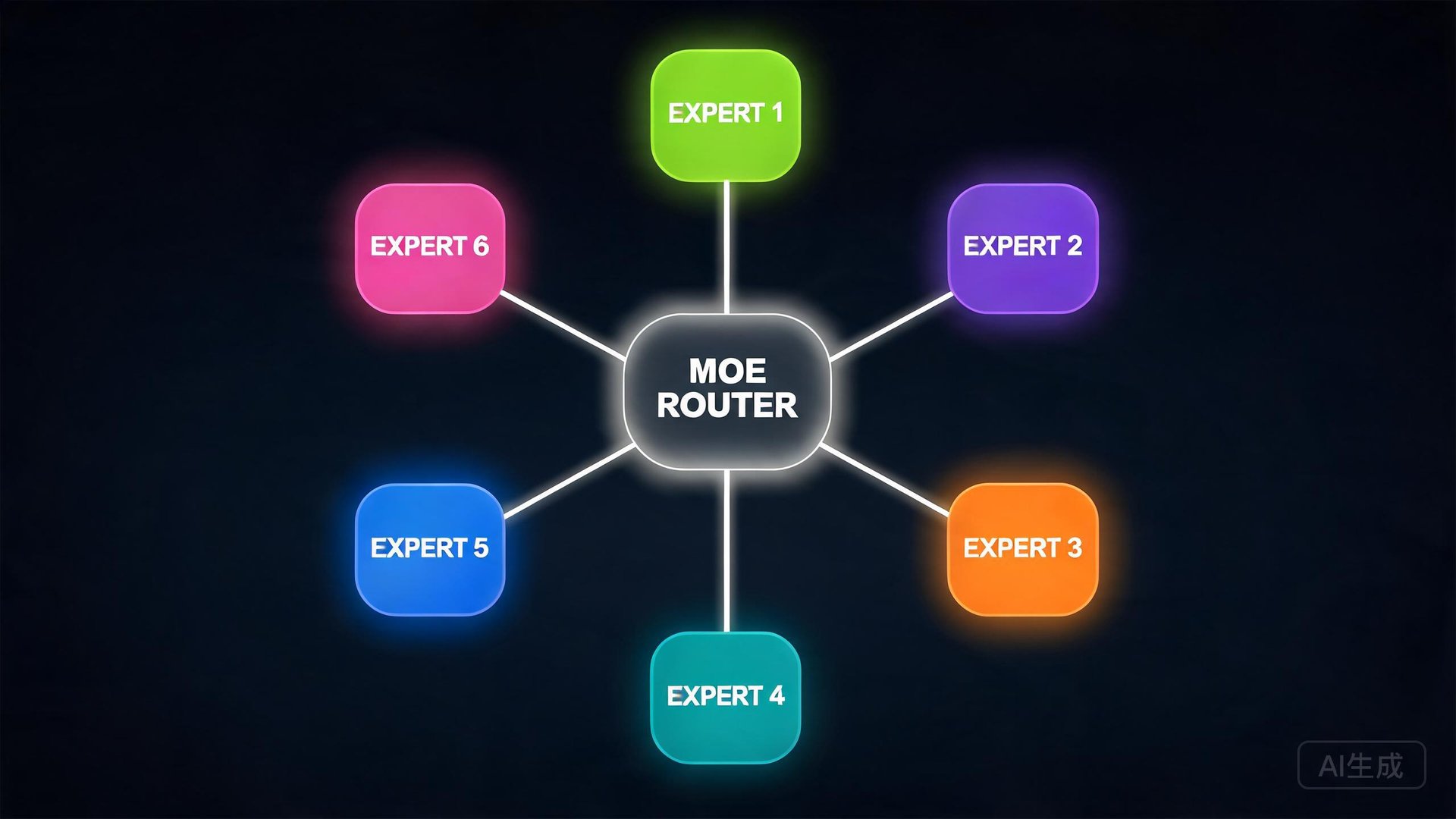
Split one giant FFN into N "expert" sub-networks, and activate only 2-4 most relevant experts per token.
Here's the MoE workflow:
- Token enters MoE layer → passes through a lightweight Router network
- Router scores → computes relevance scores for all N experts
- Top-K selection → activates only the top K experts (typically K=2 or K=8)
- Weighted aggregation → expert outputs combined by Router scores
- Next layer → the next token may activate an entirely different expert combination
Key numbers:
| Model | Total Params | Active per Token | Activation Rate | Details |
|---|---|---|---|---|
| GPT-4 (reported) | ~1.8T | ~280B | 16% | 8×220B experts |
| Mixtral 8×7B | 46.7B | 12.9B | 28% | Top-2 of 8 per layer |
| DeepSeek-V3 | 671B | 37B | 5.5% | Extreme sparsity |
Notice how DeepSeek-V3, with 671B total parameters, activates only 37B per token — under 6%. That means it achieves intelligence surpassing 70B+ Dense models at the inference cost of a 37B model.
3. Why MoE Is Inevitable
1. Revolutionary compute efficiency.
Training a 1T-parameter MoE model may cost the same compute as training a 100-200B Dense model. Economically, this means the same training budget buys you an order-of-magnitude better model capability.
2. Expert specialization drives quality.
MoE experts don't stay generic — they naturally specialize during training: - Expert-3 excels at code generation - Expert-7 masters mathematical reasoning - Expert-12 handles Chinese semantic understanding - Expert-18 specializes in creative writing
This division of labor means the model outperforms Dense models of equivalent active parameter count across virtually every vertical.
3. Local deployment thresholds are dropping fast.
This is the critical insight. A MoE model with 12B active parameters (50-100B total) requires the inference compute of a 12B Dense model, but delivers intelligence comparable to 70B+ Dense models.
In practical terms: the model capability that once required an A100 can now run on a single RTX 4090.
4. MoE's Challenges: Not a Free Lunch
Every architectural choice involves trade-offs:
1. High memory footprint. While each token activates only a subset of parameters, all expert weights must be loaded into memory. DeepSeek-V3 requires ~350GB VRAM for full loading — still out of reach for home users.
2. Load imbalance. Some experts may become "overloaded" (router collapse), causing imbalanced GPU utilization. This is one of the hardest engineering challenges in MoE training, and DeepSeek's paper dedicates substantial discussion to load-balancing strategies.
3. Inference framework maturity lags. MoE inference optimization is far more complex than Dense — it requires conditional computation support and advanced dynamic scheduling, which most inference engines are still catching up on.
5. MoE and Local Agent Computers
Returning to our core question: what does MoE mean for local LLM deployment?
Three key takeaways:
-
Thresholds are dropping. As MoE architecture and tooling mature, the model capability a ¥12,999 KAIHE E1 (32GB unified memory + 55 TOPS NPU) can run locally will dramatically exceed today's expectations.
-
Quantization synergy. MoE + 4-bit quantization + speculative decoding — the compounding effect of these three technologies will cause a step-function drop in local inference costs. Experiments already show 8×7B MoE models compressed to ~25GB running smoothly on consumer GPUs.
-
OpenClaw native integration. Through OpenClaw's model management dashboard, users can hot-switch between quantized MoE models: 2-bit for casual chat, 4-bit for code generation, full precision for complex reasoning. This dynamic scheduling capability is precisely what distinguishes an Agent Computer from an ordinary AI chatbot.
MoE is no silver bullet, but it is rewriting the economics of large language models. For local deployment, this means the era of "LLMs are cloud-only" is ending. Great architecture + a local device = your own AI reasoning capability. This is no longer science fiction.
Related reading: Check out our hands-on tutorial for deploying DeepSeek-V2-Lite (MoE-16B) on the KAIHE E1 in the Tutorials section.
tags: MoE, Mixture of Experts, model architecture, sparse models, LLM inference, local deployment