Multi-Agent Collaboration: AI Agents Evolve from Lone Operators to Digital Teams
📖 Glossary
AI Box (also known as Agent Computer / Agent PC), is a dedicated local hardware device that runs AI Agents. Pre-installed with an AI agent management system, plug-and-play, running 24/7. Users can remotely command AI to work via Discord, Slack, Telegram, WhatsApp, and more.
Abstract: A single AI Agent has inherent limits. Multi-Agent collaborative systems are becoming the industry consensus. OpenAI's Codex Agent Teams, Anthropic's Claude Code multi-instance coordination, and open-source frameworks like AutoGen and CrewAI — the technical approaches differ, but the direction is the same: AI is evolving from "one agent doing tasks" to "a team of agents working together." What does this mean for edge-cloud collaborative architecture?
In the second half of 2025, AI Agents saw a clear trend: shifting from single-Agent to multi-Agent collaboration.
OpenAI's Codex Agent Teams lets multiple coding Agents work in parallel, with a project manager Agent coordinating task splitting for 2-3x faster efficiency. Anthropic's Claude Code supports multi-instance coordination, with different instances handling frontend, backend, and testing. Open-source frameworks AutoGen and CrewAI are moving in the same direction.
Technical approaches differ, but direction is unified: AI is evolving from "one person doing tasks" to "a team working together."
Why Single Agents Hit a Wall
A single Agent's bottleneck lies in "context window" and "attention allocation."
When one Agent handles multiple tasks simultaneously, its context window fills up with information from different tasks, degrading quality on each one. Like a person juggling five things at once — none done well.
The deeper issue is "attention conflict." An Agent working on Task A suddenly needs to switch when Task B's priority rises. Frequent switching causes information loss and logical breaks.
Multi-Agent architecture solves this at the structural level. Each Agent focuses on one task domain with its own context space — no interference. A project manager Agent coordinates: splits tasks, assigns them, merges results. This is more reliable than one Agent tackling everything.
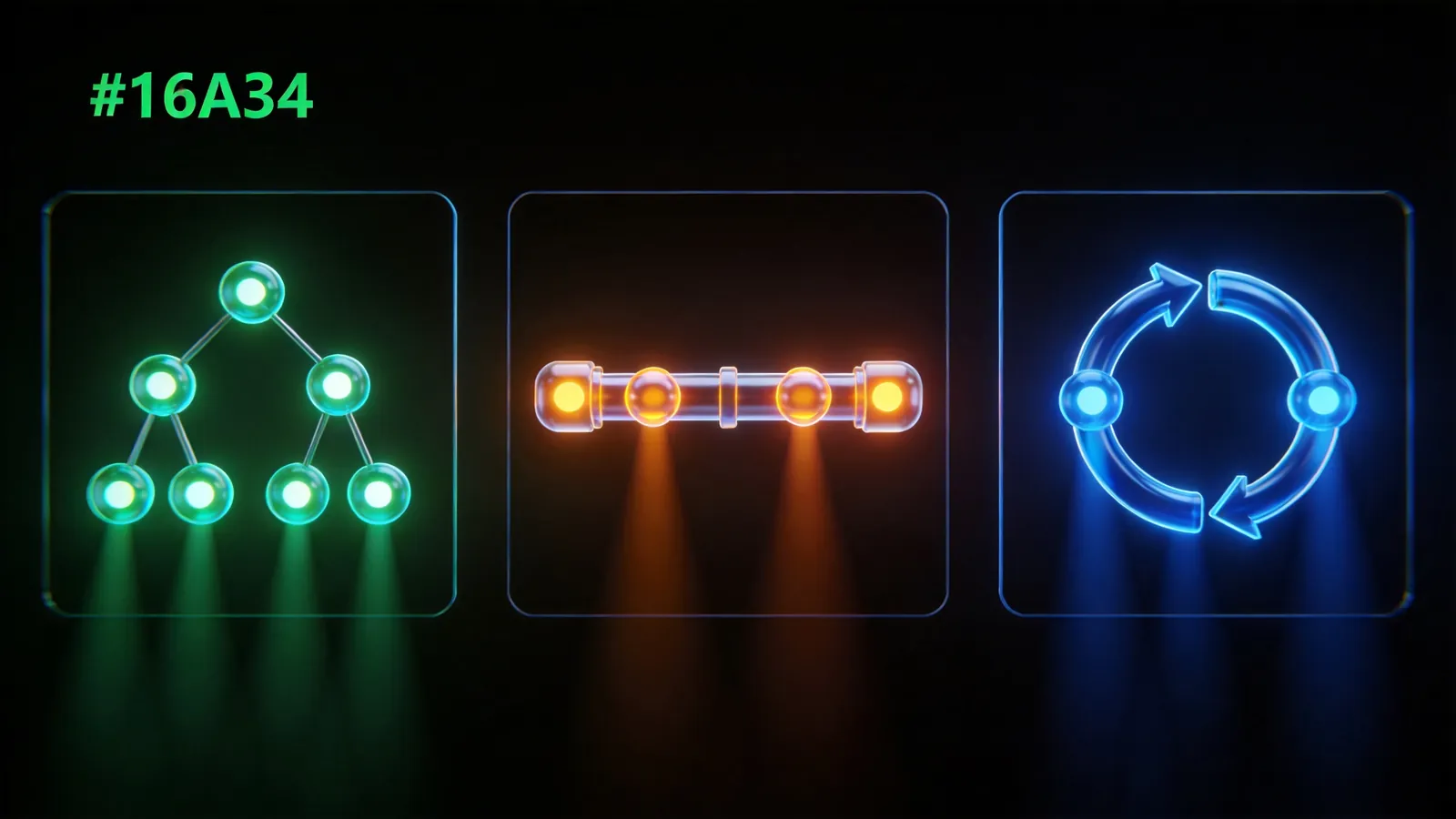
Three Main Multi-Agent Collaboration Patterns
Pattern 1: Hierarchical
One main Agent coordinates, multiple sub-Agents execute. Codex Agent Teams uses this pattern. The main Agent splits large tasks into subtasks, distributes them to different coding Agents, then merges results. Strengths: clear structure, strong control. Weakness: the main Agent is the bottleneck — if task splitting isn't granular enough, the whole system slows down.
Pattern 2: Pipeline
Agents process the same task sequentially, each handling one stage. Example content production pipeline: scraping Agent → analysis Agent → writing Agent → formatting Agent → publishing Agent. Strengths: each Agent focuses on one thing, consistent quality. Weakness: serial execution means speed is limited by the slowest stage.
Pattern 3: Debate
Multiple Agents propose different solutions to the same problem, then review and iteratively refine each other's work. Best for complex decisions requiring multi-perspective analysis. Strengths: high-quality output. Weakness: high token consumption, slow.
Practical Application Scenarios
Software Development: Codex Agent Teams has proven the efficiency of parallel multi-Agent coding. Frontend, backend, and testing Agents work simultaneously, then merge.
Content Production: trend scraping → writing → platform adaptation → scheduled publishing — one Agent per stage, forming a pipeline. One content creator built this on Kaihe AIBOX, reducing daily content production from 3.5 hours to 35 minutes.
Data Analysis: data cleaning Agent → statistical analysis Agent → visualization Agent → report generation Agent — chain them together for an automated data reporting pipeline.
Customer Service: intent recognition Agent → knowledge retrieval Agent → response generation Agent → quality check Agent — clear division of labor, each Agent handles its own stage.
Implications for Edge-Cloud Architecture
Multi-Agent token consumption has a distinctive pattern: burst concurrent load. When multiple Agents start simultaneously, API calls spike; after tasks complete, usage drops to low frequency.
This pattern is a natural fit for Kaihe AIBOX's edge-cloud collaborative architecture. Multiple Agents run on the local device, each handling their own task stage — data cleaning, formatting, tool operations, notifications — these don't need LLMs and run locally. Only the reasoning-intensive steps call cloud models, and on-demand rather than all Agents holding cloud resources simultaneously.
Compare to pure cloud: if all Agents run on cloud, either you rent high-spec servers long-term (expensive) or keep paying during idle periods (wasteful). Kaihe AIBOX places the Agents' "execution layer" locally and the "reasoning layer" on-demand in the cloud — a more rational cost structure.
Current Limitations and Challenges
Multi-Agent collaboration isn't a silver bullet.
Token costs scale linearly: 3 Agents running simultaneously means 3x consumption. More Agents, higher API costs.
Communication overhead between Agents: passing information between Agents requires serialization and deserialization — data can be lost or distorted in transit.
Debugging difficulty: single Agent issues are easy to locate. Multi-Agent system failures require inspecting each Agent's state and interaction records.
The project manager Agent's ceiling: the whole system's efficiency depends heavily on the coordinating Agent's task-splitting quality. Poor splitting causes frequent conflicts between Agents — efficiency can end up worse than a single Agent.
No perfect solutions exist yet for these challenges. But the direction is clear — from single Agent to multi-Agent, like moving from individual heroics to team collaboration, is the inevitable path for AI applications into complex scenarios.
Data Sources
This article references OpenAI Codex Agent Teams documentation, Anthropic Claude Code technical docs, AutoGen and CrewAI open-source project docs, and CSDN technical community coverage.
-#KaiheAIBOX #AIAgent #OpenSource #ArtificialIntelligence
Kaihe AIBOX | The Agent Computer That Works 7×24 for You · AI Agent