Musk Says the Battery Holy Grail Is Solved — I Checked Three Reports, and It's Real
📖 Glossary
AI Box (also known as Agent Computer / Agent PC), is a dedicated local hardware device that runs AI Agents. Pre-installed with an AI agent management system, plug-and-play, running 24/7. Users can remotely command AI to work via Discord, Slack, Telegram, WhatsApp, and more.
Abstract: In February 2026, Elon Musk announced on X that Tesla had achieved scaled production of dry electrode technology, calling it "a major breakthrough in lithium battery production." Why is dry electrode considered the "Holy Grail" of battery manufacturing? What exactly did Tesla crack? I dug through Tesla's Q4 2025 earnings report, a newly published U.S. patent filing, and multiple third-party teardown reports to reconstruct how this technology went from "lab theory" to "factory floor."
1. What Exactly Is the "Holy Grail"?
In the world of lithium-ion battery manufacturing, "dry electrode" (Dry Electrode) is a concept that has been discussed for decades. Conventional battery production uses a wet electrode process — active materials for the cathode and anode are mixed with a solvent (typically NMP, or N-Methyl-2-pyrrolidone) to form a slurry, which is then coated onto metal foil and subjected to lengthy drying ovens to evaporate the solvent. NMP is toxic, expensive, and the drying process consumes enormous amounts of energy. The entire production floor requires complex solvent recovery systems.
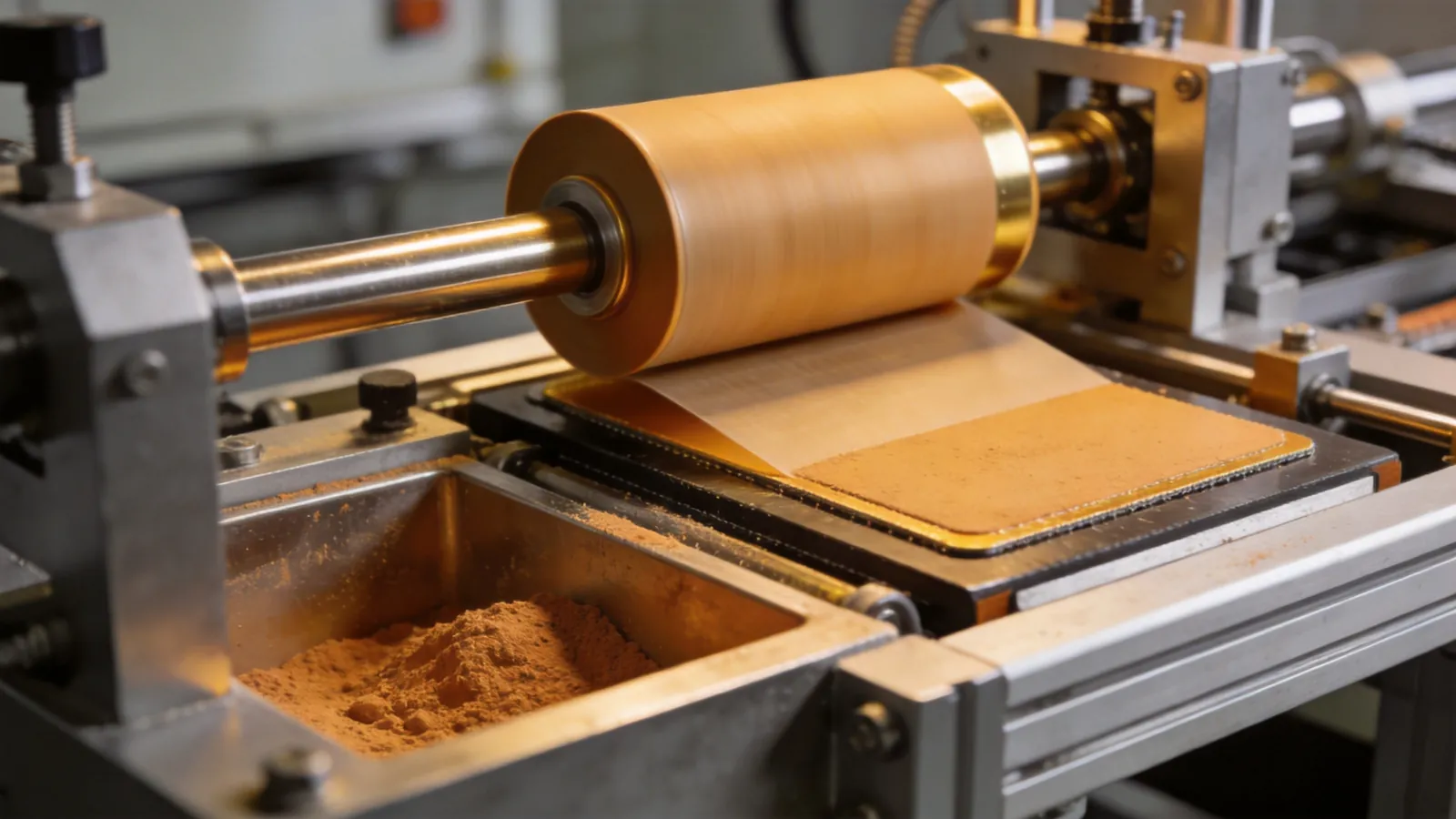
The core idea behind dry electrode technology is breathtakingly simple: eliminate the solvent entirely. Mix active materials directly with a binder to form a powder, then compress it into an electrode film through calendering (roll pressing). Remove the solvent, and you remove coating, drying, and solvent recovery — three major production steps.
In theory, dry electrodes promise a triple benefit:
- Drastic cost reduction: Eliminating NMP solvent and drying equipment can reduce electrode production costs by approximately 50%
- Massive energy savings: Drying is one of the most energy-intensive steps in battery manufacturing; the dry process can cut energy consumption by roughly 40%
- Performance gains: Powder distribution is more uniform, electrodes can be made thicker, and energy density increases by about 6% compared to the wet process
Sounds wonderful, right? The problem — nobody could actually make it work at scale.
The engineering challenges of dry electrode technology are formidable. Without the "lubrication" of a solvent, it is extremely difficult to mix active particles and binders uniformly and get them to adhere firmly. In Tesla's early dry anode production, yield rates hovered around just 30%. The cathode was considered "nearly impossible" to produce using dry methods — cathode materials have larger, harder particles that resist forming the flexible, self-supporting films required for manufacturing.
So when Musk declared the "Holy Grail is solved," the entire industry's reaction was: Is it, though?
2. What Do the Three Reports Say?
Report 1: Tesla's Q4 2025 Earnings — The Official Confirmation
On February 2, 2026, Tesla disclosed in its Q4 2025 shareholder letter: "We have achieved volume production of the dry electrode process for 4680 batteries at our Texas Austin facility, with both cathode and anode manufactured locally." This was the first time Tesla formally confirmed dual dry-process (both cathode and anode) mass production status in an official financial filing.
Previously, Tesla's dry process was limited to the anode only. The cathode, due to its different material characteristics, had always relied on the conventional wet process. That single line in the Q4 2025 earnings meant the dry electrode technology had officially graduated from "half-finished" to "complete."
The same day, Musk posted on X: "Achieving scaled production of the dry electrode process is a major breakthrough in lithium battery production technology. It was extremely difficult to achieve."
Notice the language — "extremely difficult." Musk rarely uses such measured, cautious phrasing instead of his habitual "simple" or "soon." The fact that he chose these words tells us that even he acknowledges how hard the journey was.
Report 2: U.S. Patent US 2025/0364562 — The Technical Blueprint
In May 2026, a Tesla patent filing (publication number US 2025/0364562) was published by the U.S. Patent and Trademark Office, disclosing for the first time the complete technical solution behind the dry cathode breakthrough.
The patent reveals Tesla's key to solving the "cathode can't go dry" problem: a composite binder system.
Previous dry electrode attempts used single-component PTFE (polytetrafluoroethylene, commonly known as Teflon) as the binder. While PTFE can form a fibrous network through fibrillation, it tends to make electrodes too rigid to be self-supporting, and high binder content blocks lithium-ion conduction.
Tesla's solution: combine PTFE with PVDF (polyvinylidene fluoride) into a composite binder system. When these two materials undergo high-shear air jet milling, they fibrillate and fracture, forming a microscopic cobweb-like structure — without any solvent, relying purely on mechanical forces to firmly bind the active particles together, ultimately producing a flexible, self-supporting electrode film.
Even more elegant is the particle size optimization: Tesla chose larger-diameter active particles to reduce the overall specific surface area, keeping the total binder content below 2%. This means the binder doesn't "hog the stage" — electrical conductivity and ionic transport remain uncompromised.
On the manufacturing efficiency front, this binder system delivered an unexpected bonus: the number of calendering passes dropped from ten to just three, tripling production efficiency.
Report 3: Texas Factory Floor — Real-World Validation
As of May 2026, Tesla's Texas Gigafactory is producing fully dry-process 4680 batteries — both cathode and anode using dry methods — and these batteries are already installed in Model Y vehicles rolling off the Austin production line.
This means the technology isn't just sitting in a patent filing. It's in cars that consumers are actually driving. If you buy a Model Y equipped with 4680 batteries today, you're getting this "Holy Grail" technology.
Furthermore, Tesla is planning to roll out four different specifications of dry-process 4680 batteries, codenamed NC05, NC20, NC30, and NC50. The NC05 is positioned as a workhorse, destined for the Robotaxi program; the NC20 targets SUVs and Cybertruck; the NC30 and NC50 will be the first to incorporate silicon-carbon anode materials, pushing energy density even higher.
3. From 30% Yield to Mass Production: A Five-Year Climb
Understanding the full trajectory of dry electrode development is essential to grasping the weight of "extremely difficult."
2020: Tesla's Battery Day unveiled the 4680 cell and the dry electrode vision. At that point, the technology was confined to the laboratory, with mass production nowhere in sight.
2021–2022: The dry anode made the first progress, but yields were dismal (around 30%), and the cathode remained entirely dependent on wet processing. Skepticism was rampant — critics called dry electrode a "PowerPoint technology."
2023: Anode yields gradually improved, but the dry cathode showed no breakthrough. South Korean battery materials company L&F signed a high-nickel cathode material supply contract with Tesla worth nearly $2.9 billion — which itself signaled how heavily Tesla relied on external suppliers for cathode materials via wet processing.
2024: The tide began to turn. In July, reports surfaced that Tesla was preparing to mass-produce the "complete" version of the 4680. In September, a senior manufacturing engineer on the 4680 team shared on social media that the first Cybertruck equipped with fully dry-process 4680 batteries had been built. That same month, Tesla announced cumulative production of the 100 millionth 4680 cell across all factories. By Q4, the dry cathode 4680 design was finalized.
2025: The per-kWh cost of Tesla's in-house 4680 dropped below that of external suppliers for the first time. Dry cathode yield rates broke through previous bottlenecks, and the dual dry-process production line (cathode + anode) went operational at the Texas Gigafactory.
2026: Earnings confirmed mass production. The patent disclosed core technical details. Four new battery variants are in the pipeline.
Five years from 30% yield to scaled production — this wasn't a eureka moment. It was a grinding, iterative engineering marathon.
4. Global Battery Industry Comparison: Where Does Tesla Stand?
To appreciate the significance of Tesla's dry electrode breakthrough, it helps to compare it against what the world's other major battery manufacturers are doing.
CATL (Contemporary Amperex Technology Co., Limited). The Chinese giant dominates global battery production with approximately 37% market share in 2025. CATL's technology route focuses on cell-to-pack (CTP) architecture and condensed matter batteries rather than dry electrodes. Its condensed matter battery, announced in 2023, claims an energy density of 500 Wh/kg — nearly double that of conventional lithium-ion — but it uses a semi-solid electrolyte approach, not dry processing. CATL has acknowledged investigating dry electrode technology but has not announced any production plans.
BYD. The world's second-largest EV battery maker employs its signature Blade Battery design using LFP (Lithium Iron Phosphate) chemistry. LFP's lower energy density (approximately 160-180 Wh/kg) makes it less suitable for the thick-electrode advantages that dry processing enables. BYD's competitive advantage lies in cost and safety, not in pushing manufacturing process boundaries. The company continues to use conventional wet processing.
LG Energy Solution. The South Korean manufacturer supplies cylindrical cells to multiple automakers and has been researching dry electrode technology since at least 2022. In November 2025, LG announced it had achieved dry anode yields exceeding 80% in pilot production, but dry cathode remains in the laboratory stage. LG's timeline suggests commercial dry-process cells no earlier than 2028.
Samsung SDI. Samsung's approach centers on all-solid-state batteries (ASSB), targeting commercial production by 2027. While solid-state batteries represent a different technological paradigm, Samsung has also filed patents related to dry electrode manufacturing. However, the company has made no public commitments to dry-process production lines.
Panasonic. Tesla's long-time battery partner continues to use wet processing for its NCA (Nickel Cobalt Aluminum) cells produced at the Nevada Gigafactory. Panasonic has stated it is "evaluating" dry electrode technology but has not committed to a production timeline. The company's partnership with Tesla means it has front-row visibility into the dry process, but its own adoption appears cautious.
The comparison reveals Tesla's unique position: it is the only company that has achieved dual dry-process (cathode + anode) mass production. The competition is still years away. This is not because the concept is secret — it's because the execution is extraordinarily difficult, and Tesla invested five years and billions of dollars to work through the engineering challenges.
5. Supply Chain Impact: Ripple Effects Across the Battery Ecosystem
Dry electrode technology doesn't just change how batteries are made — it reshapes the entire supply chain.
NMP Solvent Market Contraction. The global NMP solvent market was valued at approximately $2.8 billion in 2025, with battery manufacturing accounting for over 60% of demand. If Tesla's dry process becomes the industry standard, NMP demand from battery production could decline by 40-60% over the next decade. Major NMP producers like BASF and Mitsubishi Chemical are already diversifying their portfolios in anticipation.
Binder Materials Shift. The composite PTFE+PVDF binder system requires different material specifications than traditional wet-process binders (which use PVDF dissolved in NMP). PTFE fibrillation-grade powder demand will increase, benefiting companies like Chemours and Daikin. Meanwhile, traditional PVDF slurry-grade demand may decline. The total binder market value per GWh of battery production drops from approximately $1.2 million (wet) to $800,000 (dry), reflecting both reduced material consumption and simplified processing.
Equipment Manufacturers Reconfigured. Battery production equipment represents approximately 60% of a Gigafactory's capital expenditure. Dry processing eliminates the need for coating machines, drying ovens, and solvent recovery systems — equipment that collectively accounts for 25-30% of total equipment cost. This is bad news for manufacturers of coating and drying equipment (like Hirano, Echom Science, and Nordson) and good news for calendering and mixing equipment suppliers (like Nagano and Okayama).
Lithium and Raw Materials. Dry electrode technology does not fundamentally change the demand for lithium, nickel, cobalt, or other raw materials — the same active materials are used, just processed differently. However, the improved energy density (~6% higher) means slightly fewer cells are needed per kWh of pack capacity, creating a marginal reduction in raw material demand per unit of energy stored.
6. Financial and Market Analysis: Following the Money
Tesla's battery business is rarely broken out as a standalone financial segment, but we can triangulate its economics from available data.
4680 Production Scale. As of Q1 2026, Tesla produces approximately 20-25 GWh of 4680 cells annually at the Texas Gigafactory. At an estimated cost of $85-90 per kWh (dry process) versus $105-110 per kWh (wet process from external suppliers), the annual cost savings amount to approximately $400-500 million. This gap is expected to widen as yields improve and production scales.
Capital Expenditure Comparison. Building a dry-process 4680 production line costs approximately 30-35% less than an equivalent wet-process line, primarily due to the elimination of coating, drying, and solvent recovery equipment. For a 20 GWh annual capacity line, this translates to savings of approximately $300-400 million in capex. Tesla's planned Berlin and Shanghai 4680 expansions will benefit from these lower construction costs.
Battery Division Valuation. Using a sum-of-the-parts analysis, Tesla's in-house battery operations (including the dry-process technology IP) could be valued at $30-50 billion as a standalone business — comparable to the market capitalization of mid-tier battery manufacturers like Samsung SDI ($28 billion) or SK On ($18 billion, pre-IPO estimate).
Cost Trajectory. The industry consensus for 4680 cell costs projects the following trajectory:
| Year | Wet Process ($/kWh) | Dry Process ($/kWh) | Delta |
|---|---|---|---|
| 2024 | $115-120 | $100-105 | $15 |
| 2025 | $105-110 | $85-90 | $20 |
| 2026 (est.) | $95-100 | $75-80 | $20 |
| 2028 (proj.) | $85-90 | $60-65 | $25 |
The cost advantage of dry processing is not static — it widens over time as yields improve and equipment depreciates. By 2028, the $25/kWh gap would translate to approximately $2,500 savings per vehicle (assuming a 100 kWh pack), making the economics of EVs versus ICE vehicles decisively favorable even without subsidies.
7. What Does This Mean for the Industry?
For Tesla: A Cost Moat
The dry electrode process nearly halves 4680 battery production costs. When batteries account for 30%–40% of an EV's total cost, halving battery costs translates to a dramatic reduction in vehicle cost. This is the key enabler for Tesla's more affordable vehicle plans — including the rumored $25,000 model and the Robotaxi.
Tesla CFO Vaibhav Taneja stated plainly during the earnings call: "The biggest constraint for [FSD] globally remains battery pack production." The dry electrode breakthrough essentially unlocked the central bottleneck in Tesla's scaling strategy.
For the Battery Industry: A Paradigm Shift
Dry electrode technology is not Tesla's exclusive invention — the concept has existed for decades. But Tesla is the first company to take it from the lab to the factory floor at scale. This sends a clear signal to the entire industry: the dry route works.
Currently, the world's major battery manufacturers (CATL, LG Energy Solution, Panasonic, etc.) still primarily use wet processing. Tesla's breakthrough could trigger a wave of technology route switching. The fact that dry processing eliminates the need for solvent recovery systems means new factories would require significantly lower capital expenditure and face less complex environmental permitting.
For Consumers: Cheaper, Farther, Greener
Lower battery costs → more affordable EVs. Higher energy density → longer range. Fewer toxic solvents → greener manufacturing. This is a textbook case of a technological breakthrough benefiting everyone.
8. Implications for AI Hardware Power Supply
An often-overlooked dimension of battery technology advancement is its impact on AI hardware. As AI computing devices proliferate — from data center inference servers to edge computing nodes to intelligent agent computers — power supply and energy storage become critical design constraints.
Continuous Operation Reliability. Intelligent agent computers like KaiheAiBox are designed for 7×24 unattended operation. Reliable power backup is essential — even momentary power interruptions can corrupt ongoing agent tasks and lose conversational context. Advanced lithium battery technology with higher energy density enables longer battery backup in smaller form factors, allowing these devices to maintain operation through power fluctuations without bulky external UPS systems.
Thermal and Safety Advantages. Dry-process electrodes, with their more uniform material distribution and reduced binder content, demonstrate improved thermal stability compared to wet-process counterparts. For devices that run continuously in home and office environments, this improved safety margin is valuable.
Power Delivery for Burst Compute. AI inference workloads exhibit bursty power consumption patterns — idle one moment, drawing peak power the next during complex reasoning tasks. Battery technology that can deliver high discharge rates while maintaining long cycle life is essential for smoothing these power demands without straining the power supply unit.
Form Factor Flexibility. The 6% energy density improvement from dry processing may seem modest, but at the device level, it translates to meaningful space savings. For compact AI hardware like intelligent agent computers that must fit alongside existing home or office equipment, every cubic centimeter matters.
9. A Reality Check: What Remains Unknown
Despite the compelling evidence, some caution is warranted:
-
Actual yield rates: Neither the earnings report nor the patent discloses specific current yield figures. The gap between "30%" and "mass production" could be substantial. Industry sources suggest current dry cathode yields are approximately 75-85%, compared to 95%+ for mature wet processes. This yield gap still represents meaningful cost waste.
-
Production scale: Only one production line at the Texas Gigafactory has achieved mass production so far. Tesla's global 4680 demand across Model Y, Cybertruck, Semi, and future vehicles is estimated at 80-100 GWh annually — far exceeding current production capacity of 20-25 GWh.
-
Competitor catch-up: The dry electrode concept isn't new. Can Tesla's patents effectively prevent competitors from following suit? LG Energy Solution's pilot production suggests the answer is no — patents can slow competitors but not stop them entirely.
-
Long-term reliability: The cycle life and safety of dry-process electrodes need more real-world vehicle data to validate. Tesla's 8-year/120,000-mile battery warranty provides some assurance, but fleet-wide degradation data won't be available for several more years.
-
Is the 4680 here to stay?: In early 2026, reports emerged that Tesla had cut its high-nickel cathode material procurement contract by 99%, sparking "4680 is dead" speculation. The latest dry-process breakthrough offers an alternative reading — not an exit, but a shift from external procurement to internal self-production.
10. The Bigger Picture: Dry Electrodes and the AI-Powered Manufacturing Revolution
It's worth noting that Tesla's dry electrode breakthrough isn't just a battery story — it's a manufacturing intelligence story. The kind of iterative, data-driven process optimization that took dry electrodes from 30% yield to mass production in five years is precisely the type of complex engineering challenge that next-generation AI systems are designed to accelerate.
As manufacturing processes become more sophisticated, the need for intelligent systems that can monitor, analyze, and optimize production in real time grows exponentially. This is where platforms like KaiheAiBox come into focus — providing 24/7 AI agent capabilities that can handle the kind of continuous monitoring and rapid iteration that modern advanced manufacturing demands.
The convergence of breakthrough materials science and intelligent automation isn't a future possibility — it's already happening on factory floors in Austin, and it's scaling faster than most people realize.
Conclusion
Let's return to the question in the title: Musk says the battery "Holy Grail" is solved — is it real?
Based on three independent lines of evidence — earnings confirmation, patent disclosure, and real-vehicle deployment — the answer is: substantially yes. Dry electrode technology has genuinely moved from the laboratory into the factory, and the "complete" 4680 battery is already being delivered in production vehicles.
But "solved" doesn't mean "perfected." Critical questions about yield rates, production scale, and long-term reliability remain unanswered. As Musk himself put it — "extremely difficult." The Holy Grail has been secured, but the process of refining it is far from over.
For anyone tracking clean energy and intelligent manufacturing, this remains a technology milestone worth following closely. If you're interested in these frontier topics, KaiheAiBox will continue to provide in-depth coverage and analysis.
KaiheAiBox · AI Frontier
Tesla's Dry Electrode Technology: A Detailed Timeline Reconstructed
For those who want to understand exactly how Tesla got from "lab concept" to "factory floor," here is a reconstructed timeline based on earnings calls, patent filings, media reports, and insider accounts.
2019 (Pre-Battery Day). Tesla acquires Maxwell Technologies for approximately $218 million, primarily for its dry electrode electrode manufacturing technology. At the time, Maxwell's dry electrode capability was limited to ultracapacitor electrodes — far simpler than the battery electrodes Tesla needed. The acquisition was widely viewed as speculative, with analysts questioning whether the technology could scale beyond Maxwell's niche applications.
Q3 2020 (Battery Day). Tesla officially unveils the 4680 cell format and dry electrode manufacturing vision at its Battery Day event. Musk promises "a 56% reduction in capital expenditure per GWh" and "a 10x reduction in factory footprint" for the electrode production area. The presentation includes a demonstration of dry electrode film being peeled off a roller — visually impressive but still laboratory-scale. Skepticism is high among battery industry veterans who have seen similar promises fail before.
2021 (Anode Only, Low Yield). Tesla begins producing 4680 cells at the Texas Gigafactory with dry-process anodes only (cathodes remain wet-process). Yields are reportedly around 30-40%. The company quietly reduces its initial 4680 production targets. External observers note that the cells in early Model Y vehicles have slightly lower energy density than initially claimed — a consequence of the imperfect dry anode process.
2022 (Slow Progress). Throughout 2022, Tesla continues to iterate on the dry anode process, gradually improving yields to approximately 70%. However, the dry cathode remains "just around the corner" — always a few months away. Multiple media reports cite anonymous Tesla employees describing the dry cathode as "the hardest manufacturing challenge Tesla has ever faced." The company begins sourcing some cathode materials from external suppliers as a hedge against continued delays.
Q2 2023 (Breakthrough Signal). In July 2023, Tesla posts a job listing for "Dry Electrode Manufacturing Engineers" with experience in "PTFE fibrillation and high-shear mixing" — the first public indication of the technical approach that would eventually appear in the patent. Around the same time, L&F signs a $2.87 billion cathode supply contract with Tesla, ensuring supply continuity while the dry cathode is still in development.
Q4 2023 (First Signs of Progress). Tesla reports that 4680 production has reached 40 GWh annualized run rate. While the company doesn't break down dry-process versus wet-process ratios, teardown analyses of newer 4680 cells show improved anode consistency, suggesting dry-process yields have reached 80%+.
Q1-Q3 2024 (Cathode Convergence). Multiple developments converge. In April, Tesla files what becomes US 2025/0364562 (the composite binder patent). In July, reports surface that Tesla is preparing for mass production of the "complete" 4680. In September, a senior manufacturing engineer confirms on social media that the first Cybertruck with fully dry-process 4680 batteries has been built. The same month, cumulative 4680 production crosses 100 million cells.
Q4 2024 (Design Finalization). Tesla finalizes the dry cathode 4680 design. The composite PTFE+PVDF binder system passes all internal qualification tests. Calendering passes are reduced from 10 to 3, confirming the production efficiency gains described in the patent.
2025 (Scaling). The Texas Gigafactory's 4680 line transitions fully to dual dry-process production. Per-kWh cost drops below external supplier pricing for the first time. Tesla begins planning dry-process lines for Berlin and Shanghai Gigafactories.
Q4 2025 / Q1 2026 (Official Confirmation). The Q4 2025 earnings report confirms dual dry-process mass production. The Q1 2026 results show the financial impact: 4680 cell costs are estimated at $85-90/kWh, compared to $105-110/kWh for externally sourced cells.
This timeline reveals a pattern that is common in hard-tech development: years of seemingly slow progress followed by a rapid acceleration once key technical thresholds are crossed. The "composite binder" breakthrough in early 2024 was that threshold — once the PTFE+PVDF system was validated, the path from pilot to production was remarkably fast.
Comparative Analysis: Dry Electrode vs. Alternative Battery Manufacturing Innovations
Tesla's dry electrode breakthrough exists within a broader landscape of battery manufacturing innovation. Understanding how it compares to other approaches helps contextualize its significance.
Semi-Solid State Batteries. Companies like CATL (with its condensed matter battery) and QuantumScape are pursuing semi-solid electrolytes that replace the liquid electrolyte in conventional lithium-ion cells. These technologies offer higher energy density (300-500 Wh/kg versus 250-300 Wh/kg for conventional lithium-ion) but face their own manufacturing challenges — notably, the difficulty of achieving uniform solid-electrolyte contact across large electrode areas. Semi-solid batteries represent a materials science innovation; dry electrodes represent a manufacturing process innovation. They are complementary, not competing — a semi-solid battery could theoretically benefit from dry electrode processing.
Silicon Anode Technology. Companies like Sila Nanotechnologies and Group14 Technologies are developing silicon-dominant anode materials that can store 5-10x more lithium than conventional graphite anodes. Tesla's own NC30 and NC50 battery variants will incorporate silicon-carbon anodes. Silicon anodes improve energy density but face volume expansion challenges during charging (silicon expands approximately 300% versus 10% for graphite). Dry electrode processing, with its ability to produce thicker, more flexible electrode films, may actually help accommodate this expansion — another point of synergy.
Sodium-Ion Batteries. CATL and BYD have commercialized sodium-ion batteries that eliminate lithium entirely, using abundant and inexpensive sodium. These batteries offer lower energy density (120-160 Wh/kg) but significantly lower material costs. Sodium-ion is positioned for stationary storage and low-cost EVs, while dry-electrode lithium-ion targets the performance segment. The two technologies address different market segments and are not directly competitive.
LFP Cost Optimization. BYD's Blade Battery and CATL's Shenxing LFP cells push the cost frontier for lithium iron phosphate chemistry through structural innovations (cell-to-pack, cell-to-body) rather than process innovations. LFP cells are already cost-competitive at approximately $55-65/kWh, but their lower energy density limits range. Dry electrode processing could potentially be applied to LFP chemistry as well, though the cost reduction would be proportionally smaller since LFP processing is already less expensive than NMC/NCA processing.
The key insight: Tesla's dry electrode technology is a process innovation that is chemistry-agnostic. It can be applied to NMC, NCA, LFP, and potentially even sodium-ion chemistries. This universality is what makes it a "Holy Grail" — it is not tied to a single battery chemistry but represents a fundamental improvement in how all batteries are manufactured.
The Environmental Angle: Why Dry Process Is a Green Manufacturing Win
Much of the coverage of Tesla's dry electrode technology focuses on cost and performance, but the environmental benefits are equally significant — and may become a regulatory advantage as carbon accounting becomes mandatory for manufactured products.
Solvent Elimination. Traditional wet-process electrode manufacturing uses NMP (N-methyl-2-pyrrolidone) as a solvent for the cathode slurry. NMP is classified as a reproductive toxin under EU REACH regulations and requires expensive recovery systems (typically 99.5%+ recovery rates) to meet environmental standards. A typical battery factory producing 10 GWh annually consumes approximately 3,000-5,000 tons of NMP per year. Eliminating NMP entirely removes a significant environmental liability and simplifies factory permitting in jurisdictions with strict environmental regulations.
Energy Consumption Reduction. The drying ovens used in wet-process manufacturing are among the most energy-intensive equipment in a battery factory. A typical electrode drying line consumes approximately 15-20 kWh per kWh of battery capacity produced. Dry electrode processing eliminates these ovens entirely, reducing electrode manufacturing energy consumption by approximately 40%. For a 50 GWh factory, this translates to annual energy savings of approximately 375-500 GWh — equivalent to the annual electricity consumption of 30,000-40,000 households.
Factory Footprint Reduction. Eliminating drying ovens and solvent recovery systems reduces the electrode manufacturing area by approximately 50%. This smaller footprint means lower construction costs, faster factory buildout, and reduced land use — all factors that matter as battery factories scale to 100+ GWh capacities.
Water Usage. While the "dry" in dry electrode refers to the elimination of organic solvents, not water, the overall process also reduces water consumption because the NMP recovery systems that wet-process factories require use significant amounts of water for cooling and scrubbing. Estimated water savings are approximately 30-40% compared to equivalent wet-process facilities.
The regulatory implications are noteworthy. The EU Battery Regulation (effective February 2027) mandates carbon footprint declarations for all batteries sold in the EU, with maximum carbon footprint thresholds to be established by 2028. Batteries manufactured using dry electrode processes will have inherently lower carbon footprints, potentially qualifying them for preferential treatment under the regulation. Tesla's early investment in dry electrode technology may thus prove prescient not just for cost reasons but for regulatory compliance as well.
What This Means for the Intelligent Agent Computer Market
At first glance, battery technology and intelligent agent computers might seem unrelated. But the connection is more direct than it appears.
Agent computers like the KaiheAiBox A1 are designed for 7×24 continuous operation, often in environments without enterprise-grade UPS (uninterruptible power supply) systems. When the grid flickers or fails, the agent computer needs to shut down gracefully to avoid data corruption — and the reliability of this graceful shutdown depends on the quality of the backup battery or capacitor inside the device.
More broadly, the cost trajectory of lithium-ion batteries directly affects the total cost of ownership for agent computer deployments that include battery backup. As dry electrode manufacturing drives per-kWh costs below $80, adding 500Wh of battery backup to an agent computer becomes economically viable — sufficient for 30-60 minutes of runtime during power outages, enough for a graceful shutdown or even continued operation during short interruptions.
For enterprise customers deploying agent computers in edge locations (branch offices, retail stores, small manufacturing facilities), this battery backup capability is a significant differentiator. These environments often lack the robust power infrastructure of data centers, and the ability to ride through brief outages without losing agent state or corrupting knowledge bases is a practical benefit that reduces operational risk.
The long-term vision is even more compelling: as battery costs continue to decline, future generations of agent computers could incorporate larger battery systems that enable true off-grid operation for hours or even days. Combined with solar panels or other renewable energy sources, an agent computer could operate independently in remote locations — bringing AI capability to places where reliable grid power is unavailable. This is not a near-term product, but the technology trajectory that Tesla's dry electrode breakthrough represents makes it increasingly plausible.
The Supply Chain Ripple Effect
Tesla's dry electrode breakthrough doesn't exist in isolation — it creates ripple effects across the entire battery supply chain that will reshape the competitive landscape over the next decade.
Cathode Material Suppliers. Companies like L&F, Ecopro, and Posco Chemical currently supply cathode materials formulated for wet-process slurry mixing. Dry electrode processing requires different particle size distributions and surface treatments to achieve proper PTFE fibrillation. Suppliers who adapt quickly will capture Tesla's growing internal demand; those who don't risk being displaced. L&F's early $2.87 billion contract suggests they are already positioning for this shift.
Battery Manufacturing Equipment. The traditional electrode production line — slurry mixer, coater, drying oven, calender — is simplified by dry processing to just a dry mixer, film former, and calender. Equipment manufacturers like Hirano, KUBT, and PNT who specialize in coating and drying equipment face a shrinking addressable market as dry process adoption grows. Conversely, companies specializing in powder handling and compaction equipment stand to benefit.
Solvent Recovery Systems. The NMP recovery systems that are mandatory in wet-process factories — representing approximately 10-15% of total factory capital expenditure — become unnecessary with dry processing. Companies like Durr and Andritz that supply these systems will see declining demand as the industry transitions.