OpenClaw 2.0 Roadmap Revealed: Sandbox Engine, Multi-Agent Collaboration, and the Next Chapter of the Agent Computer
📖 Glossary
AI Box (also known as Agent Computer / Agent PC), is a dedicated local hardware device that runs AI Agents. Pre-installed with an AI agent management system, plug-and-play, running 24/7. Users can remotely command AI to work via Discord, Slack, Telegram, WhatsApp, and more.
Abstract: Peter Steinberger's published OpenClaw 2.0 roadmap reveals two core directions—a Sandbox security isolation engine and deep multi-agent collaboration capabilities. This is not mere feature iteration; it represents an architectural leap from "individual tool" to "collaborative platform" for the agent computer.
A Roadmap That Triggered an All-Night Meeting
In May 2026, OpenClaw founder Peter Steinberger shared the version 2.0 roadmap with the community. That same evening, the Hermes team—one of OpenClaw's most active third-party development groups—convened an emergency meeting to discuss what these changes would mean for the existing agent ecosystem.
Why would a roadmap warrant an all-night developer session? Because OpenClaw 2.0 is not just adding features. It is changing how agents fundamentally operate.
The Sandbox Engine: Drawing Boundaries Around Agents
In the current OpenClaw architecture, agents share an execution environment. An agent can access the file system, call APIs, and read and write databases, with permission boundaries enforced primarily through prompt constraints and user-configured settings. This works acceptably for single-agent setups, but when you run five or ten agents concurrently, the risks compound: one agent's misoperation can corrupt another's data, and a single prompt injection breach can spill across the entire environment.
The Sandbox Engine exists to solve exactly this problem.
Core mechanisms:
- Process-level isolation: Each agent runs inside its own sandbox, with file system access, network calls, and system interactions fully isolated from other agents.
- Permission whitelisting: Agents may only access explicitly authorized resources. Default permissions follow the principle of least privilege.
- Resource quotas: CPU, memory, and network bandwidth are capped with hard limits, preventing any single agent from monopolizing system resources.
- Audit logging: All cross-sandbox operations are recorded with complete traceability, supporting post-incident forensic analysis.
The Sandbox does not constrain agent capability—it makes multi-agent coexistence possible. Freedom without boundaries is not freedom; it is chaos.
What does this mean for KaiheAiBox A1 and B1 users? Today, agents running on KaiheAiBox devices require manual permission configuration—which directories are readable, which APIs are callable. When the Sandbox Engine ships, permission management will shift from "manual configuration" to "policy-driven automation." For non-technical users, this is a particularly meaningful improvement: you no longer need to understand file permissions. You simply tell OpenClaw, "This agent handles email, that one manages my calendar," and permissions are allocated automatically.
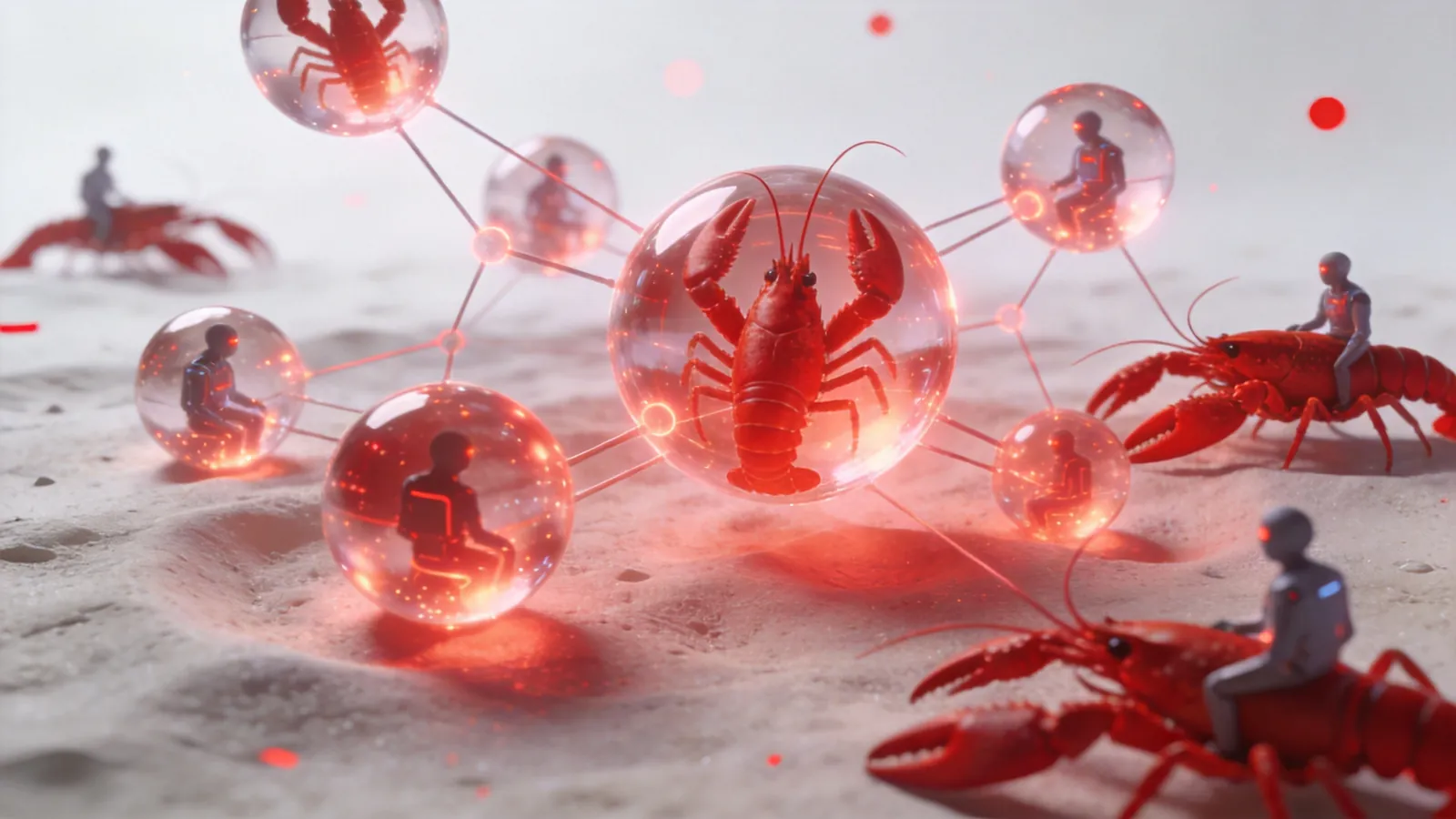
Multi-Agent Collaboration: From "Parallel" to "Coordinated"
OpenClaw's current multi-agent capabilities can be described as "parallel"—multiple agents run simultaneously, each working independently, occasionally passing messages through a queue. This is the simplest multi-agent pattern, but it falls far short of realizing collaborative potential.
The "coordinated" mode planned for OpenClaw 2.0 centers on three capabilities:
1. Shared Working Memory: Agents can share structured working memory rather than being limited to simple message passing. For instance, key information extracted by an email agent can be written directly to shared memory, instantly readable by a calendar agent and a customer relations agent.
2. Task Orchestration: Dependency relationships between agents can be explicitly defined. Agent A's output can serve as the trigger for Agent B's execution, forming automated workflows without human intermediation.
3. Conflict Resolution: When multiple agents' operations conflict (for example, two agents attempting to modify the same file), the system automatically coordinates priorities to prevent race conditions.
Why the Hermes Team Is on Edge
The core issue the Hermes team debated through the night: Sandbox Engine compatibility with the existing agent ecosystem.
Hermes maintains a popular collection of OpenClaw agent templates that were designed without sandbox isolation in mind. Some agents assume unrestricted file system access; others dynamically install dependencies at runtime. Under the Sandbox Engine, these "free-range" agents may fail to function correctly.
Peter Steinberger's roadmap explicitly states that version 2.0 will offer a compatibility mode: before the Sandbox Engine is fully enforced, existing agents can run in a compatibility mode that replicates the 1.x environment. However, compatibility mode will not persist indefinitely—the plan is to mandate Sandbox isolation starting from version 2.1.
This gives agent developers a one-to-two-version transition window to adapt their templates to the new architecture.
What It Means for KaiheAiBox Agent Computer Users
From a user perspective, OpenClaw 2.0 delivers three key shifts:
Safer: No more worrying about an agent misstep corrupting the system. The Sandbox Engine ensures each agent works within its own "room," unable to interfere with others.
Smarter: Multi-agent collaboration unlocks complex workflows. Instead of "one agent, one task," you get "a team of agents collaborating on a complex objective."
More Effortless: Automated permission management means non-technical users no longer need to understand the technical details. Tell OpenClaw what you want accomplished, and it orchestrates agents, allocates permissions, and coordinates execution automatically.
For KaiheAiBox A1 and B1 devices—agent computers designed for 24/7 operation—these architectural upgrades are especially valuable. Long-running agents are more vulnerable to isolation failures: one agent's memory leak should not crash the entire system, and one agent's security vulnerability should not expose all stored data. The Sandbox Engine addresses these risks at the architectural level rather than relying on best-effort prompt engineering.
Looking Ahead: The "Operating System Moment" for Agent Computers
If OpenClaw 1.x resembles DOS—single-tasking, direct hardware access, user-managed everything—then OpenClaw 2.0 is closer to Windows 3.1: multi-tasking, memory protection, and process isolation.
The analogy is imperfect, but it points toward the same trajectory: agent computers are evolving from "tools" into "platforms." And a platform's core value is not how many agents it can run, but how safely and efficiently those agents can collaborate.
Steinberger's 2.0 roadmap is, in essence, a blueprint for an "operating system" designed for AI agents. The Sandbox Engine is memory protection. Multi-agent collaboration is inter-process communication. Permission whitelisting is access control. These are the building blocks of any mature operating system—except this time, the primary beneficiaries are not human users, but AI agents.
This distinction matters more than it might seem. Traditional operating systems were designed around human cognitive constraints: one person can only attend to one task at a time, so the OS provides windows and notifications to manage attention. Agent operating systems face a fundamentally different challenge: dozens or hundreds of agents can operate concurrently, and the system must prevent them from interfering with each other while enabling rich collaboration. The technical requirements—sandboxing, resource quotas, audit trails—are more demanding than anything a human-facing OS needed at comparable scale.
For the KaiheAiBox ecosystem specifically, the 2.0 roadmap validates a design philosophy: that agent computers are not just hardware that happens to run LLMs, but purpose-built platforms where the operating system layer is as important as the silicon. The A1 and B1 were designed from day one with the assumption that multi-agent workloads would eventually demand isolation and orchestration. OpenClaw 2.0 is the software layer that makes that hardware foresight operationally real.
When agents acquire their own operating system, they cease to be mere tools and become residents of the digital world. Our job is to build them a secure, efficient community.
KaiheAiBox · OpenClaw Zone