Lenovo Bundles OpenClaw: What Your Lobster Can Do, Big Tech Is Already Doing
📖 Glossary
AI Box (also known as Agent Computer / Agent PC), is a dedicated local hardware device that runs AI Agents. Pre-installed with an AI agent management system, plug-and-play, running 24/7. Users can remotely command AI to work via Discord, Slack, Telegram, WhatsApp, and more.
Summary: In 2026, Lenovo's Laikool AI MINI PRO ships with OpenClaw one-click deployment, starting at ¥4,499. When "raising lobsters" moves from niche geek circles to Lenovo's official storefront, it signals that AI agents are no longer toys for tech enthusiasts — they're becoming standard features on everyone's computer.
From 280K GitHub Stars to Lenovo's Shelves
Early 2026, the open-source agent framework OpenClaw (nicknamed "little lobster") exploded globally, surpassing 280K GitHub stars and becoming one of the fastest-growing open-source projects ever. But the number that truly matters isn't the star count — it's this: Lenovo put it inside a mass-produced computer.
Lenovo's official product page reads: "Laikool AI MINI PRO High-Performance Mini PC, OpenClaw One-Click Deployment, ¥4,999." The Ultra 5 + 32GB + 512GB version starts at ¥4,499, with the 1TB variant at ¥4,999. This isn't a concept device or a developer kit. It's a consumer product anyone can order right now.
When an open-source project appears on a major manufacturer's storefront, the message is clear: agent applications have crossed the geek validation phase and entered the mainstream consumer market.
Even Government-Certified Terminals Are Running It
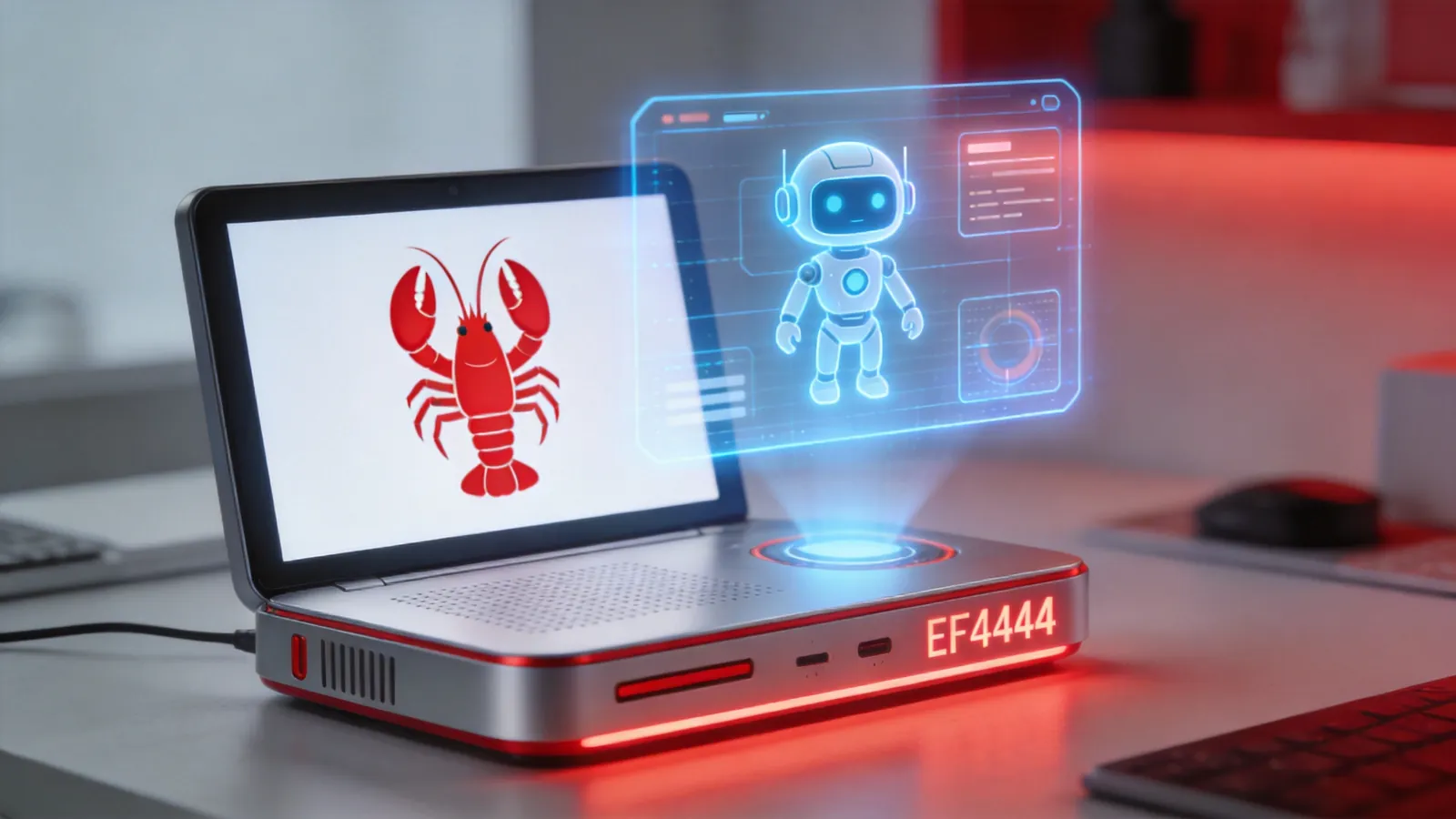
Equally significant: Lenovo Kaitian X7 became the industry's first government-certified (Xinchuang) terminal to run OpenClaw locally.
The Xinchuang market has strict requirements for domestic production and security compliance. OpenClaw running on these devices means it's not just for individual consumers — it qualifies for government and state-owned enterprise deployments. For the agent industry, this means security compliance is no longer a barrier to adoption.
Lenovo Kaitian's breakthrough proves something important: domestic certified devices aren't incapable of running AI agents — the question was whether anyone would do the integration work. OpenClaw's open-source nature makes such adaptation possible.
The Economics of "Raising Lobsters": From Paid Installation to One-Click Deployment
During OpenClaw's viral phase, an interesting market emerged — paid installation services. Some people charged thousands of yuan per visit to help users install and configure OpenClaw. Others charged to uninstall it because Token costs were too high.
What's the root cause? Usage barriers. Despite OpenClaw's "zero-code" claims, every step — installation, API key configuration, model selection, skill deployment — can be a roadblock for non-technical users.
Lenovo's one-click deployment eliminates this pain point entirely. Buy the computer, turn it on, start using it. No command line, no manual configuration. This aligns perfectly with Kaihe AI Box's philosophy: the future of agents isn't for tech people — it's for everyone.
Why Are Big Tech Companies Choosing OpenClaw?
Lenovo isn't the only major player embracing OpenClaw. Intel has proposed the concept of "Agent PC," arguing that future PCs won't be computing tools but agent carriers.
Three reasons drive big tech adoption:
First, mature ecosystem. OpenClaw's Skill ecosystem already covers office automation, coding assistance, data processing, and content creation. Users don't build from scratch — they import and go.
Second, open architecture. Open source means manufacturers can customize freely without depending on proprietary services. For hardware vendors like Lenovo, this is the foundation for building differentiated products.
Third, local-first design. OpenClaw runs locally by default, keeping sensitive data on-device. Under increasingly strict privacy regulations, this is a significant compliance advantage.
From "Installing OpenClaw" to "Agent Computer"
Lenovo's Laikool AI MINI PRO with OpenClaw pre-installed marks an important step toward mainstream adoption. But the deeper question is: Do users need "a computer with OpenClaw installed" or "a computer built for agents"?
These are fundamentally different. The former is a traditional PC with an app added on. The latter is a device optimized from hardware to software for 24/7 agent operation.
Kaihe AI Box answers with the latter. The A1/B1 series is purpose-built for agent scenarios: low-power ARM architecture ensures stable 24/7 operation, physical isolation from the primary PC guarantees data security, and the proprietary agent management system makes it accessible even for complete beginners.
Lenovo proved that "agents + computers" is a real market demand. Kaihe AI Box aims to upgrade that demand from "adding an app" to "changing the device."
KaiheAiBox · The Agent Computer for Everyone · OpenClaw Zone