Three Questions: Is OpenClaw's Lobster Outdated? Is Hermes Horse-Raising Worth It?
📖 Glossary
AI Box (also known as Agent Computer / Agent PC), is a dedicated local hardware device that runs AI Agents. Pre-installed with an AI agent management system, plug-and-play, running 24/7. Users can remotely command AI to work via Discord, Slack, Telegram, WhatsApp, and more.
Q1: Is OpenClaw's Lobster Really Outdated?
No. But in certain scenarios, it does feel cumbersome.
OpenClaw (affectionately nicknamed "Little Lobster" in the Chinese community) has accumulated 356,650 GitHub Stars as of April 2026, with sponsors including OpenAI, GitHub, NVIDIA, and Vercel. It remains the open-source AI assistant with the broadest channel coverage—25+ platforms from WeChat and Feishu to iMessage and IRC, all managed by a single Agent process. Version 2026.4.12 added experimental Active Memory and local voice mode.
OpenClaw's core is the Gateway—a dispatch center routing messages from all channels to the AI Agent. It gives you maximum control: 5,700+ community skills, MCP integration, fully transparent and auditable configuration. For power users, this is a paradise of freedom.
But freedom comes at a cost. Dependencies, errors, configurations—setup can be painful. Skills are human-written Markdown files: what you install is what you get, with no self-learning. Memory writes depend on the model's judgment of what's "worth storing," often missing important context—hence the community patches like Mem0 and Hindsight.
So OpenClaw isn't outdated—its design philosophy of "you command, AI executes" simply feels insufficiently automated for repetitive workflows. You need to continuously invest effort in maintenance and optimization. It won't grow on its own.
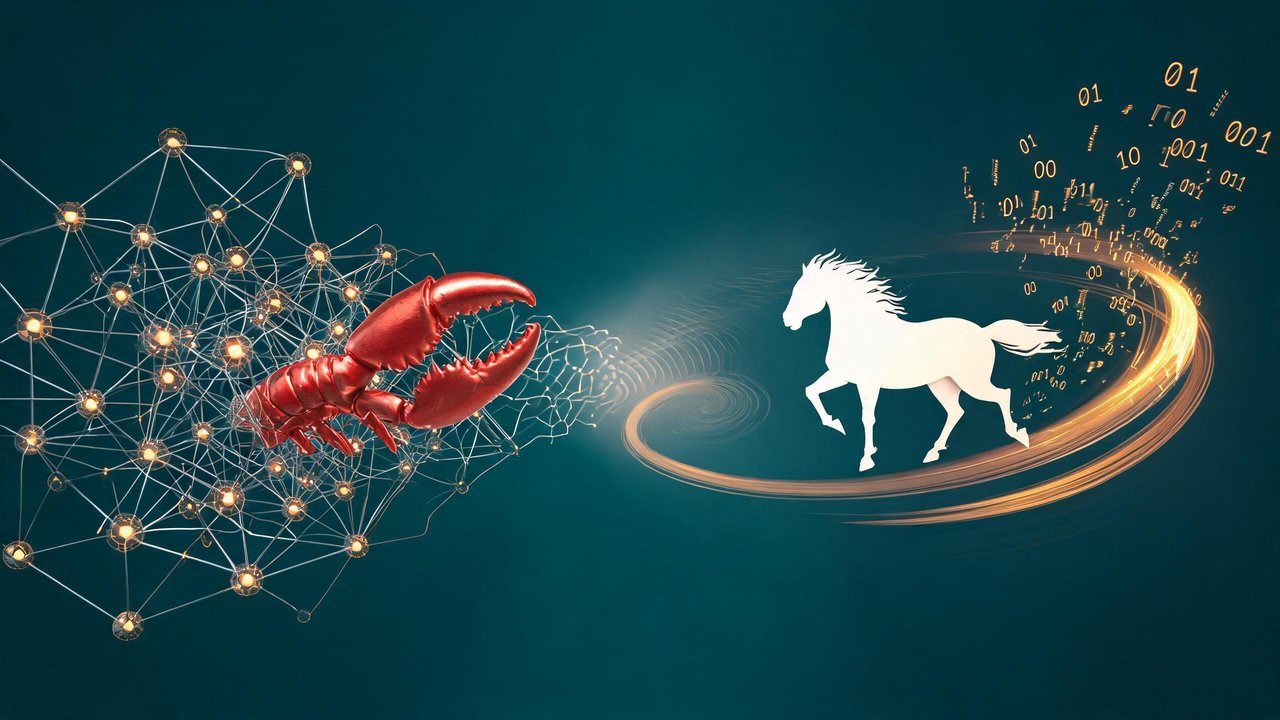
Q2: What Makes Hermes Horse-Raising So Special?
Self-evolution. These three words are the biggest differentiator between Hermes Agent and OpenClaw.
Hermes Agent is built by Nous Research (a $65M-funded Silicon Valley lab), and went from zero to nearly 74,000 GitHub Stars in just two months. Its core isn't about "how to route messages to the Agent"—it's about "how the Agent keeps getting stronger." The official term: Closed Learning Loop.
Three Mechanisms of Self-Evolution
Mechanism 1: GEPA Self-Evolution Engine. Every 10 conversation turns, Hermes silently forks a background process to review the conversation—asking itself "What user preferences emerged? What methods worked?" Valuable insights go into memory; reusable methods become skills.
Mechanism 2: Three-Layer Persistent Memory. MEMORY.md (environmental facts, 2200 char limit) and USER.md (user preferences, 1375 char limit) are auto-injected into every conversation's context. Session Search uses FTS5 full-text retrieval plus LLM summarization to find conversations from weeks ago. Memory writes pass through a security scan to prevent prompt injection.
Mechanism 3: Automatic Skill Learning & Iteration. After completing complex tasks, Hermes automatically distills the workflow into a SKILL.md file. Next time it encounters a similar task, it calls the cached skill directly. The more you use it, the more refined the methods become—v1.0 to v1.3, each iteration adding another learned lesson.
The Out-of-Box Experience Gap
Installation takes one command, and you're chatting within 5 minutes. 40 built-in tools, 92 built-in skills—ready to work out of the box. Native Anthropic Provider support matters: since April 4, 2026, Anthropic stopped covering third-party tools with Claude subscriptions. OpenClaw users now pay API fees; Hermes users just log in directly.
There's also hermes claw migrate—one command to import your OpenClaw memories, skills, and API keys. Hermes is explicitly targeting OpenClaw's user base.
But Hermes Has Gaps Too
Only 7 channels (CLI / Telegram / Discord / Slack / WhatsApp / Signal / Email)—no WeChat, Feishu, iMessage, or Teams. No voice mode, no companion app, no browser control, no Live Canvas. Chinese documentation is nearly nonexistent, and the community ecosystem is far less mature than OpenClaw's.
Q3: Which Should Regular Users Choose?
It depends on what you value most—not which one is objectively better.
| What You Need | Choose |
|---|---|
| 25+ channel coverage (WeChat/Feishu/iMessage/Teams) | OpenClaw |
| Voice mode / Companion app / Device control | OpenClaw |
| Local-first + data sovereignty + transparent config | OpenClaw |
| Automatic skill learning / Gets smarter over time | Hermes Agent |
| Strong cross-session memory (search conversations from months ago) | Hermes Agent |
| Complex task parallel decomposition (native sub-Agents) | Hermes Agent |
| Claude subscription usage (no extra API fees) | Hermes Agent |
A more pragmatic approach: they don't conflict. Use OpenClaw as your channel layer, Hermes Agent for complex tasks. They can coexist—as long as you don't assign the same Bot Token to both. If you're already raising a lobster, try hermes claw migrate --dry-run first. Preview before you commit.
For KAIHE AI users, the answer is simpler: A1-C1 Agent Computers come pre-installed with OpenClaw—25+ channels ready out of the box, 0 Token fees, local execution. E1-G1 LLM Computers support running 7B-70B parameter models locally, where Hermes Agent's self-evolution loop runs entirely on-device—data never leaves, costs go to zero. Lobster or horse? It's not a single-choice question.