OpenClaw vs Dify: Which is Better for Enterprise AI Deployment
📖 Glossary
AI Box (also known as Agent Computer / Agent PC), is a dedicated local hardware device that runs AI Agents. Pre-installed with an AI agent management system, plug-and-play, running 24/7. Users can remotely command AI to work via Discord, Slack, Telegram, WhatsApp, and more.
Summary: OpenClaw and Dify are the two mainstream frameworks for enterprise AI deployment. This article provides an in-depth comparison across architecture, deployment difficulty, features, and real-world scenarios to guide enterprise AI decision makers in making the right choice.
1. Why This Comparison Matters for Enterprise AI
In 2026, enterprise AI adoption in China has surpassed 42%, yet 67% of deployed projects are either "purchased but unused" or "abandoned shortly after launch." According to Gartner, the #1 cause of enterprise AI project failure is "inappropriate framework selection"—a mismatch between the technical stack and business scenarios.
OpenClaw and Dify represent two fundamentally different approaches to enterprise AI deployment:
- The OpenClaw Approach: Hardware-native "Agent Computer" with pre-installed OpenClaw runtime, emphasizing 24/7 stable operation and low barrier to entry
- The Dify Approach: Cloud-native PaaS platform with visual workflow orchestration, emphasizing rapid prototyping and flexible integration
Choosing the wrong framework is not just a technical mistake—it is a strategic error.
2. Architecture Comparison: Local-First vs Cloud-First
| Dimension | OpenClaw (Kaihe AIBOX) | Dify (Cloud PaaS) |
|---|---|---|
| Deployment Form | Local hardware device (A1/B1/D1 etc.) | Cloud service / private deployment |
| Runtime Environment | Pre-installed OpenClaw OS, ready out-of-the-box | Self-built infrastructure or subscription to cloud service |
| Data Storage | Local storage, data never leaves enterprise intranet | Cloud storage (private deployment can be on-premise) |
| Network Dependency | Only needs internet for LLM API calls | Continuous dependency on cloud service availability |
| Extension Method | Plugin-style Skill installation | Visual workflow orchestration |
Core Difference: OpenClaw follows the "buy a device and it just works" philosophy. Dify follows the "build your environment in the cloud" philosophy. For data-sensitive industries (finance, healthcare, government), OpenClaw's local-first architecture is a hard requirement.

3. Deployment Difficulty: 5 Minutes vs 5 Days
OpenClaw Deployment Process: 1. Unbox, connect power and Ethernet cable 2. Access device IP via browser, enter Web management interface 3. WeChat scan code to bind, enter LLM API Key 4. Install required functions from Skill Marketplace 5. Done, start using
Total time: 5-15 minutes, no IT background required.
Dify Deployment Process: 1. Prepare server (cloud VM or on-premise physical machine) 2. Install Docker, configure environment variables, pull images 3. Configure database (PostgreSQL/MySQL) 4. Configure object storage (for file uploads) 5. Configure model providers (OpenAI/Claude/local models) 6. Debug network access, configure domain and HTTPS 7. Create team, configure permission management 8. Start building workflows
Total time: 1-5 days (experienced DevOps engineer), or 1-2 weeks (average IT team).
Conclusion: If the goal is "get business teams using AI quickly," OpenClaw's deployment advantage is decisive.
4. Feature Comparison: Agent-Native vs Full-Stack LLM Apps
OpenClaw Core Capabilities: - Agent Task Scheduling: Supports cron jobs, event triggers, multi-Agent collaboration - 24/7 Stable Operation: ARM low-power hardware, automatic recovery after power loss - Skill Ecosystem: 100+ pre-built Skills covering office, customer service, data analysis - Multi-Channel Access: Feishu, WeChat Work, email, API unified access - Local Knowledge Base: Supports RAG (Retrieval-Augmented Generation)
Dify Core Capabilities: - Visual Workflow Orchestration: Drag-and-drop LLM app building, no coding required - Multi-Model Support: Simultaneously access 20+ LLM providers - Dataset Management: Supports large-scale dataset upload, annotation, evaluation - API Gateway: Automatically generates RESTful APIs for external system calls - Version Management: Workflow version control, A/B testing
Selection Guide: - Scenario primarily "automated task execution" → OpenClaw - Scenario primarily "LLM app development" → Dify - Use both together → OpenClaw for execution layer, Dify for application layer
5. Real-World Scenario Comparison
Scenario 1: E-Commerce Customer Service Automation
- OpenClaw Solution: Integrate with WeChat Work/Feishu, auto-reply to common questions, escalate complex issues to humans, 24/7 online
- Dify Solution: Build customer service Q&A workflow, requires external deployment and operations
- Recommendation: OpenClaw (simple deployment + 24/7 stability)
Scenario 2: Enterprise Internal Knowledge Base Q&A
- OpenClaw Solution: Upload internal documents, build local knowledge base, employees query via chat interface
- Dify Solution: Upload document datasets, build RAG application, supports more complex retrieval strategies
- Recommendation: Dify (stronger retrieval capabilities, finer-grained control)
Scenario 3: Data Analysis Report Auto-Generation
- OpenClaw Solution: Periodically pull data from database/API, generate reports, push to WeChat Work/email
- Dify Solution: Build data analysis workflow, requires external scheduling system
- Recommendation: OpenClaw (naturally supports scheduled tasks)
Scenario 4: Multimodal Content Generation (Image/Video)
- OpenClaw Solution: Call Stable Diffusion/Seedream via Skills
- Dify Solution: Directly call multimodal model APIs in workflow, visual debugging
- Recommendation: Dify (more flexible workflow orchestration)
6. Cost Comparison: One-Time CAPEX vs Recurring OPEX
| Cost Item | OpenClaw (Kaihe A1) | Dify (Cloud Professional) |
|---|---|---|
| Hardware/Subscription | ¥2,999 one-time | $199/month (~¥1,400/month) |
| Deployment Labor | 0 (out-of-the-box) | 1-2 person-days (DevOps) |
| Operations Cost | Near 0 (auto-recovery after power loss) | Dedicated monitoring required |
| API Call Cost | Per LLM API pricing (controllable) | Same + platform subscription fee |
| 3-Year TCO | ¥2,999 + API fees | ¥50,400 + API fees + ops personnel |
Conclusion: Over 3 years, OpenClaw total cost is approximately 1/10 of Dify.
7. Comprehensive Scoring & Decision Tree
| Scoring Dimension (out of 10) | OpenClaw | Dify |
|---|---|---|
| Deployment Speed | 10 | 5 |
| Ease of Use | 9 | 6 |
| 24/7 Stability | 10 | 7 (depends on cloud provider) |
| Feature Richness | 7 | 9 |
| Data Security | 10 (local) | 8 (private deployment OK) |
| Cost Predictability | 10 | 6 |
| Overall Score | 9.3 | 6.8 |
Decision Tree: 1. Do you need 24/7 unattended operation? → Yes → OpenClaw 2. Is data not allowed to leave the enterprise intranet? → Yes → OpenClaw 3. Is the primary scenario "automated task execution"? → Yes → OpenClaw 4. Is the primary scenario "rapid LLM app prototyping"? → Yes → Dify 5. Do you have a dedicated DevOps team? → No → OpenClaw | Yes → Either is OK
8. Conclusion: Not Either/Or, But Complementary
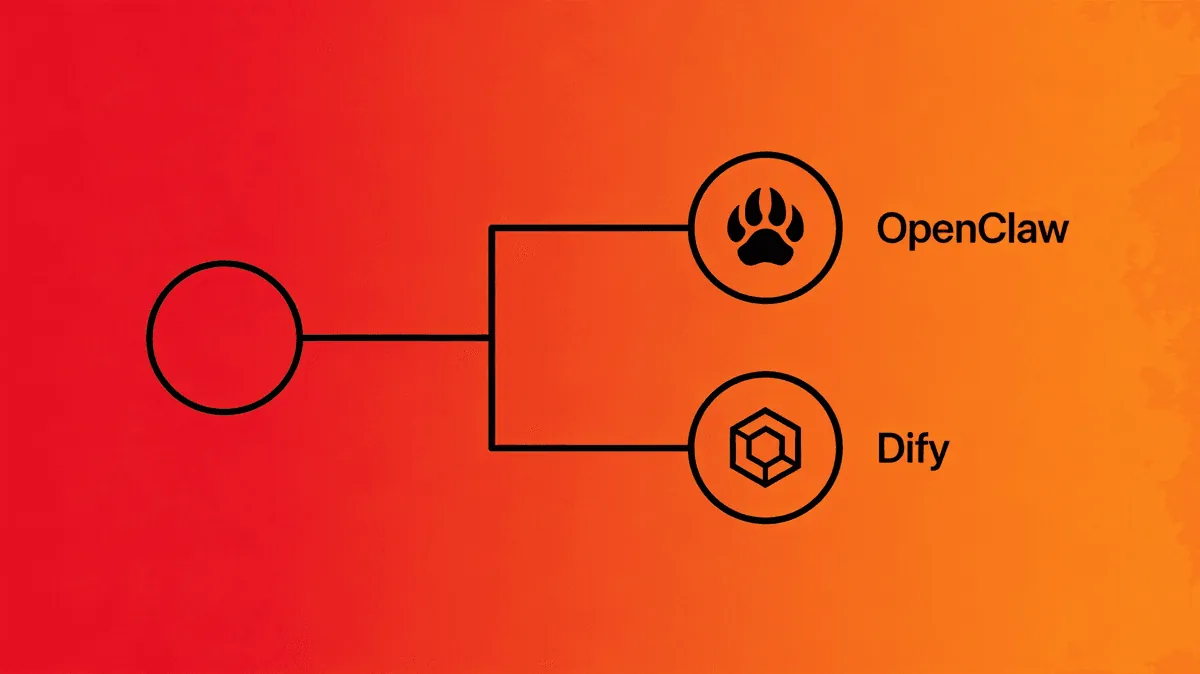
OpenClaw and Dify are not competitors—they are two complementary options for enterprise AI deployment:
- OpenClaw = "The reliable workhorse for AI automation," suitable for scenarios requiring stable, secure, low-cost continuous operation
- Dify = "The innovation workshop for rapid AI app development," suitable for scenarios requiring flexible orchestration and rapid iteration
For most traditional enterprises (manufacturing, retail, logistics, healthcare), OpenClaw is the more pragmatic first choice—get AI "up and running" first, then gradually expand capability boundaries.
Kaihe AIBOX comes with OpenClaw pre-installed, turning enterprise AI deployment from a "lofty concept" into a "plug-and-play" reality.
KaiheAiBox| Agentaibox that lets AI work for you 24/7· OpenClaw Zone