OpenClaw vs Hermes: How to Choose? A Side-by-Side Comparison
📖 Glossary
AI Box (also known as Agent Computer / Agent PC), is a dedicated local hardware device that runs AI Agents. Pre-installed with an AI agent management system, plug-and-play, running 24/7. Users can remotely command AI to work via Discord, Slack, Telegram, WhatsApp, and more.
After choosing a Nizwo device, the biggest dilemma remains: should you use both OpenClaw and Hermes, or just one? This article helps you decide using 6 real-world scenarios.
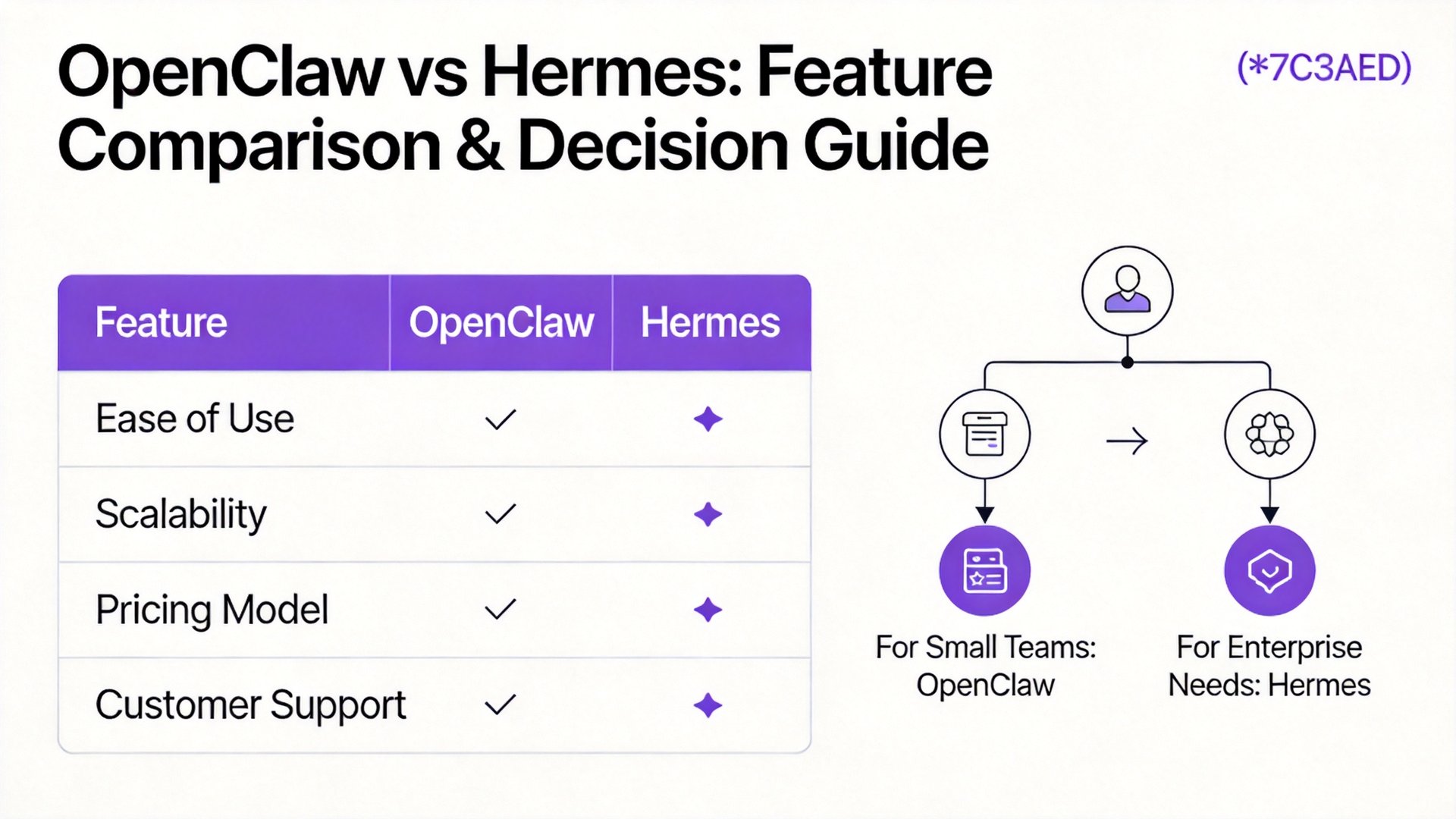
The Bottom Line: How Should 90% of People Choose?
If you're struggling right now, here's a direct answer:
- One person, love to tinker → OpenClaw
- One person, don't want to tinker → Hermes
- Team sharing, need multi-user collaboration → Hermes
- Developer with deep customization needs → OpenClaw
- Enterprise deployment, want plug-and-play → Hermes
- Full control, flexible combination → Use both
But "don't want to tinker" is a bit vague. Let's translate it into concrete scenarios.
Scenario 1: Auto-Organizing Information Every Morning
Need: Before arriving at the office every day, AI automatically organizes missed emails, messages, and system notifications from the night before into a "Today's Focus Summary."
OpenClaw Solution: Combine Cron scheduled tasks + Email Skill + Calendar Skill. Requires configuring scheduling rules, email filters, and summary format templates. Estimated first-time setup: 30-45 minutes.
Hermes Solution: Tell Hermes once: "Every morning at 8 AM, organize all information from the past 12 hours for me, ranked by importance." It will plan the workflow itself and remember the habit. Done in 2 minutes.
Recommendation: If you don't want configuration, choose Hermes. If you enjoy it, choose OpenClaw.
Scenario 2: Writing an Industry Analysis Article
Need: Topic selection → research → analysis → writing → image generation → publishing, full process assistance.
OpenClaw Solution: This is where OpenClaw shines. Through multiple Skill pipelines—web search Skill for material collection, then AI handles analysis and writing, Seedream Skill generates images, and finally publishing Skill pushes to the website. The process is highly customizable with granular control at every step.
Hermes Solution: Tell Hermes, "Help me write a deep analysis article on 2026 AI chip industry trends, with 3 images, publish to the official website." Hermes launches multi-agent collaboration: one agent searches materials, one writes, one coordinates image generation. Equally fully automated, but you don't need to worry about intermediate configuration.
Recommendation: Similar results, different processes. OpenClaw lets you see and control every step; Hermes encapsulates the complexity for you.
Scenario 3: Managing Customer Relationships
Need: Remember each customer's communication history, preferences, and follow-up status. Auto-reminders for who to contact next.
OpenClaw Solution: Requires external CRM Skill integration or self-built recording and retrieval logic. Suitable for scenarios where a mature CRM system already exists and AI is only needed for interface adaptation.
Hermes Solution: Hermes' memory system is naturally suited to this task. It automatically builds "customer profiles," remembers key communication points for each person, and proactively reminds you at the right time.
Recommendation: Hermes' long-term memory mechanism is more natural for managing multi-dimensional interpersonal relationships.
Scenario 4: Data Analysis and Reporting
Need: Connect to company databases, generate analysis reports based on natural language commands.
OpenClaw Solution: Implement through Database Connection Skill + Data Analysis Skill. Suitable for teams with existing databases and SQL query needs. Extremely flexible, can customize various data visualization formats.
Hermes Solution: Equally supports database connections, but Hermes learns your reporting preferences. "Generate weekly sales report every Friday afternoon"—set once, execute forever.
Recommendation: Simple data needs → Hermes for ease. Complex data pipelines → OpenClaw for flexibility.
Scenario 5: Multi-Platform Content Distribution
Need: After writing an article, automatically adapt format and distribute to 6 platforms including WeChat Official Account, Zhihu, Toutiao, Twitter, etc.
OpenClaw Solution: OpenClaw's cross-platform message routing is a natural advantage. It natively supports multi-channel distribution. Combined with Skills, it can achieve "write once, multi-platform format adaptation + auto-publishing." This is one of OpenClaw's core strengths.
Hermes Solution: Hermes also supports multi-platform distribution, but its strength lies in "learning content preferences for each platform"—by analyzing historical data, it automatically adjusts title styles and image strategies to fit different platforms.
Recommendation: Channel coverage → OpenClaw. Content optimization → Hermes.
Scenario 6: Team Knowledge Management
Need: Turn all internal documents, process manuals, and historical project materials into a queryable knowledge base.
OpenClaw Solution: Build a knowledge base through RAG Skill + document processing toolchain. Suitable for teams with the technical capacity to maintain retrieval pipelines.
Hermes Solution: Three steps—import documents → Hermes automatically builds the index → entire team can query. It also automatically discovers relationships between documents and records team members' query patterns to optimize retrieval results.
Recommendation: Small teams → Hermes for plug-and-play. Large teams needing deep customization → OpenClaw.
The Ultimate Solution: Use Both
This is actually the most common real-world choice.
OpenClaw handles the underlying pipeline: message routing, scheduled tasks, automation workflows, third-party service connections.
Hermes handles the upper-level intelligence: self-evolution learning, multi-agent collaboration, personalized interaction, personal preference memory.
The relationship between the two is like an operating system and application software—OpenClaw is the "infrastructure layer" of the AI world, and Hermes is the "intelligent application layer" running on top. They're complementary, not competitive.
And here's the good news: Nizwo's Kaihe A1 and D1 both come with both systems built-in. You don't need to choose between hardware.
Final Advice
If after reading all of this you're still unsure, try this simple decision rule:
Do you care more about the "process" or the "outcome"?
Care about process—enjoy the pleasure of configuration and customization—choose OpenClaw. Care about outcome—want AI to work directly for you—choose Hermes.
Or even simpler: try both. Nizwo has prepared two for you—just use them.
This is the second article in the Hermes column series. Next up: How strong is Hermes' self-evolution capability? A real user data analysis of 30 days of change.