Open-Source LLM Landscape 2026: Who's Leading and Who's Chasing
📖 Glossary
AI Box (also known as Agent Computer / Agent PC), is a dedicated local hardware device that runs AI Agents. Pre-installed with an AI agent management system, plug-and-play, running 24/7. Users can remotely command AI to work via Discord, Slack, Telegram, WhatsApp, and more.
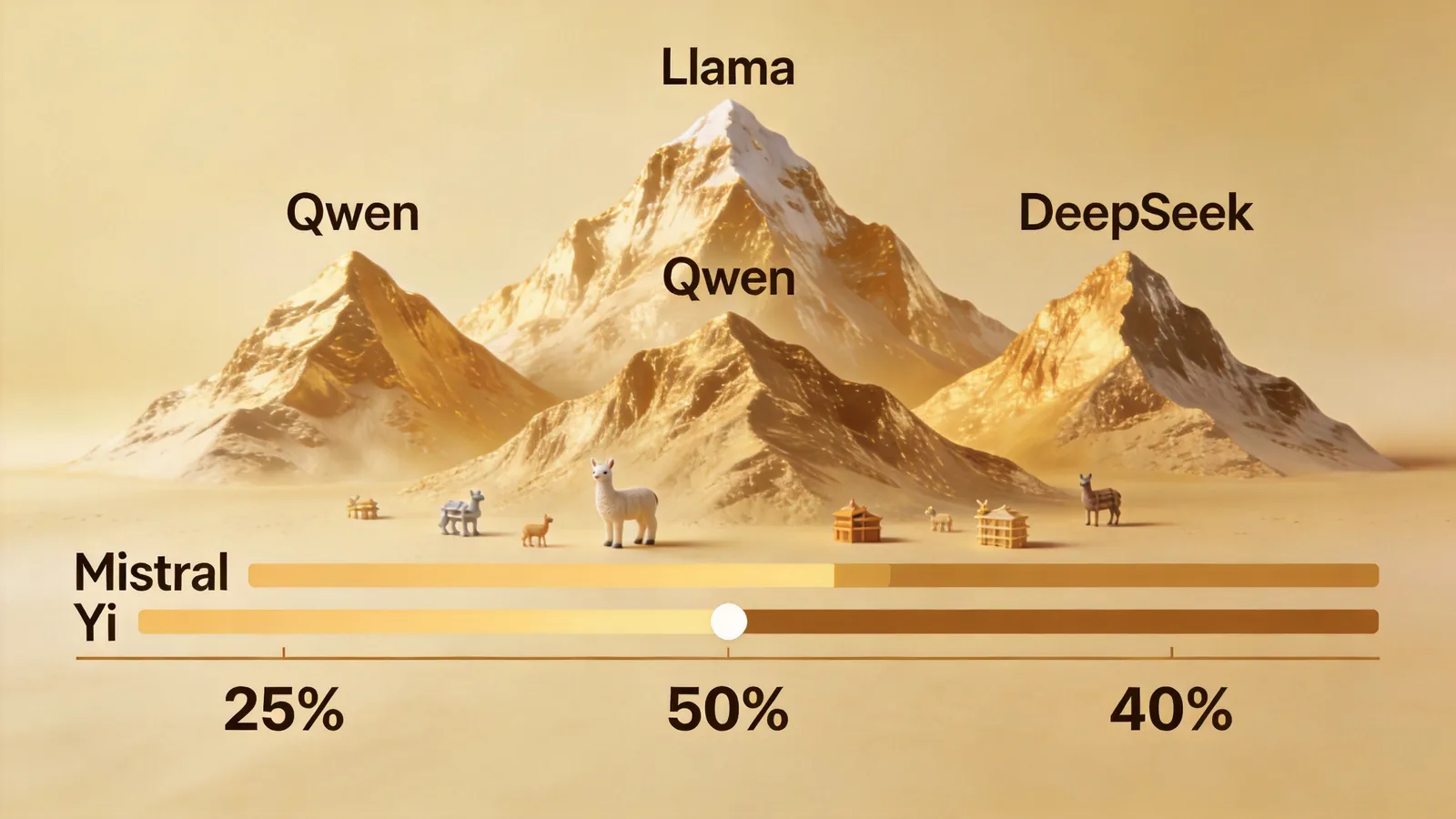
This time last year everyone was asking "when will open-source models catch up to GPT-4." That question is irrelevant now — not because they caught up, but because the entire battlefield shifted.
The Tier 1 lineup: Meta's Llama 4 family, Alibaba's Qwen 3 series, and DeepSeek's V4 series. Three very different strategies. Llama 4 bets on maximum coverage — models from 1B to 400B parameters, the most mature ecosystem and toolchain. Qwen 3 differentiates on Chinese language capability — not just more training data, but genuinely better handling of Chinese reasoning, idioms, and colloquialisms than Llama. DeepSeek V4 is the dark horse — its MoE architecture achieves training costs dramatically lower than comparable competitors. On the price-to-performance axis, it currently has no rival.
Two Tier 2 players worth watching: Mistral Large 3 and 01.AI's Yi-Lightning. Mistral dominates European compliance use cases — GDPR-sensitive clients almost always choose them. The Yi series keeps chasing but always seems half a step behind — the technical specs are solid, but ecosystem and brand awareness lag. My read: it either gets acquired by a major player or finds an irreplaceable position in a vertical like finance or legal.
An underappreciated shift is model miniaturization. Last year, 1B-3B models were toys. This year, the same parameter counts deliver usable long-context understanding and basic reasoning. This means edge deployment no longer requires 7B+ models — phones, laptops, even IoT devices can run a 3B Qwen or Llama for daily conversation and simple tasks.
What this means for KAIHE hardware. Our target users care less about "the strongest model" and more about "what model suits my use case." I break it into three tiers: Entry level (8-16GB RAM) runs 3B-7B models for daily writing and Q&A — perfectly adequate. Intermediate (16-32GB) runs 13B-20B models for code generation and complex reasoning — genuinely useful. Professional (32GB+) runs 70B-class models for deep domain analysis — genuinely powerful. It's not about choosing the biggest model. It's about matching the workload.
One risk to flag. Open-source model iteration is frighteningly fast — Qwen went from v2 to v3 in roughly eight months. The hardware you buy today targets the best current open-source model. Three months from now that model may be obsolete. When selecting hardware, always budget for headroom. Don't buy exactly enough.