This morning, Alibaba dropped a bombshell.
Qwen3.8-Max is officially released. 2.4 trillion parameters. The largest model in Qwen history. Open-sourcing next week.
Those four words — "open-sourcing next week" — are the real story. This is the first time Alibaba has ever open-sourced a Max-tier flagship model. All previous Qwen Max models were closed-source — API access only, no weights. 3.8-Max breaks that pattern.
{http://14.18.124.36:3987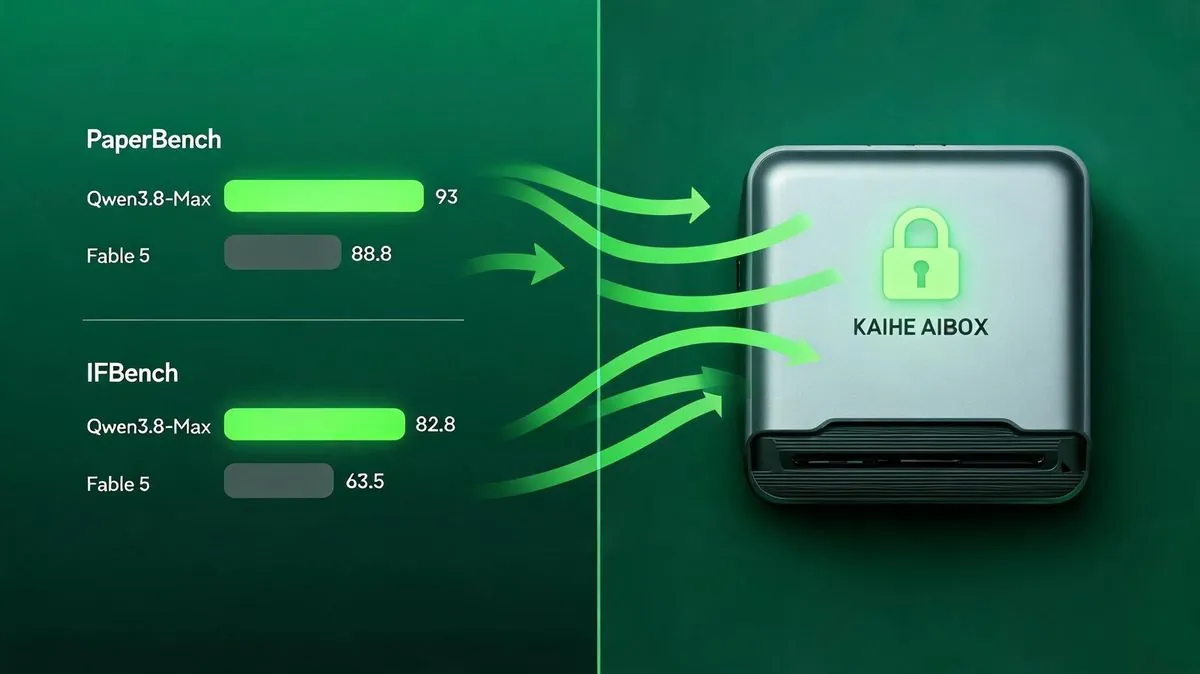 }
}
How Strong Is It Really?
📖 Glossary
AI Box (also known as Agent Computer / Agent PC), is a dedicated local hardware device that runs AI Agents. Pre-installed with an AI agent management system, plug-and-play, running 24/7. Users can remotely command AI to work via Discord, Slack, Telegram, WhatsApp, and more.
The Qwen team released a full benchmark comparison:
| Benchmark | Qwen3.8-Max | Fable 5 | GPT-5.6 Sol |
|---|---|---|---|
| PaperBench | 93.0 | 88.8 | 90.5 |
| IFBench | 82.8 | 63.5 | 72.7 |
| HealthBench | 60.2 | — | 55.3 |
| CoWorkBench | 74.8 | 75.9 | — |
| OSWorld (visual execution) | 86.1 | 85.0 | — |
| AndroidWorld | 85.3 | 88.8 | — |
In one sentence: it surpasses Fable 5 on paper comprehension, instruction-following, and medical knowledge, and essentially matches it on general collaboration and mobile device control. Six months ago, these numbers were exclusive territory for closed-source flagship models. Now a model that will be open-sourced next week is achieving them.
The Most Impressive Part Isn't Benchmarks — It's Autonomous Coding
The Qwen team didn't just release a score table. They let 3.8-Max actually build things, with zero human intervention.
Case 1: From Empty Folder to Production Project. The model created oh-my-cli from scratch, running autonomously for about 16 days, completing 265 commits, 127 PRs, and 151 issues. It integrated user feedback, community practices, and self-testing results into a complete engineering loop — requirement intake, code generation, testing, and validation. The project now has hundreds of stars on GitHub, all written by AI.
Case 2: Replicate and Surpass a Research Paper. The model worked independently for about 125 hours, wrote approximately 7,600 lines of code, executed over 1,100 operations, and ran 33 rounds of GPU training. It fully replicated all six core findings of a research paper on data selection for LLM reasoning. Then it entered a "self-evolution" phase — proposing and testing 18 improvement approaches, ultimately outperforming the original paper's method by 2.7 points on the AIME24 competition-level math benchmark.
Case 3: Beat 87% of Human Teams in 24 Hours. The model entered the WWW2025 Multimodal Conversational Intent Recognition Challenge. Among 526 human teams, after 45 submission iterations, its accuracy climbed from 0.60 to 0.853, defeating 458 teams.
{http://14.18.124.36:3987 }
}
Real-World Office Scenarios: From Lawyer to Structural Engineer
The Qwen team tested 3.8-Max across hundreds of professional scenarios:
- Corporate Compliance Lawyer: Read hundreds of documents in a single pass, flagged 1,284 relevant clauses, completed in one hour. Equivalent work typically takes a legal team about a week.
- UI/UX Designer: Generated an 8-page high-fidelity interactive prototype with zero human revisions.
- Structural Engineer: From a blueprint alone, reconstructed a 30-story building's seismic structural model in a browser — traditionally a week-long task.
- Chip Design: Across 500 rounds of interaction, optimized a cryptographic hardware accelerator from 8,298 gates down to 678, reducing chip area by 81% — from 106×106 µm² to 46×46 µm², wiring length from 33,369 µm to 4,187 µm.
In E-Commerce Bench (a 365-day e-commerce management simulation), 3.8-Max achieved ¥416,252 (4.16x return), beating second-place GLM 5.2 by 38% and improving 152% over the previous Qwen3.7-Max.
Why This Matters to You
Three words: open source + local.
Qwen3.8-Max is available now via the Qwen AI platform API: $2.0/M input tokens, $6.0/M output tokens. It supports both OpenAI-compatible and Anthropic-compatible protocols — direct integration with Claude Code, Codex, Qoder CLI, OpenClaw, and other mainstream development tools.
But the bigger news is next week's open-source release. Weights will be available on Hugging Face and ModelScope.
This means one thing: you can run a Fable 5-class model on your own hardware. No API fees. No data sent to Alibaba Cloud. No sudden pricing changes. The model lives on your hard drive and runs on your machine.
And the Kaihe AIBOX is built precisely for this.
A 24/7 online AI host, under 10W power consumption, with all data stored on local drives. Deploy Qwen3.8-Max on it — run China's strongest open-source model locally, paired with Hermes Agent for task orchestration — and you have a private AI team that actually gets work done.
The model is free and open-source. The AIBOX keeps it online 24/7. Have it write code, make presentations, and analyze data during the day. Let it compile reports, run backtests, and monitor anomalies at night. Your data stays in your hands, never becoming anyone's training set.
How to Get Started
After open-source release next week, three commands to get running:
# 1. Download weights from HuggingFace
# 2. Deploy locally with llama.cpp or vLLM
# 3. Switch model endpoint in Hermes
Deploy on Kaihe AIBOX and it runs even without internet. API pricing comparison: Fable 5 at $10/M input tokens vs Qwen3.8-Max at $2 — one-fifth the cost, with essentially equivalent performance.
For the first time, a Chinese open-source large model has truly reached the world summit.