The Inflection Point: How a Research Team Used KAIHE AIBOX to Turn Data Processing from "Manual Army" to "One-Person Command"
📖 Glossary
AI Box (also known as Agent Computer / Agent PC), is a dedicated local hardware device that runs AI Agents. Pre-installed with an AI agent management system, plug-and-play, running 24/7. Users can remotely command AI to work via Discord, Slack, Telegram, WhatsApp, and more.
A five-person research group at Peking University's College of Environmental Sciences was modeling PM2.5 spatiotemporal distribution across northern Chinese urban clusters. In spring 2026, they hit a data bottleneck.
The data: 100,000 daily air quality records (28 cities × 10 years), 50GB of ERA5 reanalysis in NetCDF, 200GB of satellite AOD in HDF. "Plenty of data, but format chaos," said PhD candidate Wang Haoran. Historically, preprocessing at this scale required one graduate student's full-time effort for two to three months of glue-code scripting.
The Pivot
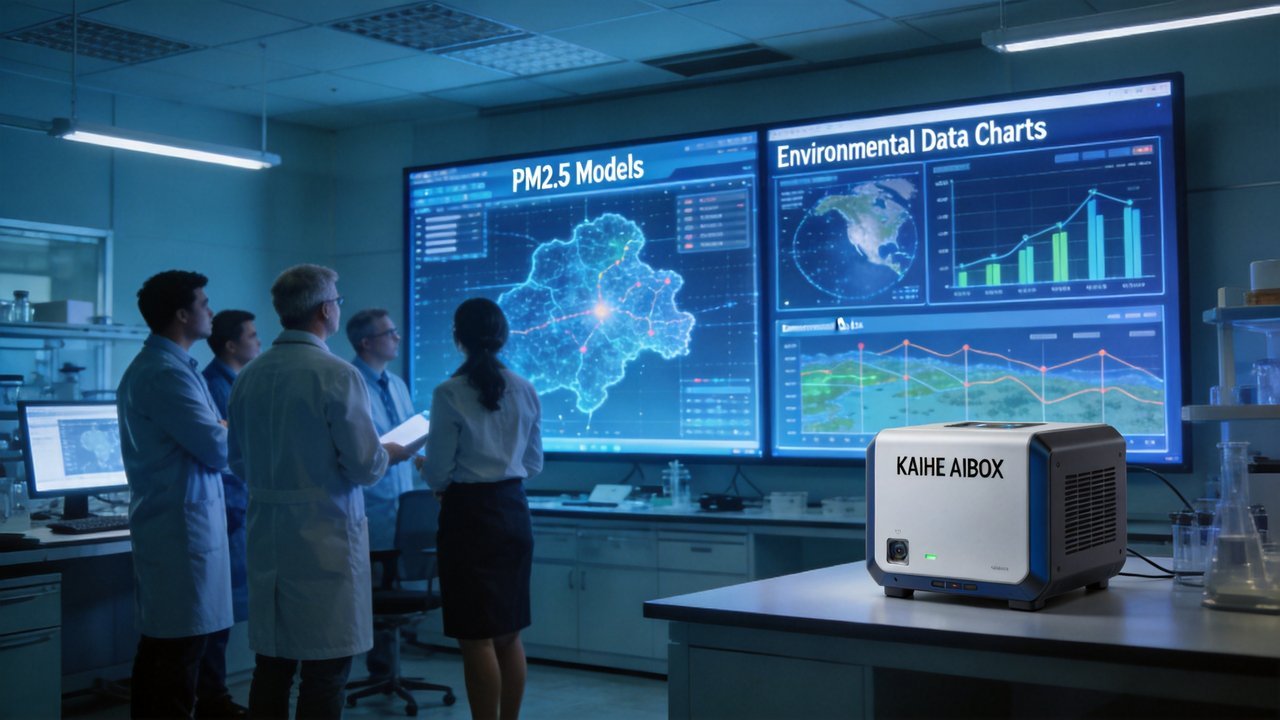
The group's advisor learned about KAIHE AIBOX at a conference. The value proposition hit precisely: local processing, zero data egress, one gateway to multiple models.
Wang's first experiment: feed NetCDF metadata to the model and let it generate complete parsing/cleaning Python scripts. "What took me three days to write and debug became three hours of AI generation plus a half-day of human verification."
The biggest gain came during cleaning. The AI flagged an anomaly pattern invisible to human eye: three consecutive weeks in spring 2018 showed "suspicious uniformity" — 21 cities' PM2.5 readings clustered too tightly, suggesting either a massive pollution event or calibration drift. Manually, this segment would have passed as normal, skewing model accuracy.
Efficiency Comparison
| Stage | Before (manual) | After (AI-assisted) | Gain |
|---|---|---|---|
| Data parsing scripts | 3 days | 3 hours | 8x |
| Anomaly detection & cleaning | 5 days | 1 day | 5x |
| Feature engineering | 7 days | 2 days | 3.5x |
| Hyperparameter search | Manual trial-and-wait | AI suggestions + verify | ~4x |
| Total | ~60 days | ~18 days | 3.3x |
Cascading Impact
The 42 days saved triggered a chain reaction: paper submitted three months early (ahead of a competing group), more time for sensitivity analysis and robustness testing, and two extra months redirected toward expanding the model to national-scale urban clusters.
The advisor's project summary: "AI isn't a substitute for scientific research — it's research's time lever. It freed five students from data labor to focus on what truly demands creativity: proposing new hypotheses, designing new experiments, building new theoretical frameworks."