Solo Developer Migrates from Cloud API to Local AI Box: A Real Migration Log
📖 Glossary
AI Box (also known as Agent Computer / Agent PC), is a dedicated local hardware device that runs AI Agents. Pre-installed with an AI agent management system, plug-and-play, running 24/7. Users can remotely command AI to work via Discord, Slack, Telegram, WhatsApp, and more.
Summary: An indie developer shares the real experience of switching from cloud API to Kaihe AIBOX local deployment. Monthly API bills dropped from 800 RMB to 40 RMB electricity, data fully localized, agents running 24/7 without interruption. Not a tutorial — a real log of what worked and what didn't.
Many solo developers hit the same wall with AI Agents: cloud APIs bill per call, and before you know it, the monthly invoice spirals out of control.
My situation was this: I had built an automation workflow based on Claude API — 200 tasks per day scraping industry news, generating summaries, pushing to Feishu. Functionality was fine. But the monthly bill? Over 800 RMB. For a side project that wasn't making money yet, that hurt.
What made me more uncomfortable was data. Part of my workflow processed user feedback text. I did anonymize, but the fact that data passed through a cloud API was a risk I couldn't fully control. If the API provider changed their privacy terms tomorrow, or a breach happened, I'd be the one holding the bag.
The Math That Changed My Mind
The official store lists the full product lineup. I looked at the numbers: 800 RMB/month on API calls, that's 9,600 RMB/year. Kaihe AIBOX is a one-time hardware purchase, after which the only cost is electricity — about 40 RMB/month for 24/7 operation. Break-even in roughly half a year.
Migration: Smoother Than Expected, But With Pitfalls
Previous architecture: Python scripts + Claude API + Feishu Webhook + GitHub Actions cron. After migration: OpenClaw running on AIBOX + local LLM + WeChat/Feishu message channels + OpenClaw built-in cron.
The architecture actually got simpler. GitHub Actions was no longer needed — OpenClaw has its own cron. Feishu Webhook didn't need separate configuration — OpenClaw natively supports message channel integration.
Migration took about a week. The time wasn't spent on deployment — OpenClaw installation is genuinely simple — but on prompt tuning. Local model output quality does differ from Claude API, especially for structured output and long-context understanding. My solution: run DeepSeek locally as the primary model, with cloud API as fallback for complex tasks via OpenClaw's model routing. This cut API calls by about 80% while keeping quality where it matters.
7×24 Reality Check
This is what I'm most satisfied with. Previously, GitHub Actions free tier had limits, and complex tasks often timed out. The cloud approach also had a hidden cost: you need a server to run the scheduler — cloud functions, a cheap VPS, something. All extra things to maintain.
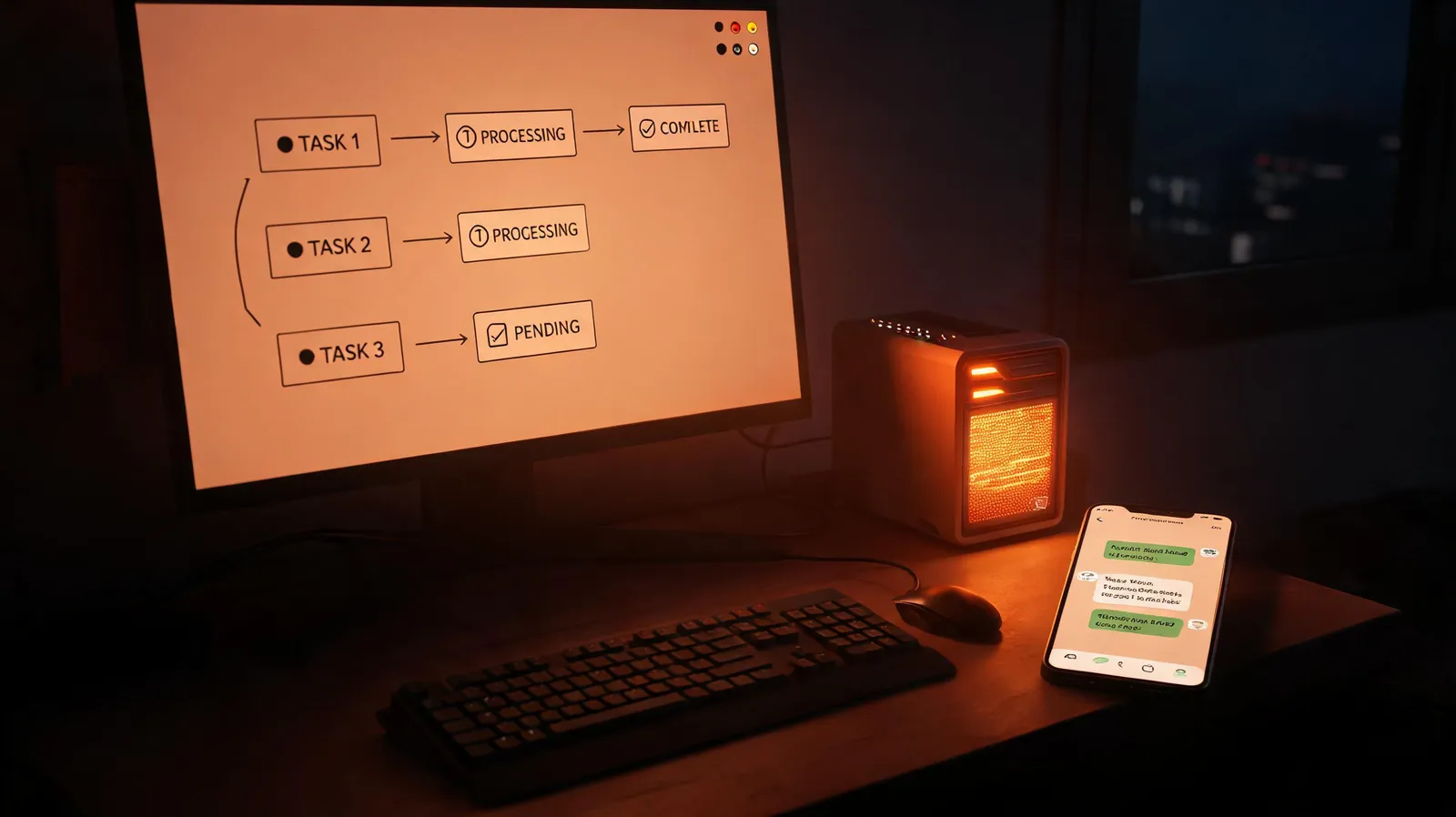
Kaihe AIBOX just runs. Plug it in, and it stays on. OpenClaw's heartbeat mechanism enables periodic self-checks and automatic recovery. My A1 unit has been running for 47 days straight without a restart, executing over 3,000 tasks — daily news scraping, user feedback classification, code review assistance.
One detail that shows the designers understand developers: AIBOX supports WeChat as a message channel. I don't need to open my laptop to check task status — I send a WeChat message to query, adjust parameters, or emergency-stop a task. This is far more convenient than the Feishu Webhook approach, because WeChat is already open on my phone all day.
Pitfalls I Hit
Model selection. Initially I used the largest local model available, but A1's memory couldn't handle it — frequent OOM crashes. Turned out 7B-class models are sufficient for routine tasks. Only deep reasoning tasks need larger models. OpenClaw's model routing feature — automatically selecting models by task type — solved most of this.
Storage. After two months, task logs and intermediate artifacts ate significant disk space. A1 has limited storage and needs periodic cleanup. I wrote an OpenClaw Skill to auto-archive logs older than 30 days to an external drive.
Network. AIBOX runs local models offline, but if your Agent needs external API access (web scraping, search), network stability affects task success rate. My fix: a USB NIC for network redundancy, automatic failover when the primary connection drops.
Cost Breakdown
Cloud approach monthly: API calls ~800 RMB + VPS 60 RMB + GitHub Actions Pro 28 RMB = ~888 RMB/month.
Kaihe AIBOX monthly: Electricity ~40 RMB + occasional cloud API fallback ~50 RMB = ~90 RMB/month.
That's nearly 10x difference. And the gap widens as call volume grows — cloud costs scale linearly, local costs are essentially fixed.

Of course, the upfront investment counts. The hardware itself is a one-time purchase, plus external drive and USB NIC — about 200 RMB in extras. At 800 RMB/month savings, payback period depends on which model you choose.
When NOT to Migrate
If your Agent has low task volume — a dozen or two dozen calls per day — cloud API costs might be lower than electricity. Migration doesn't make economic sense.
If your tasks demand top-tier model quality — legal document analysis, medical text understanding — local models currently can't match that level. Forcing migration would hurt business quality.
If you want zero maintenance — cloud API's biggest advantage is "not your problem." Server down? Not your concern. Local deployment means you handle hardware failures, system updates, model upgrades yourself.
My Recommendation
If you're a solo developer with a working but unaffordable AI Agent project, seriously consider local deployment. My experience: the technical barrier is lower than expected. OpenClaw + Kaihe AIBOX is mature enough for daily use.
Start with one low-frequency task — like a daily news summary — to validate whether local model output quality is acceptable, then gradually migrate other tasks. Don't cut over everything at once.
Model routing is the key feature. Don't try to replace all cloud API calls with one local model. Tier your tasks — routine, quality-insensitive work goes local; critical, quality-sensitive work stays cloud. This saves money without sacrificing core experience.
The risk is the local model capability ceiling. Current 7B-14B class models handle routine tasks adequately, but there's a gap versus Claude Sonnet 4.5. The good news: open-source models iterate fast. Every few months brings new releases, and the ceiling keeps rising.
Further Reading
- Does AI Still Work After You Turn Off Your Computer? Kaihe AIBOX Runs Non-Stop — More 24/7 use cases
- Full Product Selection Guide — Choose the right model for your compute needs