Tencent Can't Sit Still Anymore — Next Month's AI Agent Conference: What Workers Should Do to Prepare
📖 Glossary
AI Box (also known as Agent Computer / Agent PC), is a dedicated local hardware device that runs AI Agents. Pre-installed with an AI agent management system, plug-and-play, running 24/7. Users can remotely command AI to work via Discord, Slack, Telegram, WhatsApp, and more.
Abstract: Tencent has announced an upcoming AI Agent-focused conference, signaling that the internet giant has officially elevated AI agents to a strategic level. From WeChat ecosystem to WeCom, from Tencent Cloud to Tencent AI Lab, Tencent's AI Agent deployment is accelerating across the board. For ordinary workers, this is not just another "big shots having a meeting" news item — it is a clear signal of workplace transformation. This article examines why Tencent is making this move now, what the conference is likely to deliver, and how individuals should position themselves for the AI Agent era.
Why Tencent "Can't Sit Still Anymore"
In May 2026, an internal memo leaked from Tencent: the company formally established an AI Agent Business Unit, led by a former WeChat Business Group Vice President reporting directly to the executive committee. In Tencent's organizational structure, this signals the highest level of strategic priority — the last comparable move was the establishment of the WeChat Pay Business Unit in 2014. Shortly after, Tencent announced it would host its first-ever AI Agent-focused conference next month, inviting developers, enterprise clients, and ecosystem partners.
Tencent is not a latecomer to AI — from AI Lab to the Hunyuan large model, Tencent has been investing in the AI space. But when it comes to AI agents specifically, Tencent's moves have indeed been slower.
The reasons are not hard to understand: Tencent's core business is social networking and content, two areas where AI needs are primarily "assistive" rather than requiring autonomously running agents. But as AI agent application scenarios have expanded from tech circles into the enterprise market, Tencent has discovered:
- WeCom customers are asking "can AI automatically reply to customer messages"
- Tencent Cloud customers are asking "can you help me deploy a 24/7 AI assistant"
- WeChat ecosystem developers are asking "can mini-programs integrate AI agent capabilities"
These demands, when aggregated, represent the market opportunity for AI Agents. Tencent can no longer afford to wait.
The internal pressure is mounting. According to a source familiar with the matter, Tencent's enterprise sales team has received over 2,000 AI Agent-related inquiries in Q1 2026 alone — a 400% increase from the previous quarter. These are not idle curiosity calls; they come with budgets and deployment timelines. The market is pulling Tencent into the AI Agent space whether the company is fully ready or not.
A former Tencent executive put it bluntly in a recent interview: "Tencent missed the first wave of AI agent platforms. The second wave is about enterprise adoption, and Tencent cannot afford to miss this one. The company's entire business model — connecting people and businesses — is fundamentally aligned with what AI agents do. It is a natural extension, not a pivot."
The Competitive Pressure
The deeper reason is competitive dynamics. Since 2025, Baidu's ERNIE Agent Platform has onboarded over 500,000 developers, Alibaba's DingTalk AI assistant covers 3 million enterprise users, and ByteDance's Coze platform has surpassed 1 million daily active users. Tencent is the undisputed king of social networking, but in the AI Agent race, competitors have opened up half a lap. If Tencent does not formally enter now, once user habits solidify, the cost of being a latecomer will far exceed the investment of being first.
Industry sources close to Tencent revealed that the conference will host over 1,000 attendees at Tencent's Seafront Towers in Shenzhen, with a two-day agenda — Day 1 focused on developers (technical platform and toolchain announcements), Day 2 focused on enterprise clients (industry solution showcases). This dual-track "technology + business" design signals that Tencent is not "testing the waters" — it is going all in.
What Signals the Conference Might Release
Based on industry analysis and Tencent's recent moves, this AI Agent conference may release the following signals:
WeCom + AI Agent
WeCom is the most natural landing point for AI agents. With 300 million WeCom users generating massive customer service, approval, and collaboration needs daily, if Tencent can natively integrate AI Agent capabilities into WeCom, it would be the ultimate killer feature. Imagine: every WeCom workspace gets a built-in AI agent that handles routine inquiries, drafts responses, manages approval workflows, and generates meeting summaries — all without requiring any technical setup.
Tencent Cloud Agent Service
Benchmarking AWS's Bedrock Agent and Microsoft's Copilot Studio, Tencent Cloud may launch a one-stop AI Agent deployment platform, lowering the barrier to enterprise adoption. This would include visual agent builders, pre-built templates for common business scenarios, and managed infrastructure for running agents at scale.
Technical Architecture Preview: Based on industry sources and Tencent's patent filings, the likely architecture follows a three-tier model: (1) Agent Orchestration Layer — a visual workflow builder where users drag and drop agent components; (2) Model Routing Layer — an intelligent router selecting optimal models for each step, balancing cost and quality; (3) Integration Layer — pre-built connectors for WeCom, Feishu, DingTalk, Salesforce, and major Chinese ERP systems. Custom connectors via configuration, no code required.
The target: reduce deployment from the current industry average of 4-8 weeks to 24 hours for standard use cases. If achieved, this 5-10x speed improvement would be a compelling advantage for enterprises that need to move fast.
WeChat Ecosystem Opening
Allowing mini-programs and official accounts to integrate AI Agent capabilities would bring a new wave of entrepreneurial opportunities to the WeChat developer ecosystem. WeChat has over 1.3 billion monthly active users — even a tiny fraction adopting AI-powered services would create a massive market.
What WeCom AI Agents Mean for SaaS Companies: The WeCom integration poses an existential question for SaaS companies currently selling standalone AI agent tools. If WeCom offers comparable functionality natively — with the advantage of zero integration effort and lower cost — many enterprises will choose the path of least resistance. This is exactly what happened with WeCom's built-in attendance, approval, and reporting features, which replaced dozens of standalone SaaS products. SaaS companies in the AI Agent space have two options: differentiate on depth (offering capabilities that WeCom cannot match) or integrate (becoming the premium option within WeCom's ecosystem). Companies that try to compete head-to-head with a free or cheap WeCom offering will lose. Companies that position themselves as specialized, high-performance alternatives — or as the professional tier above WeCom's standard offering — may thrive alongside Tencent rather than being crushed by it.
Hunyuan Model Upgrade
To support AI agents' autonomous reasoning capabilities, the Hunyuan model may receive targeted optimizations in long context (potentially 256K+ tokens), tool invocation (function calling with structured outputs), and multi-step reasoning (chain-of-thought with self-verification).
Hunyuan Model Upgrade: Technical Deep Dive
The Hunyuan model upgrade deserves special attention because it reveals Tencent's technical strategy. Current industry benchmarks show that Hunyuan lags behind GPT-4 and Claude 3.5 in general reasoning, but excels in Chinese language tasks and multi-modal understanding. For AI agents, the key capabilities are different from general chatbot performance:
- Function Calling Accuracy: Hunyuan currently achieves 87% accuracy on structured function calls, compared to 94% for GPT-4. The upgrade targets 92%+, which would make it competitive for enterprise agent deployment.
- Long Context Window: Current Hunyuan supports 128K tokens. The upgrade is expected to push this to 256K+, enabling agents to maintain context over longer, more complex workflows.
- Multi-Step Reasoning: The biggest gap. Hunyuan's chain-of-thought performance on 5+ step reasoning tasks is 23% below GPT-4. Tencent is reportedly investing heavily in this area, with a dedicated research team working on reasoning-specific optimizations.
- Latency Reduction: For real-time agent interactions, response latency must be under 500ms. Hunyuan currently averages 800ms for complex queries. The upgrade includes inference optimization that could cut this to 400ms.
These technical improvements are not academic — they directly determine whether AI agents built on Hunyuan can handle real enterprise workloads or remain demo-quality toys.
The Enterprise WeChat Integration: A Game Changer
Of all the potential announcements, the one with the most immediate business impact is WeCom's native AI Agent integration. WeCom currently serves over 10 million enterprises and 600 million users. If every WeCom customer suddenly had access to AI agents — without needing to purchase separate software, hire AI engineers, or learn new interfaces — the adoption curve would be vertical.
Consider the use cases that become trivial with WeCom-integrated agents: - Automated meeting scheduling: The agent reads calendar availability, proposes times, handles timezone conversions, and sends invites — all within WeCom - Intelligent document routing: The agent reads incoming documents, classifies them by type and urgency, routes them to the appropriate person, and follows up on deadlines - Expense report processing: The agent extracts receipt data, validates against company policy, routes for approval, and syncs with accounting systems - Customer inquiry triage: The agent categorizes incoming customer messages, drafts responses for common questions, and escalates complex issues with full context
Each of these is a standalone product today, costing 5,000-50,000 RMB/year. Bundled into WeCom at no additional cost (or a modest premium), they would become the default choice for the 10 million enterprises already on the platform. This is the Tencent playbook: embed essential capabilities into an already-ubiquitous platform, making switching costs prohibitive.
Industry Solutions
Out-of-the-box AI Agent templates for high-frequency scenarios like customer service, marketing, and data analysis. These would be vertical-specific — a customer service agent for e-commerce, a compliance agent for financial services, a recruitment agent for HR. for customer service, marketing, and data analysis. These pre-configured agents allow enterprises to go from zero to deployed in hours, not weeks. Expected templates include: customer inquiry triage agent, social media monitoring agent, report generation agent, compliance checking agent, and HR screening agent. Each template is customizable — enterprises can adjust workflows, add domain-specific knowledge, and fine-tune behavior without writing code.
Investment and Acquisition Signals
Following Tencent's historical playbook in gaming and social, strategic investments or acquisitions to quickly fill AI Agent infrastructure gaps are likely. Over 200 AI Agent startups exist in China alone — expect 1-2 strategic investments announced around the conference.
The most likely acquisition targets fall into three categories: companies with mature agent orchestration technology, companies with deep enterprise customer relationships in vertical industries, and companies with specialized domain models that complement Hunyuan's general capabilities. Tencent's investment arm has been unusually quiet in the AI Agent space compared to its aggressive moves in gaming and social — this conference may mark the end of that silence.
Developer Incentive Program
To rapidly build an ecosystem, Tencent may launch an Agent developer revenue-sharing plan — similar to the traffic monetization mechanism for Mini Programs, allowing developers to earn money selling Agent capabilities within Tencent's ecosystem. This approach was highly effective in driving the Mini Program ecosystem boom in 2017, and will likely be replicated for AI Agents.
The potential scale is staggering. Mini Program developers earned over 10 billion RMB in 2025. If Agent developers can capture even a fraction of this, it will attract significant talent and capital into Tencent's AI Agent ecosystem. The key question is whether Tencent will offer more generous terms than competitors to accelerate adoption — early signals suggest they might, given their latecomer position.
Global Expansion Ambitions
While primarily focused on the domestic market, Tencent may also signal its intention to compete globally in AI Agent infrastructure. Tencent Cloud International already operates in 27 regions worldwide, and an Agent-as-a-Service offering would give it a differentiated product in markets where AWS and Azure currently dominate. This global angle would not be the headline of the conference but could appear as a roadmap item.
What This Means for Workers
Tencent's entry means AI Agents are no longer "tech circle self-congratulation" but are about to become mainstream tools. This is like when Mini Programs launched in 2017 — many people thought "it is just a lightweight app" — now Mini Programs support millions of developers.
But AI Agents' impact will be far more disruptive than Mini Programs. Mini Programs changed "service delivery" — from downloading apps to instant access. AI Agents change "work execution" — from humans doing to AI doing. The former improved experience; the latter redefines productivity.
A concrete comparison: in 2017, learning to build Mini Programs might boost your efficiency by 20%. In 2026, learning to manage AI Agents could boost your efficiency by 500%. This is not hyperbole — one person orchestrating 10 AI agents can produce output equivalent to a 10-person team.
Your company will soon ask you "can we use AI for this": Not in the distant future, but within the next 6-12 months. Tencent's entry will accelerate enterprise AI Agent adoption by 3-5x.
Your competitors are already using it: Those who deployed AI agents early have 5-10x the efficiency. Not because they are smarter, but because they acted sooner. One e-commerce company that replaced 80% of its customer service staff with AI agents reduced first-response time from 45 seconds to 2 seconds and actually improved customer satisfaction by 12 percentage points.
New positions are emerging: AI Agent operations, AI workflow design, AI effectiveness evaluation — these positions are not yet on job boards, but they soon will be.
Industry shakeout will accelerate: Tencent's entry means AI Agent deployment costs will plummet. Previously, deploying a custom AI Agent required hiring a tech firm at 50,000-100,000 RMB. Within Tencent's ecosystem, it may become "select template — fill in parameters — launch" at a cost of a few hundred RMB or even free. Lower barriers = intensified competition = non-adopters get eliminated.
The Tencent effect on pricing: When Tencent enters a market, prices drop across the board. We saw this with cloud computing (Tencent Cloud's aggressive pricing forced industry-wide reductions), mobile payments (WeChat Pay's zero-fee strategy for small merchants), and video streaming. The same will happen with AI Agent deployment — Tencent's scale and willingness to subsidize for market share will make AI Agent tools dramatically cheaper, accelerating adoption but also compressing margins for Agent tooling companies.
The Second-Order Effects
Beyond direct workplace impact, Tencent's entry into AI Agents will trigger second-order effects that are easy to overlook:
Educational curriculum changes: As AI Agent management becomes a core skill, universities and training programs will need to adapt. Expect "AI Agent Operations" courses to appear in business schools within 12-18 months.
Regulatory attention: When a company with 1.3 billion users launches AI Agent capabilities, regulators will take notice. Data privacy, algorithmic accountability, and consumer protection regulations specific to AI agents are likely to accelerate.
Investment reallocation: Venture capital currently spread across 200+ AI Agent startups will consolidate toward platforms integrated with major ecosystems (Tencent, Baidu, Alibaba). Standalone Agent tooling companies without clear ecosystem partnerships will face existential challenges.
The Freelancer and Solopreneur Opportunity
While most analysis focuses on enterprise employees, freelancers and solopreneurs may actually benefit the most from Tencent's AI Agent ecosystem. These individuals already operate as one-person departments — they handle sales, marketing, delivery, and administration single-handedly. AI agents can multiply their capacity without requiring them to hire employees.
A freelance graphic designer, for example, could deploy AI agents to: generate initial design concepts based on client briefs, handle client communication and project management, track invoices and follow up on late payments, and monitor social media for new project opportunities. Each of these tasks currently consumes 30-60 minutes daily — time that could be redirected to creative work.
The economic math for freelancers is even more compelling than for enterprises. A freelancer earning 200 RMB/hour who saves 3 hours daily through AI agents gains 60,000 RMB in additional annual earning capacity — against an AI agent cost of perhaps 10,000-20,000 RMB/year. The 3-6x ROI makes adoption a no-brainer.
The Small Business Opportunity
While much of the discussion around Tencent's AI Agent conference focuses on enterprise customers, the real sleeper opportunity is for small businesses. Tencent's ecosystem uniquely reaches small businesses through WeChat — 50 million small merchants already use WeChat Pay. If Tencent can package AI Agent capabilities into a WeChat Mini Program that any shop owner can use, the market size becomes staggering.
Imagine a noodle shop owner who can deploy an AI agent that: automatically responds to customer inquiries on WeChat, tracks inventory and generates purchase orders, analyzes sales patterns and recommends menu adjustments, and manages delivery orders across multiple platforms. Today, this requires hiring a part-time manager or struggling alone. With a Tencent AI Agent, it becomes a 5-minute setup.
The economic impact of small business AI adoption would be enormous. China has approximately 100 million small businesses. If even 10% adopt AI agent capabilities within 3 years, that is 10 million new users — a market that no other AI Agent platform currently serves effectively.
The Developer Ecosystem Dynamics
Tencent's developer ecosystem strategy will be critical. The key question is whether Tencent will build a closed ecosystem (like Apple's App Store) or an open one (like Android). The answer will determine how quickly the AI Agent ecosystem grows and how much innovation it attracts.
Signals from Tencent's recent moves suggest a hybrid approach: a curated marketplace for enterprise-grade agents (with quality guarantees and liability frameworks) alongside an open sandbox for experimental agents. This dual-track model balances safety with innovation — enterprises get reliability, developers get creative freedom.
For developers, the financial opportunity is significant. If Tencent follows the Mini Program revenue model, top-performing agent developers could earn millions annually. The top 100 Mini Program developers earned over 5 billion RMB in aggregate in 2025. Agent developers could match or exceed this, given that agents deliver more direct business value than Mini Programs.
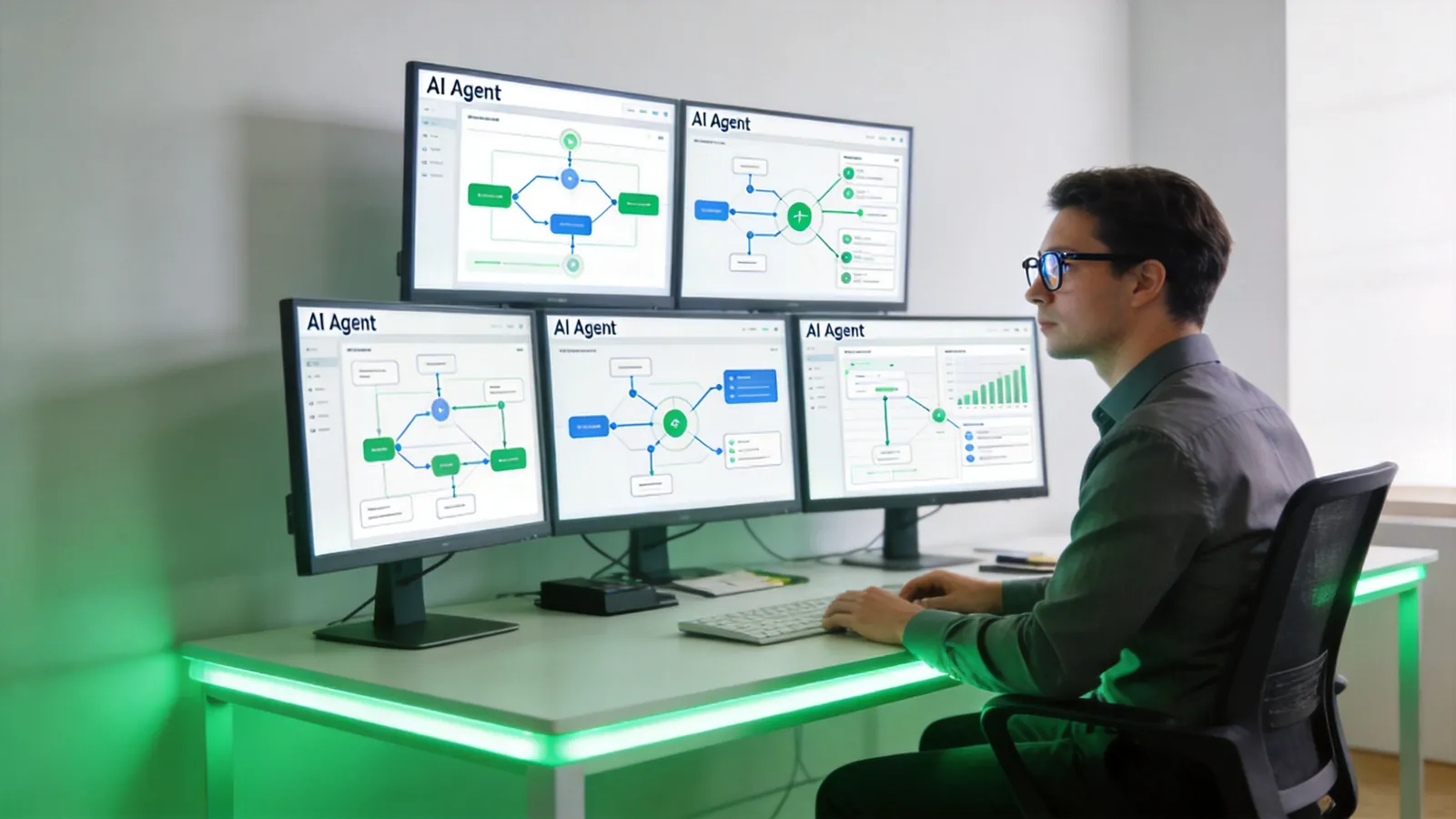
5 Things You Can Start Preparing Now
You do not need to wait for the technology to mature. You can start preparing today:
The 80/20 Framework for AI Readiness
Before diving into specific preparation steps, it helps to adopt the 80/20 framework: 80% of the value from AI agents comes from 20% of possible use cases. Do not try to automate everything at once. Identify the highest-impact, lowest-complexity workflows in your daily work and start there.
Most knowledge workers discover that 2-3 workflows account for 60% of their repetitive work. For a marketing manager, these might be: weekly report generation, social media content scheduling, and competitor monitoring. Each of these can be partially automated with AI agents within a week of setup. The cumulative time savings from just these three workflows can exceed 10 hours per week.
The mistake most people make is trying to build the perfect AI system from day one. Start ugly. Start small. Get something running, learn from it, and iterate. The best AI agent workflow is the one you actually use, not the one you theoretically designed.
1. Learn to Talk to an AI Agent: Not chat-style conversation, but "goal-oriented" conversation. Instead of saying "help me write some copy," say "you are a Xiaohongshu operations expert. Please write 3 product seeding posts, 800 words each, in a lifestyle-oriented tone." The more specific your objective, the higher the AI output quality. The most common beginner mistake is giving AI vague instructions and then complaining that AI is not capable enough.
2. Understand AI Agent Capability Boundaries: AI agents excel at tasks with clear rules and decomposable workflows — data processing, content generation, customer response, report analysis. They struggle with scenarios requiring creative leaps, interpersonal judgment, and moral decisions — brand strategy, crisis communication, team leadership. The ability to judge "what should go to AI vs. what must stay with humans" will be the most valuable skill over the next three years.
3. Try at Least 2-3 AI Agent Tools: OpenClaw (open-source agent framework with rich Skill ecosystem), Coze (by ByteDance, visual builder), and Dify (low-code Agent platform) are all good starting points. You do not need to master them, but you need to know "so this is how AI agents work." Spend at least 2 hours on each tool running a complete task workflow — not just clicking around.
4. Audit Your Workflow for Automation Potential: List everything you do daily and mark which tasks are repetitive and rule-defined — those are the parts AI agents can take over. A practical method: keep a work log for one week, then use a red-yellow-green system — red = highly repetitive and automatable, yellow = partially automatable, green = must be done by humans. Red and yellow combined typically account for 60-70% of daily work.
5. Build Your Personal AI Toolchain: Do not wait for your company to deploy AI uniformly. Start from personal efficiency and build your own AI workflow — use OpenClaw for content production, AI for data analysis, and automation tools for routine approvals. This toolchain is your future competitive moat.
6. Build Cross-Functional AI Literacy: The biggest barrier to AI agent adoption in enterprises is not technology — it is organizational resistance. Department heads who do not understand AI agents will resist deployment, fearing obsolescence. The solution: organize cross-functional AI literacy workshops where every department head experiences hands-on AI agent management. One financial services company made this mandatory and saw AI adoption rates jump from 12% to 67% within one quarter.
7. Establish AI Governance Frameworks: Before deploying agents at scale, establish clear rules: what decisions can agents make autonomously, what requires human approval, how are agent errors handled, and who is accountable. Companies that skip this step face costly compliance issues later. A healthcare company that deployed patient-facing AI agents without governance protocols was fined 2 million RMB for unauthorized data processing — an entirely avoidable outcome with proper frameworks.
8. Create Internal AI Agent Champions: Identify 2-3 early adopters in each department and give them extra training, resources, and recognition. These champions become internal evangelists who drive grassroots adoption far more effectively than top-down mandates. One manufacturing company offered a 5,000 RMB quarterly bonus to department AI champions and achieved 80% adoption within 6 months.
The Enterprise Adoption Curve: What History Teaches Us
Tencent's entry into AI Agents mirrors a pattern we have seen repeatedly in enterprise technology adoption. Understanding this pattern helps predict what comes next.
The Three Phases of Enterprise Tech Adoption
Phase 1: Experimentation (2023-2025) — Early adopters and tech companies experiment with AI agents. Most deployments are small-scale, department-level pilots. Failure rate is high because the technology is immature and best practices are undefined. This is where we were when companies like OpenAI launched their agent frameworks.
Phase 2: Platformization (2026-2027) — Major platforms (Tencent, Baidu, Alibaba, international players) launch agent ecosystems. Deployment costs plummet. Best practices emerge. Failure rate drops significantly. This is the phase Tencent's conference signals — the beginning of mainstream accessibility.
Phase 3: Infrastructure (2028-2030) — AI agents become as ubiquitous as email and spreadsheets. Not having an AI agent strategy is like not having an email strategy in 2005. The technology recedes into the background; what matters is how you use it.
We are at the beginning of Phase 2. Tencent's entry is the clearest signal yet that the transition from experimentation to platformization is underway. For enterprises, this means the window for competitive advantage through early adoption is closing — not because it is too late to start, but because starting will soon become table stakes rather than a differentiator.
What the Cloud Computing Analogy Teaches
The closest historical analogy is cloud computing. In 2010, having a cloud strategy was a competitive advantage. By 2016, it was a necessity. By 2020, companies without cloud infrastructure were dinosaurs. The AI Agent timeline will be compressed: competitive advantage in 2025, necessity by 2027, existential requirement by 2029.
Agent Computing: The Infrastructure After Tencent's Entry
Tencent builds software and platforms, but AI agents still need somewhere to run. The cloud is convenient, but has latency, privacy, and cost issues. Local operation is a necessity for many enterprises, especially those with data security requirements.
The KaiheAiBox Agent Computer is designed for this need: 24/7 local operation, web interface management, WeChat QR code binding, enter an API Key and start using. For non-technical users, this is the simplest AI Agent runtime solution.
When Tencent builds the AI Agent software ecosystem and KaiheAiBox provides the hardware foundation — users only need "select agents on Tencent Cloud + run agents locally on KaiheAiBox" to achieve a hybrid architecture of cloud inference and local execution, balancing efficiency and privacy.
The Pricing Question
One of the most frequently asked questions about Agent Computing is: "Why buy a dedicated device when I can run AI agents on my existing computer?" The answer has three parts:
-
Reliability: Your main computer gets restarted, updated, and occasionally crashes. An Agent Computer runs 24/7 with enterprise-grade stability. For business-critical agents (customer service, monitoring, trading), downtime equals lost revenue.
-
Isolation: Running AI agents on your work computer creates security risks. Agents with API keys and data access running alongside your browsing, email, and other applications is a recipe for data leakage. An Agent Computer provides physical isolation — the same principle as keeping your work computer and personal computer separate.
-
Performance: AI agents running in the background of a busy computer compete for resources with your other applications. An Agent Computer dedicates all its resources to agent workloads, ensuring consistent performance even during peak usage.
The pricing math is straightforward: a KaiheAiBox costs roughly equivalent to 1-2 months of a single employee's salary. If it enables you to manage AI agents that handle work equivalent to 5 employees, the payback period is measured in weeks, not years.
The Local-First Advantage in Regulated Industries
For industries with strict data residency requirements — healthcare, finance, government — the ability to run AI agents locally is not a nice-to-have but a must-have. Regulations like China's Data Security Law and Personal Information Protection Law require that certain categories of data never leave the organization's premises.
Cloud-based AI agents, by their nature, transmit data to external servers for processing. Even with encryption and contractual safeguards, this creates compliance risk. Agent Computing solves this elegantly: the agent runs locally, only the inference request (stripped of personally identifiable information) goes to the cloud, and the result is processed locally.
A hospital network in Guangdong deployed this architecture for patient record analysis. The AI agent processes all data locally on the Agent Computer, using cloud inference only for complex medical reasoning. Patient data never leaves the hospital's network, satisfying regulatory requirements while still leveraging state-of-the-art AI capabilities. The compliance team approved the deployment in 2 weeks — a process that had stalled for 8 months with cloud-only solutions.
The Complementary Partnership
This "Tencent ecosystem + KaiheAiBox hardware" combination is particularly noteworthy. Tencent excels at software and platforms but lacks hardware support for local deployment, edge computing, and physical isolation — all enterprise-level necessities. KaiheAiBox's ARM-based low-power design fills precisely this gap. For industries with stringent data compliance requirements — finance, healthcare, government — the "Tencent Agent capability + KaiheAiBox local runtime" combination may be the most pragmatic choice.
The Bigger Picture
From a macro perspective, Tencent's entry validates a key judgment: AI Agents are not a passing trend but an infrastructure-level transformation akin to cloud computing. When Tencent fully embraced cloud computing in 2014, it took 12 years for cloud to become standard infrastructure for all enterprises. The AI Agent story will likely repeat — with the critical difference that adoption speed will be significantly faster.
The reason is simple: cloud computing required companies to migrate entire systems, a multi-year endeavor. AI Agent adoption can start at the department or even individual level. You do not need to replace your entire IT infrastructure — you just need to start using AI agents for specific workflows. The adoption friction is orders of magnitude lower.
Lessons from Tencent's History
Tencent has a pattern of late entry followed by market dominance. They were late to social networking (after Renren and Kaixin001) but won with WeChat. They were late to mobile payments (after Alipay had 80% market share) but now split the market with WeChat Pay. They were late to cloud computing (after Alibaba Cloud had a 5-year head start) but grew Tencent Cloud to the #2 position.
Each time, the strategy was the same: leverage their massive user base and social graph to distribute the new capability at unprecedented scale. AI Agents are likely to follow the same playbook — the question is not whether Tencent will catch up, but how quickly.
What to Watch After the Conference
The conference itself is just the starting gun. What matters more is what happens in the 90 days following it: Which products actually ship? Which enterprise clients sign on? How fast does the developer ecosystem grow? History suggests that Tencent's execution speed post-announcement is as important as the announcements themselves.
Key metrics to watch: monthly active agents on Tencent's platform, number of enterprise clients using Agent capabilities in WeCom, developer registrations for the Agent SDK, and revenue generated through the Agent marketplace. These numbers will tell you whether Tencent's AI Agent strategy is gaining real traction or just generating hype.
Looking Ahead: The Next 12 Months
The 12 months following Tencent's AI Agent conference will be pivotal. Here are the key milestones to watch:
Month 1-3: WeCom AI Agent beta launches. Expect 10,000+ enterprise signups in the first week. The quality of the beta experience will determine whether early adopters become advocates or detractors.
Month 4-6: Tencent Cloud Agent Service enters general availability. This is when the developer ecosystem begins to form. Watch the number of third-party agent templates — if it exceeds 1,000 within 6 months, the ecosystem is healthy.
Month 7-9: WeChat Mini Program AI integration pilots. This is the wildcard — if WeChat opens AI agent capabilities to Mini Programs, the addressable market expands from 10 million enterprises to 1.3 billion consumers.
Month 10-12: Competitive response. Baidu, Alibaba, and ByteDance will not sit still. Expect counter-announcements, price wars, and feature races. The ultimate beneficiary will be the consumer — competition drives innovation and reduces costs.
For workers and businesses, the strategy is clear: start preparing now, not after the conference. The organizations that begin building AI agent capabilities today will have a 6-12 month head start when Tencent's ecosystem reaches critical mass. In a market where competitive advantages erode quickly, that head start may be the difference between leading and following.
Big tech entry is not the end — it is the beginning. When even Tencent is pushing AI Agents, hesitating about whether to learn means you are already behind.
KaiheAiBox · AI Agent Tracking