What Is an AI Agent? From "Delivery Rider" to "Digital Employee" in Three Minutes
📖 Glossary
AI Box (also known as Agent Computer / Agent PC), is a dedicated local hardware device that runs AI Agents. Pre-installed with an AI agent management system, plug-and-play, running 24/7. Users can remotely command AI to work via Discord, Slack, Telegram, WhatsApp, and more.
If there's only one new AI concept you learn in 2026, make it AI Agents. It's not an algorithm, not a model, not even a product—it's an entirely new way of working. But everything you've heard about it is either too technical or too marketing-heavy. Here, we'll use the simplest possible analogy to explain it clearly enough that you can explain it to friends over dinner.
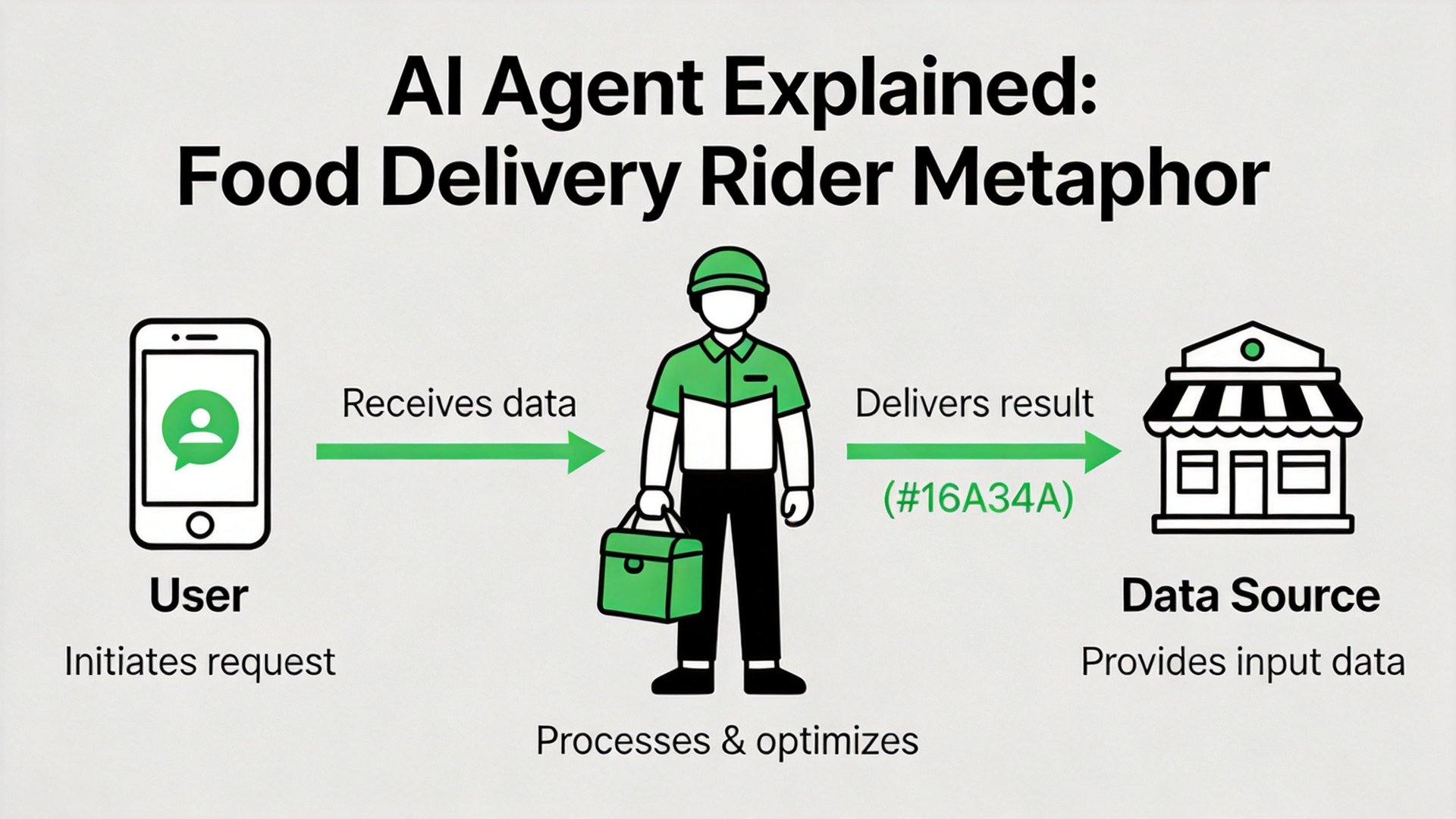
The Delivery Rider as a Perfect Demonstration
Let's say you're hungry at noon, and you open a food delivery app to place an order. What happens next?
A rider accepts the order. First, they understand the task—where the restaurant is, where the delivery address is, what the time limit is. Then they plan—go to the restaurant first, use navigation to avoid traffic, find the right building when arriving at the complex. Next, they execute—ride to the restaurant, wait for the food, pick it up, ride to the complex, go upstairs, knock on the door. Finally, they confirm the result—food delivered, you tap confirm, mission complete.
There's a complete behavioral pattern here: perceive environmental information (order details, traffic conditions, building layout), formulate an execution plan (what to do first and next, which route is faster), use tools to complete the task (electric bike, phone navigation, elevator), and adjust next steps based on results (detour if there's traffic, call if they can't reach you).
What an AI agent does is essentially the same thing. Except it has no physical body—its "eyes" are API interfaces and data streams, its "brain" is a large language model, its "hands and feet" are various software tools it can call. But the behavioral pattern? Exactly like a delivery rider.
Three Core Capabilities, All Essential
An AI agent isn't just a chatty AI. Chatting is one of its basic capabilities, just like speaking is one of many human capabilities. A true AI agent must have three core capabilities.
First is perception. An agent needs to know what environment it's in and what information exists in that environment. For digital-world agents, perception means reading your emails, querying databases, browsing web pages, receiving API callbacks. It can "see" far more than you might imagine.
Second is planning. This is the most fundamental difference between agents and chatbots. A chatbot answers one question at a time—each conversation round is independent. An AI agent, when given a task, breaks it down itself—how many smaller steps does this big goal require? Which comes first, which comes later? If an intermediate step fails, what backup plan triggers? This "figure out steps and methods" capability is what large language models have gradually gained through chain-of-thought reasoning and related techniques. It's also the core value proposition of agents.
Third is action. Thinking doesn't count—acting does. Here "acting" means calling tools—sending emails, checking calendars, writing files, calling APIs, controlling browsers, operating IoT devices. An agent's tool-calling capability determines its ceiling. To use a comparison, a person's capability largely depends on how many tools they can use—someone who can drive versus someone who can't has a vastly different travel radius. Same with agents.
The Line Between Agents and Chatbots
This might be the most easily confused aspect. A chatbot responds to whatever you say, its only output is text. An AI agent's output isn't necessarily text—it might be a sent email, an updated spreadsheet, a published content piece, a triggered automation flow.
Even more critical is autonomy. A chatbot waits for your questions—it's passive. An AI agent can proactively do things—you set a goal and constraints, and it runs continuously without you watching, periodically reporting progress. In industry terms, chatbots are "human-in-the-loop," while advanced agents are moving toward "human-on-the-loop"—you don't need to participate in every decision, just confirm at key checkpoints.
Understand this distinction, and you won't be fooled by those "AI customer service is an AI agent" marketing claims. Most so-called AI agents are just chatbots wrapped in a simple rule engine.
The Three-Component Architecture of Agents
Take apart an AI agent, and its internal structure is three components.
The brain layer is the large language model, responsible for understanding tasks, breaking down plans, making decisions. Currently the most common choices are GPT-4-level models or open-source models like DeepSeek. The model's size and capability directly determine the agent's "intelligence."
The action layer is tools and APIs. The richness of this layer affects practical results more than the brain layer. Whether an agent can send emails, query databases, call search engines, manipulate documents, read and write code—the combination of these tools determines how complex a task it can complete.
The memory layer is the agent's context system. Three types—short-term memory is the current task's conversation content, so it doesn't forget what was just said. Long-term memory is your preferences, history, past decisions, so it understands you better over time. Working memory is intermediate state during task execution, like "currently at step three, the results of the first two steps are X and Y."
These three layers together form the complete architecture of an agent. Missing any layer, it degrades into something simpler—missing the tool layer, it's a chatbot; missing the memory layer, it's a single-query tool; missing the brain layer... well, then it's not AI at all.
Three Real Scenarios, Not Science Fiction
Scenario one: Content operations agent. You tell it "this week we need three AI-related articles for our official account," and it automatically collects weekly hot topics from major tech communities and paper platforms, lists three topics for your confirmation. After confirmation, it writes drafts, adds images, schedules publishing, then tracks reading metrics after publication, generating a weekend report on which piece performed well and how to adjust for next time.
Scenario two: Data analysis agent. You give it a business question—"why did order volume drop 15% during week three last month"—and it queries the database itself, pulls concurrent marketing activity data, competitor actions, weather data, customer service feedback, cross-analyzes everything, and produces a report concluding "a competitor ran a major promotion that week, we lost repeat customers, suggest launching a targeted member day during the same period next month."
Scenario three: Programming agent. You say "help me convert this Python script to support multithreading and write unit tests," and it reads the code, understands the logic, rewrites for multithreading, writes test cases, runs them to confirm they pass, commits to Git—all without you lifting a finger.
All three scenarios are technically achievable today in 2026. Not perfect, still makes mistakes, but no longer science fiction.
So What Should You Pay Attention To
For enterprises, the question isn't whether to use AI agents, but when to start preparing. Three things to prepare: First, identify which parts of your business processes are repetitive, rule-defined, and information-accessible—these are the first nodes that can be replaced by agents. Second, organize scattered data and documents into structured, searchable forms—how effective agents can be depends on how solid your data infrastructure is. Third, pick one specific small scenario for a pilot. Don't start with some grand "all-staff AI transformation" plan—that's self-deception.
For individuals, learning how to "direct" an AI agent to work in 2026 is probably as important as learning to use a search engine was in 2000. You won't be replaced, but that person who knows how to use agents might indeed run faster than you.
This article was created by the Kaihe AI content team, based on AI agent industry status and practical observations.