Zhipu GLM-5.2 Open Source Reaches #1: First Open Model to Match Claude Opus, Reshaping Global AI Landscape
📖 Glossary
AI Box (also known as Agent Computer / Agent PC), is a dedicated local hardware device that runs AI Agents. Pre-installed with an AI agent management system, plug-and-play, running 24/7. Users can remotely command AI to work via Discord, Slack, Telegram, WhatsApp, and more.
Abstract: On June 17, Zhipu AI (Z.ai) released and open-sourced GLM-5.2, a 753B parameter MoE model. It topped all open-weight models on Artificial Analysis with 51 points, ranked #1 among available models on Code Arena's million-user blind test, and trailed Claude Opus 4.8 by just 1% on FrontierSWE long-range tasks — the first open-source model to approach closed-source frontier. MIT license, free for commercial use.
On June 17, Zhipu AI released and open-sourced GLM-5.2, its new flagship large model.
This sparked significant discussion in AI circles. Not because it's "another Chinese model" — but because it created a historic milestone: an open-source model, for the first time, approached the level of Claude Opus 4.8 on globally recognized benchmarks.
What Makes It Strong
Coding: #1 among available models on Code Arena. Code Arena is a real-world blind testing platform with over a million participants — not institutions running tests, but real users scoring on real tasks. GLM-5.2 ranked #1 among all available models, surpassing Claude Opus 4.7, GPT-5.5, and all other available closed-source models.
On the frontend development ranking, it placed second — behind only the now-delisted Claude Fable 5. "Available models" is key: GLM-5.2 is currently the strongest frontend coding model ordinary users can actually call.
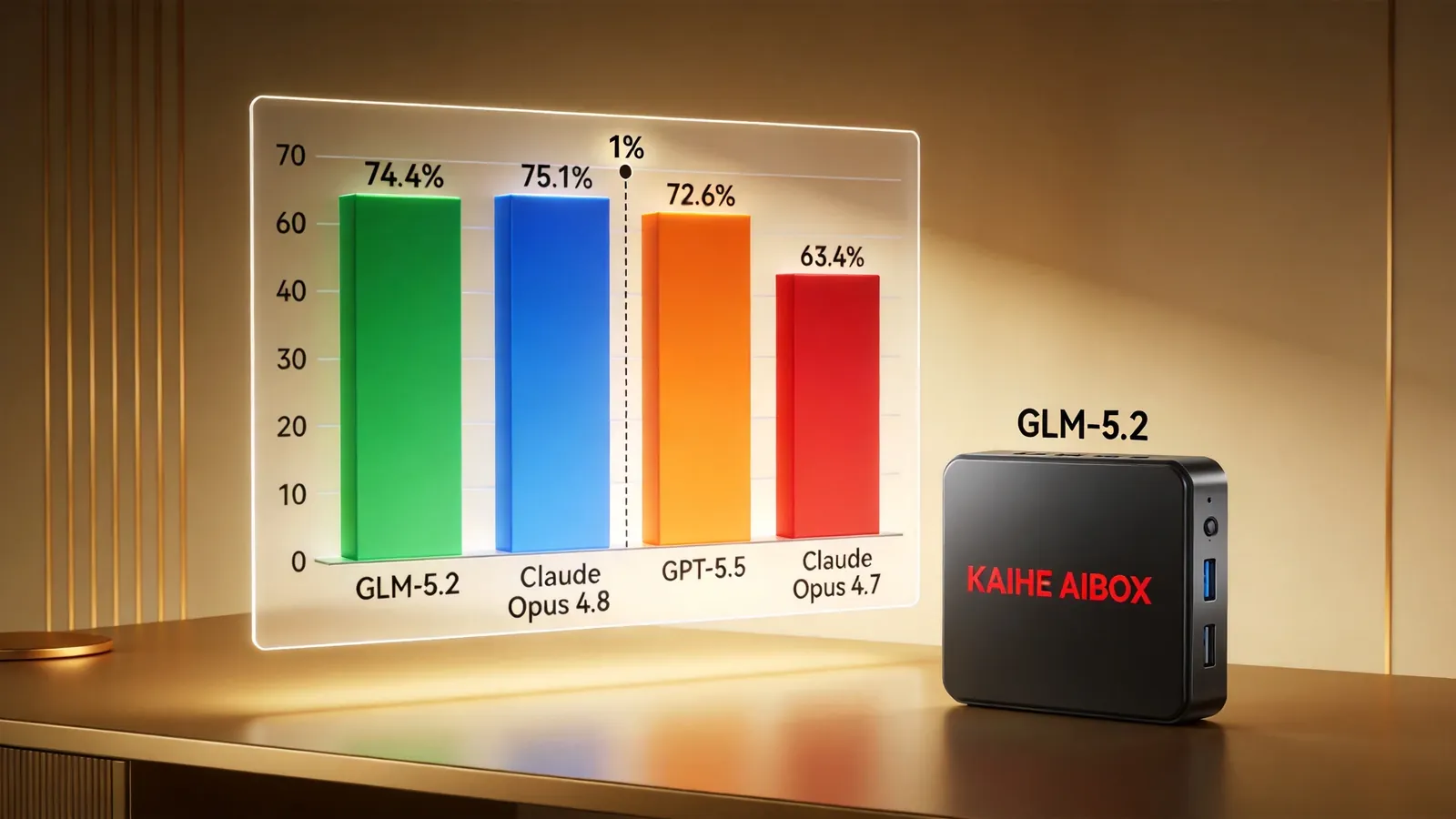
Long-range tasks approach Claude Opus 4.8. FrontierSWE specifically tests whether AI can complete complex technical projects over hours, like a software engineer. GLM-5.2 scored 74.4% — just 1% below Claude Opus 4.8, 1% above GPT-5.5, and 11% above Claude Opus 4.7.
In plain terms: for tasks requiring "sustained work over hours without going off track," GLM-5.2 essentially matches the strongest model on Earth, significantly outperforming everything else.
1M context is not a gimmick. Many models claim million-token context but start "forgetting" beyond a certain length. GLM-5.2's 1M context was specifically reinforced through training, maintaining stable performance with 880K real input tokens — no degradation.
What Topping the Comprehensive Benchmark Means
On Artificial Analysis's Intelligence Index v4.1, GLM-5.2 scored 51 — topping all open-weight models, significantly ahead of MiniMax-M3 (44), DeepSeek V4 Pro (44), and Kimi K2.6 (43).
This benchmark isn't single-dimensional — it combines coding, reasoning, math, multimodal, and other capabilities. GLM-5.2 topping this comprehensive ranking shows it's not a specialist that only codes, but a well-rounded competitor across directions.
The ranking also reflects a shift in the global AI landscape: a "new big three" is forming — Anthropic, OpenAI, and Zhipu.
What MIT Open Source Means
GLM-5.2 uses the MIT license — one of the most permissive open-source licenses. You can use it free, commercially, modify it, distribute it — no payment or authorization needed from Zhipu.
The model is uploaded to Hugging Face (zai-org/GLM-5.2), supporting vLLM and SGLang local deployment. With sufficient GPU compute, you can deploy the entire model on your own servers — no API dependency.

This is attractive for enterprises — data stays on-premises, model runs on own hardware, cost is one-time compute investment rather than ongoing API fees.
Pricing: ¥8/Million Input Tokens
GLM-5.2's API is priced at ¥8/million input tokens. Mid-to-high among Chinese flagship models — more expensive than DeepSeek, but clearly more capable.
For developers whose daily work involves coding, long-range tasks, or multi-document analysis, GLM-5.2's capability premium justifies the price difference. For high-volume enterprise users, open-source self-deployment is an alternative.
Value for Kaihe AIBOX Users
GLM-5.2's release is positive for Kaihe AIBOX users.
Previously, A1 users' primary Chinese model option was DeepSeek — good performance, cheap, but with a gap in long-range tasks and coding versus GLM-5.2.
Now A1's management dashboard supports GLM-5.2 API — select Zhipu in model configuration, enter API Key, and use the world's strongest open-source coding model.
Best-fit scenarios: - Coding tasks: code generation, debugging, code review — GLM-5.2 is currently the strongest open-source coding model - Long document analysis: contracts, reports, papers — 1M context handles a full book - Long-range Agent tasks: work spanning hours — GLM-5.2's long-range capability exceeds DeepSeek's
A Rational View
"Open-source model matches Claude Opus" is impactful, but needs caveats:
Blind tests ≠ all tasks. Code Arena and Design Arena reflect frontend development specifically. In other areas (writing, multimodal, math reasoning), the gap between GLM-5.2 and Claude Opus 4.8 may be larger.
Open source ≠ free. MIT license covers model weights and architecture, but running requires GPU compute. An H100 rents at several dollars/hour, and deploying 753B parameters needs multi-card parallelism — not easily affordable for individual developers. API calls remain the mainstream option for ordinary users.
The progress is real. Regardless of caveats, GLM-5.2 reaching near-frontier levels in coding and long-range tasks — the two hardest directions — is a genuine achievement for open-source. The first time this has happened, and the significance is real. To learn more, visit the homepage.
Want to Go Deeper?
"Kaihe AIBOX A1 Running DeepSeek Tested: Best Value Chinese AI Under ¥1000" — another Chinese model test "One Device, All Models: Kaihe AIBOX Supports GPT/Claude/DeepSeek/Doubao" — multi-model comparison
-#ZhipuGLM5_2 #OpenSource #KaiheAIBOX #AI #ChineseAI
Kaihe AIBOX | The Agent Computer That Works 7×24 for You · AI Frontier