📖 Glossary
AI Box (also known as Agent Computer / Agent PC), is a dedicated local hardware device that runs AI Agents. Pre-installed with an AI agent management system, plug-and-play, running 24/7. Users can remotely command AI to work via Discord, Slack, Telegram, WhatsApp, and more.
Summary: On October 19, MiniMax shipped M3.1 Flash at $0.15 per million input tokens and $0.60 per million output tokens, claiming 70% lower total cost on agent work and nearly three times the speed of its predecessor. The rate card is impressive, and swapping the model in will probably not lower your bill this month: KAIHE AIBOX would put it, the model sets the unit price but your execution base decides the bill.
Start with the numbers
Input runs $0.15 per million tokens, output $0.60, cached input $0.015. MiniMax claims 70% lower total cost on agent tasks than M3 and nearly 3x the speed. The specification is serious too: a 1,000,000-token context, text, image, and video input, mixture-of-experts at roughly 428B total parameters with about 23B active, and an effort dial from low to max.
The previous M3 sat at $0.30 input and $1.20 output, so this halves the price twice. Reading only that table, there is no argument against switching.

Tokens got cheap. Loops did not
What determines your bill is not the unit price. It is how many times one task calls the model.
A chat session is one question, one answer. An agent works in a loop: read a file, call a tool, inspect the result, notice the mistake, retry, run the tests, patch it. A request to reorganize a report into a dashboard can sit on a hundred model calls.
That produces a counterintuitive outcome. Cut the unit price by 70%, but let the cheaper rate make you comfortable iterating three times as much, and total cost lands at 0.9x. It went up.
MiniMax's own disclosure points the same way: the anonymous model used to validate this release, Space Bunny, processed more than 200 trillion tokens in two weeks. Cheaper models get called more often. The real lever was never a cheaper model but who schedules those calls.
The default that costs the most
M3.1 Flash cannot turn thinking off. Sending thinking: disabled returns a 400 error, and the guidance is to lower the effort level instead. Omit the parameter and the default is max — the slowest, most token-hungry setting there is, and the one an uninformed new user gets. MiniMax's own documentation is blunt: deeper thinking consumes more, and simple tasks belong at a lower depth.
Dropping routine formatting from max to low is not a marginal saving, but it exposes the structure of the problem: the savings switch lives in the scheduling layer, not the model layer.
What the launch did not say
Every benchmark here was run by MiniMax: DeepSWE v1.1 at 73.7%, OSWorld V2 at 61.7, CyberGym at 82%. 2026 already produced a cautionary case — Kimi K2 published roughly 50% on Humanity's Last Exam and testers who re-ran it got 29.4%. Between a vendor's claim and an independent reproduction there is always a layer, so do not mistake a published score for your own output.
The machine that stays online is the ledger
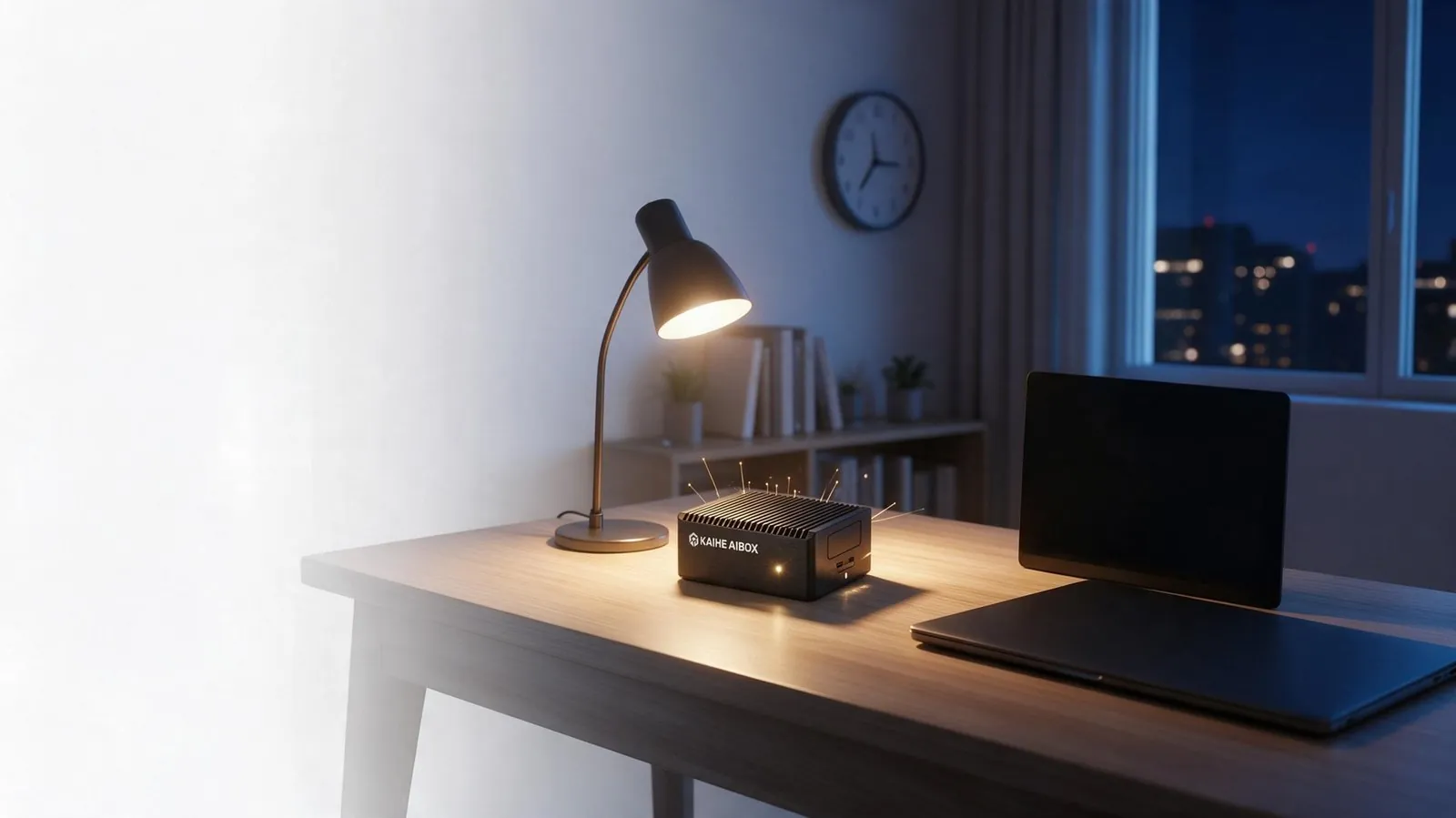
KAIHE AIBOX is a dedicated agent computer, engineered specifically for running agents. Its position lands in exactly that gap: the model layer can belong to anyone, but the scheduling layer has to be yours.
- Set tasks by day, run them at night — batch non-urgent work into the cheapest compute window
- Match effort to task — formatting at a low tier, refactors at a high one
- Reuse cached results — the same document read twice is not recomputed
- Run 24/7 independently — closing the lid does not stop it
- Buy once, no software subscription — the model can change vendor; the base stays yours
Two ways to save
| Dimension | Cheaper model only | Plus your own base |
|---|---|---|
| Unit price | Down 70% | Down 70% |
| Call volume | Manually triggered | Queued off-peak |
| Thinking depth | Defaults to max | Matched to task |
| Long-term cost | Price fell, volume rose | Both fall |
Who holds the power to save
Through 2026, DeepSeek, GLM, LongCat, and MiniMax have all competed on being cheaper and faster. Once everyone's models are cheap, cheap stops being an advantage. What separates people is who can use that cheapness to the full — a machine that stays online, memory that holds context, a scheduler that knows which work belongs now and which belongs at 3 a.m. None of it is on a price sheet; it is in your own base.
Related Reading: - Gemini 4 Argon Scored 97.5% on ARC-AGI-3. The Same Model on a Standard Harness Scored 49.8%. - DeepSeek-V4.1-Flash-1017 Ships Wish-Style Coding and Its Own Search API - LongCat-2.5 Opens Only Its API, Not Its Weights. How Do You Use a 1.6T-Parameter Agent Base?
For more information, search [KAIHE AIBOX] or contact: [email protected]
KAIHE AIBOX · 7x24 Personal AI Assistant | AI Frontier